
The Russian government’s communications watchdog, Roskomnadzor, recently delivered a devastating blow to millions of Russian children by officially blocking access to the wildly popular U.S.-based gaming platform, Roblox.
Citing concerns over “inappropriate content that can negatively impact the spiritual and moral development of children,” including the dissemination of “extremist materials” and “LGBT propaganda,” the move is the latest in Moscow’s tightening grip on foreign digital platforms.
But the quiet compliance the Kremlin might have expected was shattered hundreds of miles away, deep in the frozen heart of the country: Siberia.
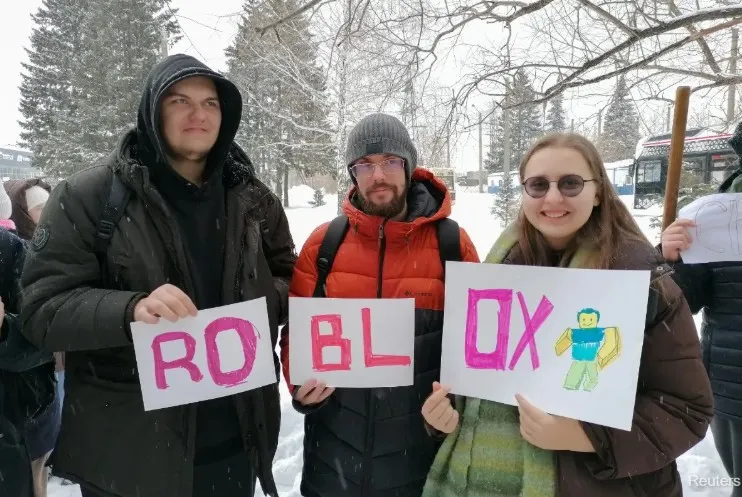
In the city of Tomsk, a rare and poignant act of public defiance emerged. Several dozen people, including children and their supporters, gathered in Vladimir Vysotsky Park to protest the ban. In scenes described as unusual for public dissent in the region, protestors stood in the Siberian snow, holding up hand-drawn placards that served as a direct and emotional appeal to the authorities.
The Frozen Rebellion of Tomsk
The images emerging from Tomsk are powerful. Despite the harsh winter conditions, the small circle of protestors brought the digital battle into the physical world. Their messages, scrawled on cardboard and paper, cut through the official rhetoric:
- “Hands off Roblox”
- “Roblox is the victim of the digital Iron Curtain”
- “Bans and blocks are all you are able to do”
This is not just about a game. For Russian youth, who have already seen access restricted to other major social platforms like Facebook, Instagram, and Snapchat, Roblox was a vital social lifeline. With over 150 million global daily active users, it served as a digital playground, a creative hub, and a key communication channel. The protests highlight the deep emotional connection young people have to these platforms, often viewing them as the only accessible public spaces left for genuine, unstructured social interaction and creativity.
Why The Kremlin Took the Nuclear Option
The ban on Roblox, which stopped working for Russian users in early December, wasn’t a snap decision. Roskomnadzor has been building a case for months, arguing that the platform’s moderation system is fundamentally inadequate to protect minors.
The official reasons given for the ban are multi-layered, reflecting both international concerns about child safety and Russia’s specific domestic censorship laws:
- Inappropriate Content: Allegations that the platform is “rife with inappropriate content” and that its open structure makes it a meeting ground for ill-intentioned adults.
- Extremist Materials: Accusations of hosting content promoting or justifying extremist activity.
- LGBT Propaganda: In line with Russia’s strict laws against promoting “non-traditional sexual relations,” Roskomnadzor specifically cited “LGBT-related material” as a reason for the block.
While the concerns about child exploitation and unmoderated content are legitimate and globally debated—the U.S.-based platform has faced scrutiny in many countries, including Turkey and Iraq—critics argue the ban is part of a larger, systemic effort to purge foreign digital influence and steer citizens toward domestic, state-controlled alternatives.
The VPN Loophole That Makes the Ban Pointless
The most stinging critique from the Siberian protestors and digital freedom advocates is the ultimate futility of the ban. In a digitalized world, an outright block on a popular platform is easily sidestepped.
Many young Russian users are already circumventing the restriction using Virtual Private Networks (VPNs). This widespread practice is not only technically legal but also fosters a growing dismissive attitude toward government decisions among the youth, according to some local officials. The ban, therefore, achieves the opposite of its stated goal: it fails to protect children and instead introduces them to tools that teach them how to subvert state censorship from a young age.
Even Kremlin-aligned figures have voiced concerns. Yekaterina Mizulina, head of the Safe Internet League, noted that the restriction has caused such distress that some children have expressed a desire to leave Russia, underscoring the ban’s severe emotional impact.
The protest in Tomsk may be small, but it represents the frustration of a generation whose social fabric is now entirely digital. The message from the frozen park is a defiant one: the Russian state can block a server, but it cannot ban a community.

I am a passionate content writer from the Chandigarh–Panchkula region. I am curious and love exploring diverse topics. At DailyBarta.in, I primarily write about video games and sports, bringing readers fresh insights, engaging analysis, and easy-to-understand breakdowns of the latest trends.









