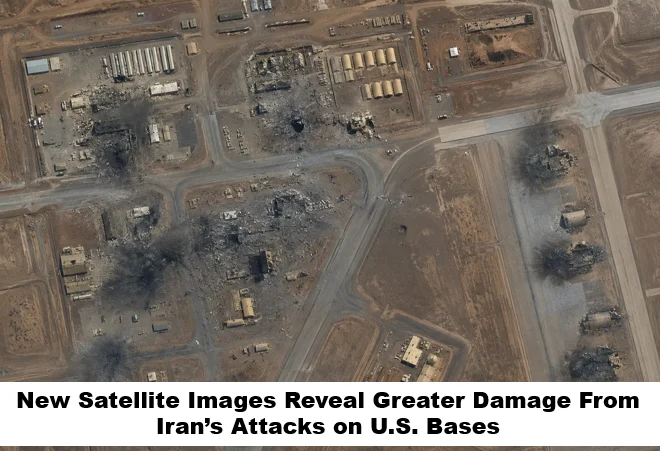

A new look at satellite images has brought up new questions about how badly US military bases were really damaged during the recent war with Iran. The results show that Iranian missile and drone attacks may have hit a lot more military targets in the Gulf than officials first said. This has led to more debate about how well regional defences work and how honest battle reporting is.
A look at satellite photos and military reports led the study to the conclusion that many American sites were badly damaged during the war. The results contradict earlier public comments that said the killings didn’t have much of an effect.
Significant damage was found at several military sites
The study says that Iranian attacks in the Gulf region injured or destroyed at least 228 buildings and pieces of military equipment. These attacks happened at about 15 US military bases. According to reports, the things that were damaged were camps, fuel storage areas, aircraft hangars, radar systems, communication infrastructure, and air defence equipment.
The amount of damage seems to be much worse than what was officially admitted before. Images from space showed that several sites had been directly hit, which suggests that Iranian forces were very good at hitting both operating structures and support areas.
Military experts who looked at the pictures said that many of the strikes looked very accurate, which suggests that the Iranians who planned the attacks knew exactly where important assets were located before they attacked.
Read also: Trump’s feuds with friends may outlive the Iran conflict
Official evaluations have been called into question
Because of the new information, people are looking more closely at what people said during and after the fight. Some critics say that the public reports made at the time may not have shown how bad the situation really was for the US troops in the area.
During the war, US leaders kept saying that even though Iran was attacking, American troops were still operating and able to complete their tasks. Even though military operations went on, the satellite analysis shows that it may have cost a lot more to keep everything ready for action than was first thought.
Reports say that some facilities were damaged badly enough that they need major repairs, and some places had to temporarily change how they did business after the attacks. As new proof comes in, experts are wondering if the full extent of the damage was purposely kept to a minimum so as not to give strategic information to enemies or cause political problems at home.
Precision strikes show how warfare is changing
One of the most important things that the satellite review showed was how well Iran’s rocket and drone strategy seemed to be working. Even though they were up against one of the world’s most powerful armies, Iranian forces were able to hit a lot of different targets in several countries that had US troops and weapons there.
Analysts say the fight showed how war has changed since the 1960s. Reports say that drones and missile systems that aren’t too expensive can threaten high-tech military sites that are covered by complex air defence networks.
The results also show where defence facilities in the area is weak. Many facilities were not built to resist large-scale drone and rocket attacks, leaving planes, equipment, and support buildings open to harm, according to experts.
The damage seen in the pictures has led to debates about whether military leaders didn’t give the Iranian forces enough credit for their strength and thought that current defence systems were enough to protect them.
Read also: US Eyes India’s $300 Billion Nuclear Boom as Rules Get Easier
The war’s human and strategic costs
Reports say that the attacks had major effects on people and operations in addition to the damage they caused to property. During the larger battle, hundreds of American soldiers were hurt, and a few died.
There were also big cash costs related to the harm. A lot of money will likely need to be spent to fix military facilities, replace broken equipment, and make area defences stronger. When operating costs and rebuilding efforts are added up, analysts say the total cost of the war has hit tens of billions of dollars.
Because of the attacks, leaders all over the Middle East had to rethink how to protect their troops. In some cases, people were moved and more defences were put in place to make the area less vulnerable to future attacks.
Military experts think that the fight could affect future choices about where and how to build US bases in the area, especially since the threats from drones and missiles are only getting stronger.
More Consequences for Regional Safety
The news comes at a time when tensions between Washington and Tehran remain high, even as efforts are underway to maintain the shaky ceasefire. Analysts are warning that the satellite data could change how people think about the conflict and how both sides plan to use military power in the future.

I am a versatile content writer from the MP region, covering politics, business, crime, current affairs, entertainment, video games, and sports with clear insights, engaging analysis, and timely, reader-focused updates.