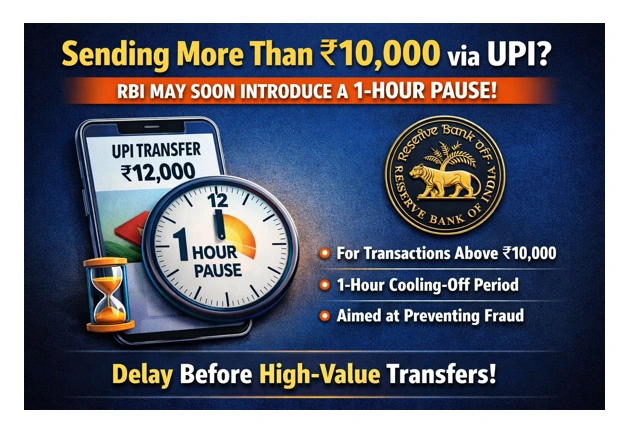

If you use UPI to send large amounts of money, things might be about to change. The RBI wants to help stop internet scams by putting a 1hour hold for payments over Rs 10,000.
Sending money quickly through UPI is something that many Indians do all the time. But that speed might stop soon. To stop the growing number of online scams, the Reserve Bank of India (RBI) is considering a plan to delay some high value digital payments by one hour.
Giving people a short time to cancel a deal if something seems wrong is the easy idea behind it.
What the plan for delay will do
Under the plan, payments between accounts worth more than Rs 10,000 might not happen right away, especially when done through UPI. Instead, the person who is supposed to get the money might have to wait an hour.
At this point, the money will be taken out of the sender’s account but put back for now. This extra money is there to help people cancel the payment if they find out they were scammed or messed up.
During this time, banks will also do checks in the background. Users may get a message asking them to confirm the payment again if the transaction seems odd, like moving a lot of money to a new account.
If the bank thinks something is wrong, it might not go ahead with the transaction until it hears from the sender again.
This move is being thought about by RBI
The central bank is worried because there has been a sharp rise in digital theft, especially when users are tricked into giving their permission for funds.
In terms of the number of fraud cases, the RBI says that deals above Rs 10,000 account for about 45% of all fraud cases but almost 98.5% of all money lost. This makes deals with more money a major source of risk.
The RBI thinks that adding a wait will add an extra layer of security without making digital purchases totally impossible.
Read also: RBI keeps policy repo rate unchanged at 5.25 percent
More safety for users over 65
The plan also focuses on keeping people safe who are more likely to be scammed.
The RBI has suggested an extra step for high value payments over Rs 50,000 for people aged 70 and up and for disabled people. A “trusted person” may need to sign off on these deals.
Which payments are going to be late?
Not all payments are going to be put on hold. The plan is aimed at certain kinds of moves.
Transfers from one person to another (P2P)
On these sites, you can send money to someone else. Like sending ₹20,000 to a friend through UPI.
It’s likely that these moves will be held up if:
- More than ₹10,000
- The receiver is new or can’t be trusted.
- The transaction seems odd.
- Paying someone to a business (P2M)
- This is money given to businesses. For instance, paying at a store, buying tickets, or getting food online. These probably won’t be late.
What this means for you
- Most of the time, your daily payments will stay quick.
- You can only stop moves that are big or risky.
- The main point is that the system is after risky behaviour, not normal use.
Protection for Seniors
The RBI pointed out that 92% of all reported scams includes people over the age of sixty. So that this group is safe, it recommends that deals over ₹50,000 started by people aged 70 and up should be held for 24 hours.
Under this plan, seniors could choose someone they trust, such as a family friend, to serve as a backup authenticator. Before the bank sends the money, this person would have to look over it and give their OK.
Read also: Gratuities—new rules? How do you figure out a gratuity?
Daily payments may not be affected
The RBI has worked to keep daily business running smoothly. People who pay for things with checks, EMIs, or subscriptions, and payments to stores are likely to be exempt from the wait system.
Users may also be able to “whitelist” people they trust so that payments to them don’t have to wait.
What will happen next?
These are just ideas for now. The RBI has asked people to give feedback until May 8 and will look over the replies before making a decision.
If this is put into place, it could change how digital payments work in India. Some deals might take a little longer, but they might be much better.

A versatile writer mainly works on trending news, daily updates from politics, business, crime, current affairs and entertainment.