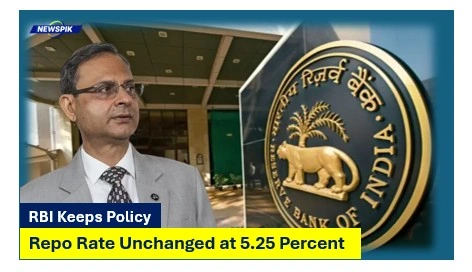

Signalling a combination of confidence and caution, the government’s central bank –Reserve Bank of India (RBI)- has kept statusquo in its lastmonetary policy review for fiscal 2025-26. Friday, February 6, 2026 Governor Sanjay Malhotra had announced at a press conference that the Monetary Policy Committee (MPC) voted unanimously to maintain status quo on pulicy repo rate at 5.25%.
The central bank’s pass is after it acted four times over the last 12 months reducing 125 basis points to lower interest rates. Though large sections of the industry were expecting one last “parting gift” of a 25-basis points cut, to support the government’s growth agenda in the latest Union budget, RBI maintained its policy stance at ”Neutral,” indicating that rates were unlikely to go down further.
- The Logic: Goldilocks Economy It is the balancing act for which there has been no parallel in history between a “hot” and “cold” economy.
- “Goldilocks zone” is a situation in which growth is strong and inflation is moderate; it doesn’t mean that the Indian economy isn’t too hot or cold, but rather just right.
- Rupee Pressure: The interest rate differential with world markets could have eased further reducing the RBI’s ability to support the rupee which is still under pressure, close to 90 against the US dollar.
- Base Effect Worries: The RBI cautioned that “unfavourable base effects” from the previous year could result in a technical uptick in inflation in Q4FY26.
Gold and silver prices skyrocket Gold and silver surged in price recently, adding a mild upward bias to the CPI forecast numbers offered by the RBI — which felt compelled to nudge its inflation estimate for FY26 higher, at 2.1%.
Growth Moves To The Fore: Upside Adjustment Of FY26 GDP Outlook
The Governor’s statement contained perhaps its most optimistic note concerning a modified outlook for growth. Because of robust domestic demand and the inking of game-changing trade pacts with both the United States and the European Union, RBI upped its FY26 real GDP growth forecast to 7.4% (from 7.3%).
Key Changes to Regulation: A Win for Small Business and Real Estate
In addition to the headline interest rates, there were a few key “developmental” announcements in February to deepen India’s financial markets:
- Collateral-Free Loans: The maximum amount of collateral-free loan that can be given to MSMEs (Medium, Small and Micro Enterprises) has been doubled from ₹10 lakh to ₹20 lakh.
- Banking Lending to REITs: RBI permitted for the first time, banks to lend to Real Estate Investment Trusts directly. This is expected to infuse liquidity in the commercial real estate market, which has been starved of cash.
- Digital Fraud Cover: The RBI announced terms for reimbursing on payments systems fraud (₹25,000), to further bolster customer’s trust in the digital payment system.
Verdict is In: RBI Announces Bi-Monthly Monetary Policy Today
What This Means for Your Wallet: Home Loans and FDs?
No change in repo rate For the common man, the “unchanged” repo rate brings a paradox of stability and lost opportunities.
Home Loan Borrowers
If you have had a home loan that’s linked to the EBLR (External Benchmark Lending Rate) — as most modern loans are — your EMIs will not budge. There isn’t quite relief given the absence of relief, but there is at least no threat of a hike. Since such borrowers are yet on the old MCLR (Marginal Cost of Funds-based Lending Rate) regime, it makes sense for them to switch out to an EBLR-linked loan in order to avail of the 125-bps cuts early this year.
Fixed Deposit (FD) Investors
FD Holders can take a deep breath! If the RBI does not cut rates, banks are unlikely to reduce deposit rates anytime soon. Public sector banks are offering between 6.5% and 7% while some Small Finance Banks (SFBs) have been offering upto 8% to senior citizens today.
Expert Take: “Now that the RBI is in protracted pause mode, it may be the best time to lock into long-term FDs before any subsequent liquidity tuning drives rates lower,” says Adhil Shetty, CEO of BankBazaar.
Looking Ahead to April 2026
The next MPC meeting will hold from April 6 to 8, 2026. It will be another crucial session as RBI is likely to move over a new GDP and Inflation base series. For now, the message coming from Mint Street is straightforward: India is navigating a steady course and the central bank has little incentive to shake things up.

I am a versatile content writer from the MP region, covering politics, business, crime, current affairs, entertainment, video games, and sports with clear insights, engaging analysis, and timely, reader-focused updates.