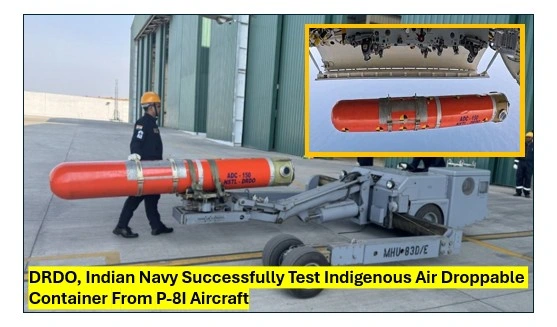

The Defence Research and Development Organisation (DRDO) and the Indian Navy made a landmark breakthrough of accomplishing a set of tests to do the in flight release of the ADC-150, an Indian-made Air Droppable Container.
The trials which took place off the coast of Goa, between 21 st February and 1 st March 2026, involved the use of the Navy highest long-range maritime surveillance aircraft, the Boeing P-8I Poseidon. This is not just a hardware test, but a logistical breakthrough taking place that has made it possible to have Indian warships stay on the high seas a little longer until they are able to go back to port to take replenishment.
The ADC-150: A Skywalker of a Lifeline
The ADC-150 (Air Droppable Container – 150 kg) is a modern means of logistics created to overcome the great distances of the navy of the blue water. Even in a case in which a naval ship is thousands of kilometers out in the Indian ocean, even the most basic mechanical malfunction, a burst gasket, broken circuit board or shortage of particular medical equipment can conventionally compel a ship to abandon its mission and head back to the closest harbor.
That is altered by the ADC-150. The 150 kg carrying capacity of the container means that it can be dropped by the P-8I aircraft with an accuracy of pinpoint accuracy. It can be critical engineering spares, emergency medical kits or specialized electronics but the bottom line is that the Navy can conduct its forward presence in the Indian Ocean Region (IOR) with no downtime whatsoever using the so-called sky-drop.
Technical Mastery: Visakhapatnam to Agra
The joint force of defense laboratories of India has been proven by the success of the ADC-150. Every part of the test was a master work of a precision engineering:
- Design & Development: The nodal agency was the Naval Science and Technological Laboratory (NSTL) in Visakhapatnam, where the container was designed to survive the impact of high velocity of an aerial drop into the salt water.
- The Descent: The Special parachute system was invented by the Descent Research and Development Establishment (ADRDE) located in Agra. This system makes sure that the 150 kg payload does not simply fall, but it does fall controlled at a steady rate in order not to damage itself as soon as it touches the ocean surface.
- Safety & Certification: The certificate of flight clearances necessary to drop heavy objects off the P-8I which is mainly an anti-submarine aircraft were obtained by the Centre of Military Airworthiness and Certification (CEMILAC) in Bengaluru.
- Instrumentation: The trials were monitored by the Defence Research and Development Laboratory (DRDL) in Hyderabad using high-tech instrumentation to counter the extreme release conditions to get the container to meet its target coordinates.
Read more: BlueBird Block-2 mission: ISRO successfully launches LVM3-M6 rocket
Humanizing the High seas: The View of the Sailor
The ADC-150 has an impact that cannot be measured by its metal casing and parachutes. Suppose a crew on a stealth frigate was on the southern extremes of the Indian Ocean. The water desalination plant in the ship breaks down. In its absence, the water supply of the crew is timed.
Before, the ship would have to go off route, which used up fuel and left its area of patrol. It is possible to send a P-8I to an Arakkonam or Goa airbase. In only a few hours, the crew is witnessing a parachute floating in the sky opening and presenting them the very item they require inside the waves. A Rigid Inflatable Boat (RIB) comes on board, the container is reclaimed and by dinner time the ship is operational again.
Also read: PSLV rocket failure: A huge loss for India
Strategic Significance in 2026
These trials are of especial interest to take place in terms of the present-day geopolitical environment. As the war in West Asia continues, and there is ever more maritime tension in the Indo-Pacific, the capability of India to deploy on the long-term basis is paramount. The P-8I, which is already a very formidable submarine hunter, is now doubling up as a high speed delivery aircraft.

A versatile writer mainly works on trending news, daily updates from politics, business, crime, current affairs and entertainment.