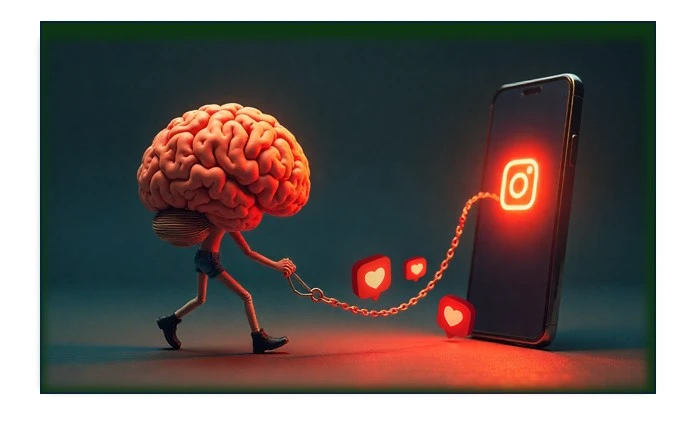

Infinite scroll is a design paradigm in which the content is loaded while the user is scrolling a webpage, thereby eliminating the concept of click-to-go-to-next-page or “Next“-type links. The infinite scrolling concept gained popularity from the use of social networking websites like Facebook, Instagram, TikTok, and even Twitter (X), but infinite scrolling is not a purely technological concept—it has tremendous links to the psychology of human beings.
1. Variable Rewards and the Dopamine Loop
Variable reward is one of the most powerful psychological forces driving the use of infinite scrolling. This phenomenon is a result of behavioral psychology research, specifically B. F. Skinner. When outcomes are not fixed, meaning they are random—sometimes very positive, very often not significant, occasionally negative—this is called variable reward.
Each scroll raises questions: Will the next entry be interesting, humorous, shocking, or affirming? This holds the clever key to unlocking the dopamine centers of the brain, with which anticipation better resonates than actual prize possession. Just as the slot machine holds consumers holding on to the lever arm, infinite scroll holds consumers scrolling back and forth on their phones.
Unlike finite content, infinite scroll never cues closure. There is no natural endpoint that satisfies and cuts engagement.
2. The Zeigarnik Effect: Unfinished Feels Uncomfortable
The Zeigarnik effect maintains that people remember unfinished things more than finished ones and feel subtle psychological tension when things are not completed. Infinite scroll just uses that by making the consumption of content seem to never be finished.
When there is no end, the brain never gets that cue that signals the task is “done.” Instead of closure, users are left with a nagging feeling that there’s always more to be seen. This unresolved state fosters ongoing scrolling, even when the user had actually intended to stop.
3. Loss of Temporal Awareness (Time Distortion)
Infinite scroll is incredibly effective at inducing time distortion-a state where users don’t realize how much time has passed. The reason this occurs is because:
- There are no pauses or breaks between pages.
- Content is rapidly consumed in small, digestible units
- Cognitive load stays low, diminishing self-monitoring.
As users aren’t interrupted by something happening on their own page (such as page loading or turning), the experience removes temporal markers that users need to control their behaviors. This type of problem relates somewhat to ‘flow state,’ but users aren’t exactly engaging with something valuable: instead, ‘passive consumption’ might be the act.
This is why scrolling often continues for ‘just a minute,’ until later realization of having spent considerable amounts of time on the activity.
The Xteink X4 is a small magnetic e-reader that you can attach to your phone
4. Reduced Friction and Decision Fatigue
Each choice takes mental energy. The infinite scroll removes as many decision-making points as possible, getting rid of decision options such as:
- Should I go to the next page?
- Do I want to continue?
- Is this worth my time?
Consequently, this reduction of friction impacts positively by reducing the cognitive overload of scrolling on or continuing on that site or application. Eventually, this generates an automatic performance of scrolling, where scrolling becomes an unattended action that users implement due to loss of effort in stopping compared to continuing.
Such effects are all the more potent in circumstances of exhaustion, tedium, or stress, when self-control resources are already depleted.
5. Intermittent Social Validation
Infinitely scrolling the platform has a direct relationship with the platform’s social rewards, which include likes, comments, shares, and relatable material. Social validation, or the receipt thereof, fosters the behavior of infinitely scrolling through the platform through notions of being part of and/or comparing oneself with others.
Even when users aren’t posting, the act of content consumption gives social cues: trends, opinions, jokes, and outrage. The brain registers this as social information, this information being deemed important enough that users feel driven to scroll down solely for the purpose of staying informed.
6. Attentional Capture and Novelty Bias
Humans have the ability to notice novelty. The infinite scroll shows new stimuli all the time, whether it’s an image, a headline, or a video, all vying for the same attention. It leverages the novelty bias, which gives priority to novelty over familiarity.
Since the content mix is algorithmically determined, the platform raises the chances of being exposed to something emotionally engaging just often enough to recapture their attention when it wanes in intensity.
7. Habit Formation and Conditioning
Over time, infinite scroll habituates a user into behavior patterns. The particular cues—opening an app, feeling bored, waiting in line — produce scrolling. The behavior is no longer driven by any conscious motivation; it’s an automatic response.
This conditioning is reinforced through consistency and ease. The infinite scroll always behaves in a repeated manner, and it is always offering content. It therefore becomes a reliable coping mechanism for states of boredom, loneliness, or anxiety.
5 stunning roads in India that deserve to be on your Instagram feed!
Conclusion
The psychology underlying infinite scroll is its seamless alignment with human cognitive vulnerabilities: our sensitivity to variable rewards, discomfort of incompletion, novelty craving, and habit-formation tendencies. Removing stopping cues while maximizing emotional and social reinforcement turns passive content consumption into extended engagement with infinite scroll.
But this design also increases ethical concerns over attention, autonomy, and digital well-being. Understanding the psychology behind infinite scroll is the first step to using technology more intentionally—and designing it more responsibly.

A versatile writer mainly works on trending news, daily updates from politics, business, crime, current affairs and entertainment.