
In the very heart of India lies Madhya Pradesh, a land often celebrated in folk songs inspired by neighboring cultures, where stories of love, village life, and nature come alive through music and dance. Framed by vast teak forests and rich wildlife, the state has long been proud of its identity as India’s “Tiger State.” But as 2025 draws to an end, that pride is being overshadowed by deep concern.
Madhya Pradesh is facing its darkest year for tiger conservation since Project Tiger began in 1973. The loss of these powerful animals has reached an alarming scale, with tigers dying at a rate never seen before.
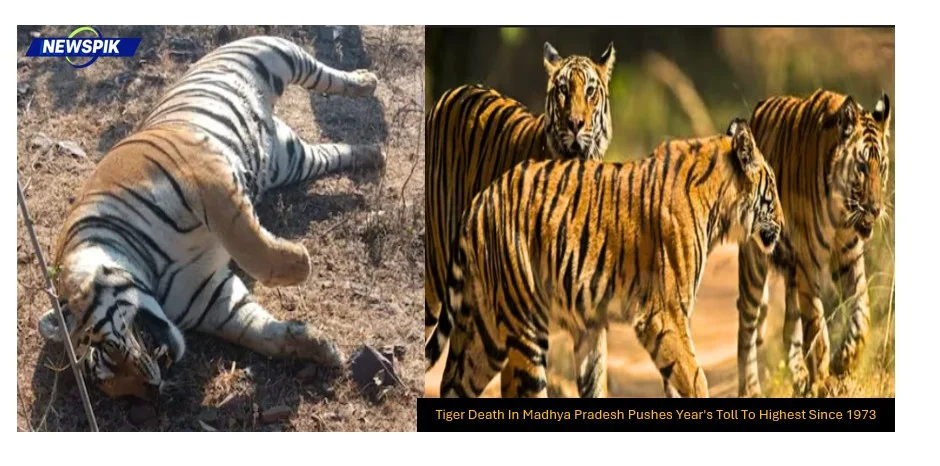
The discovery of another tiger carcass in Sagar district has pushed the state’s tiger death count for 2025 to 55. This figure is not just a number—it reflects a growing crisis. It highlights how fragile the balance has become between conservation success and the increasing pressures of habitat loss, human expansion, and environmental change.
A Heavy Burden for the “Tiger State”
For decades, Madhya Pradesh has been the backbone of India’s tiger conservation efforts. According to the latest census, it is home to around 785 tigers—the highest in the country. This achievement once stood as a symbol of success. Today, it also brings immense responsibility.
The pace of tiger deaths has sharply increased in recent years. In 2024, the state recorded 46 tiger deaths. Crossing the 50 mark in 2025 is unprecedented in the last 50 years. This troubling rise has sparked serious questions among conservationists and policymakers alike.
Many now wonder whether the very success of tiger conservation—growing populations in shrinking habitats—has created new challenges that are harder to control. The crisis serves as a reminder that protecting wildlife is not just about increasing numbers, but about ensuring safe, sustainable environments where these animals can truly survive.
India’s Wildest Train Journey: Through the Deep Tiger Forests of the
Tiger Deaths in 2025: A Quick Overview
- Total tiger deaths in Madhya Pradesh: 55
- Share of India’s total losses: Nearly one out of every three tiger deaths reported across the country in 2025 occurred in Madhya Pradesh, out of a national total of 162.
- Most affected areas: Bandhavgarh, Ratapani, and the forest corridor connecting Panna with Veerangana Durgavati Tiger Reserve.
What Is Causing the Rise in Tiger Deaths?
Wildlife specialists agree that the high number of deaths is worrying, but the reasons behind them are complex. There is an ongoing debate among experts. Some believe the deaths are a side effect of a growing tiger population, while others point to deeper problems such as weak protection systems and gaps in law enforcement.
Clashes Over Territory: Nature Turning Brutal
A large share of the tiger deaths this year—nearly 70 percent—has been linked to natural causes, mainly violent territorial fights. In reserves like Bandhavgarh, tiger numbers have increased so much that space is becoming scarce. Young male tigers are forced to challenge stronger rivals to claim territory, often leading to deadly encounters. Older tigers and vulnerable cubs also become victims as forests reach their limit in supporting more animals.
The Hidden Killers: Wires and Traps
The most alarming trend in 2025 has been the rise in unnatural deaths outside protected forest zones. As tigers move through wildlife corridors in search of new areas, they increasingly come into contact with human settlements. In many farming regions, illegal electric fencing and wire traps are used to protect crops from wild animals like boars.
These live wires are silent and deadly. A single step on such a trap can kill a tiger instantly. In the recent Sagar district case, no clear external injuries were found, raising strong suspicions that electrocution may have been the unseen cause.
Delhi implements 50% mandatory work from home amid air pollution crisis
Death on the Fast Track: Rail and Road Threats
Transport corridors cutting through forest land have become deadly flashpoints for wildlife. Ratapani Wildlife Sanctuary, in particular, has seen repeated incidents linked to trains and highways. Despite speed restrictions, warning signs, and animal underpasses, fast-moving trains continue to pose a serious danger.
Past incidents underline the risk. In early December 2019, a tiger was killed after being hit by a train on the Budhni–Midghat railway stretch. The tragedy exposed how poorly protected forest crossings can turn vital animal habitats into danger zones.
Rising Tensions Between Humans and Wildlife
The growing crisis extends beyond tigers alone. As big cats roam farther outside protected forests into shared, human-used landscapes, encounters are becoming more frequent—and more dangerous. Recent attacks in buffer areas, including the killing of bamboo cutters in December, have spread fear among villagers who depend on forests for their livelihood.
This growing friction highlights the urgent need for better safety measures—for both wildlife and local communities.
Forest Officials on High Alert
Bhopal: The spike in tiger deaths during 2025 has put forest authorities under intense pressure. Principal Chief Conservator of Forests V.N. Ambade has reportedly issued strong warnings to field officers and demanded explanations for deaths that could have been prevented.
Veteran conservationists echo this concern. Former PCCF J.S. Chauhan has stressed the need to strengthen wildlife corridors, noting that while core tiger reserves remain relatively secure, the routes connecting them are dangerously vulnerable. These corridors have become hotspots for poaching, accidents, and electrocution.
“A rising tiger population is a sign of success,” one senior wildlife official observed. “But without protecting the paths they use, we are only increasing the risk of loss.”
As 2025 comes to a close, the roar of the tiger still echoes across Madhya Pradesh’s forests. Yet it is the silence left by 55 lost lives that speaks the loudest. The challenge for 2026 is clear: to ensure the Tiger State remains a place of survival—not a record of decline.

I am a versatile content writer from the MP region, covering politics, business, crime, current affairs, entertainment, video games, and sports with clear insights, engaging analysis, and timely, reader-focused updates.