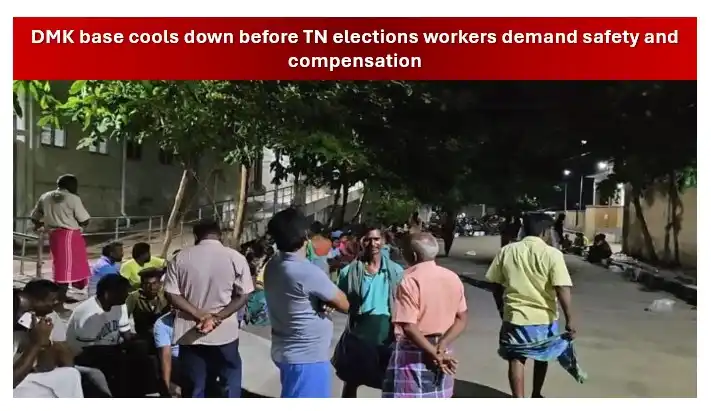

The plant explosion in Virudhunagar that killed 23 people started a political fight before the election. ADMK says Stalin’s government is to blame for not doing enough to keep people safe.
The Virudhunagar area in Tamil Nadu is the center of India’s firecracker and match businesses. It is not strange for firecracker factories to go off.
But even so, people living within 10 km of the Vanaja Fireworks factory were shocked by how strong and quick the explosion was on Sunday.
Two days after the blast that killed at least 23 people, family members of the victims are getting more angry and sad. Many of them wouldn’t take the bodies until late Monday night, citing what they call widespread safety failures at the unit.
Now, workers and family members of workers are calling for fair pay, strict license rules, and safety measures at these firecracker units, which they say are operating in dangerous conditions.
Tamil Nadu is getting ready for assembly elections on April 23. In Virudhunagar, a base of the DMK, workers are getting increasingly angry about what they say are repeated safety problems. This anger has now become a political issue.
But people who follow politics said that while these kinds of events may have caused small changes in voting in the past, they have rarely caused big changes in this area.
Chief Minister M.K. Stalin is sorry for the deaths and has ordered an investigation into what happened. He has also sent ministers to watch the rescue efforts.
But Edappadi K. Palaniswami, the leader of the opposition AIADMK, says Stalin is to blame because he didn’t do enough to stop firecracker accidents.
He said that if the AIADMK won power, safety rules would be enforced in companies that make fireworks. Chief of Tamilaga Vettri Kazhagam Vijay also said that his party would work to stop these kinds of tragedies if it won power after the factory workers’ deaths.
Police officers and members of the DMK’s supporters, the CPI (M) and VCK, got into a tense fight at the Virudhunagar Government Medical College Hospital, where bodies were brought to be identified. The workers were asking fair pay.
Failures in the system
The plant is in the town of Kattanarpatti. The accident site still smells like chemicals and burnt things as the police, fire and rescue, and other departments figure out what happened.
Many of the bodies were burnt so badly that it is still hard for grieving family members to figure out who they are.
Of the 23 people who died in the blast, she was one of the lucky ones who were able to get away. Ten members of the fire and rescue teams were hurt in a second blast while they were trying to save people. At least six women were hurt in the first explosion.
Around eighty percent of India’s fireworks for holidays and other events are made in the hub of Virudhunagar, Sattur, and Sivakasi.
Accidents like this happen all the time. Families and workers said that these units are dangerous because of too much work, too many people, and claimed regulatory flaws.
Chemicals like potassium nitrate, sulphur, aluminium powder, and magnesium powder are very sensitive during the production process. Any movement can start a chain reaction.
Veera, whose sister died in the accident, said that a lot of places that made fireworks did not have licenses. He also said that renting or subcontracting these jobs led to too many people working together for profit.
He said that deaths could be avoided by doing proper checks once a week or once a month and making licenses tighter.
read also:
- Manipur Protests Worsen After Deaths of 4-Year-Old Girl
- Trump Praises Delhi Lt Governor Taranjit Singh Sandhu
He also questioned the conditions at the units
Under the Explosives Rules, 2008, every unit involved in the manufacture, possession, storage, transport, import, or export of explosives and hazardous substances requires a licence from the Petroleum and Explosives Safety Organisation (PESO).
The rules also mandate minimum distances between sheds, limits on the number of workers and the quantity of explosive material per shed, no work on rest days like Sundays, proper storage, and safety training. District authorities can issue licences only for small quantities.
Inadequate compensation and a lack of medical facilities
Workers also said the emergency response to Sunday’s blast was delayed.
The explosion occurred at 3 p.m., but despite multiple attempts to reach the 108 ambulance service, the ambulances reached the spot only at around 4 p.m. It then took another 20 minutes to transport the injured to the hospital, because the manufacturing unit is located on the outskirts.
The government hospital in Virudhunagar does not have a specialised burns unit with air-conditioning, and medical specialists for burns cases are available only for two days at the Sivakasi Government Hospital.
In response to Sunday’s explosion at the firecracker manufacturing unit in Kattanarpatti, the state government has offered compensation of Rs 4.5 lakh for each deceased worker. The factory association has offered Rs 3.5 lakh for each deceased.
However, many workers said this amount wasn’t enough and are demanding Rs 20 lakh.

A versatile writer mainly works on trending news, daily updates from politics, business, crime, current affairs and entertainment.