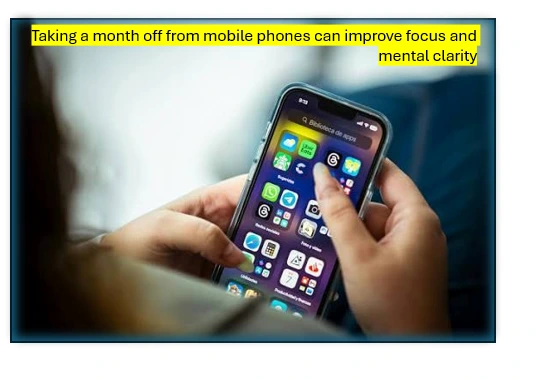

Disconnecting from a mobile device for a month will have a positive impact on your brain and body. The constant flow of notifications, social media scrolling, and screen exposure causes your brain to be in a continuously stimulated state, affecting your dopamine levels, attention span, stress hormones, and sleep cycles.
By taking away this daily input of digital information, your nervous system can go through a reset. Over time, you may notice improvements in your focus, less anxiety, more stable sleep, better posture, and stronger real-world connections. The first week may have feelings of restlessness or boredom, but your brain will slowly adapt. At the end of the month, most people notice increased mental clarity, emotional stability, and an overall sense of well-being.
1. Dopamine & Attention Reset
Each time your phone pings, you get another little burst of dopamine (a chemical that regulates motivation and anticipation). After 30 days without a mobile device, many users report:
- Less intrusive urges to check their phone compulsively
- Better attention span.
- Less mental “itching” or feeling uncomfortable when they’re not using their mobile devices.
Brain imaging studies done on heavy digital users reveal that constant switching of attention destroys your ability to focus. When you remove the device, you provide optimal working conditions for your prefrontal cortex (responsible for focus and self-control). The first week may seem difficult; however, by weeks 3–4, the attention may feel deeper and less interrupted.
2. Stress and Cortisol Levels
Your phone is a subtle stressor. It does this in a few ways: continuous notifications; news exposure; work-related text messages after working hours; and by creating social comparisons.
Over the course of a month, you will notice positive changes in the following areas: decreased background anxiety, improved emotional regulation, and fewer stress spikes during the day.
Some studies also show that merely having your phone in your vicinity (even if not being used), reduces your available cognitive capacity. By removing your phone, you eliminate the pressure of “always-on.” Cortisol (the stress hormone) should be regulated during his period, especially if you often connect phone use to scrolling until late at night or interruptions at work.
3. Quality of Sleep Dramatically Improves
This is often the most significant change that you may notice. Your phone affects your sleep in a few ways: Blue light inhibits your melatonin production; mental stimulation prior to bed; and notifications received during the night.
After a month, you should notice almost instantaneous improvements in the following sleep aspects: falling asleep more quickly; going into REM sleep more deeply; having fewer awakenings during the night; waking up feeling more refreshed.
Improving your quality of sleep alone can enhance your mood, improve immune function, aid in memory consolidation, and improve your metabolic health.
4. Social Brain Rewiring
Going “old school” (without mobile messaging or social media access) prompts your brain to move away from “broadcast-style” to a deeper, slower, and more sincere form of connection with others. Some possible benefits of developing a deeper and slower connection with other people may include:
- Increasing your amount of in-person interactions.
- Improving your ability to read nonverbal social cues.
- Developing a greater level of emotional presence.
- Lowering your tendency to engage in social comparison.
Increased engagement of the amygdala (emotion processing) and mirror neuron systems occur during face-to-face communication rather than text-based communication. People consistently report feeling like they are “more connected socially” during in-person interactions.
5. Physical benefits to the body
Going without a mobile phone for one month may minimize the physical effects on the body.
- Improved Postural and Musculoskeletal Freedom
- Better Eye Health
- Reduced incidence of dry eye symptoms.
- Decreased incidence of digital eye strain.
- Decreased frequency of headaches.
- (If your screen time was high, your frequency of tension headaches may be reduced.)
6. Emotional withdrawal phase
It may take time for you to feel the benefits of separation from a mobile device.
You may experience:
- Phantom vibrations from your phone.
- Increased levels of boredom.
- Increased levels of irritability.
- Increased feelings of fear about missing out (FOMO).
The withdrawal phase that you will experience is behavioral and not addiction-based, as the brain is simply adjusting to a new lower frequency of stimulation. Most individuals will typically experience a decrease in these behavioral withdrawals during weeks three and four.
7. Creativity & Default Mode Network Activation
The brains default mode network (DMN), when it does not have constant digital inputs, becomes more activated. This network:
- Dream
- Think (long form)
- Self Reflect
- Create/Innovate
With no constant scrolling on the phone, boredom returns, and boredom is the neurological breeding ground for creativity. The outcome of many people includes:
- Journaling More
- Clarity In My Thinking
- More Original Thoughts
- Better Problem Solving
- Stated simply, stopping using a phone will not:
- Remove Anxiety Disorder
- Solely Cure Depression
- Automatically Improve Relationships
The time gained from not using a mobile device must also be filled with healthy habits (exercise, reading, socialization) in order to reap maximum benefits.
Conclusion
After one month of not using your mobile device, the brain tends to have:
- Less Reactivity
- More Focus
- More Rested
- Emotionally More Stable
The body will tend to experience:
- Better Sleep
- Lower Stress Levels
- Less Physical Stress
The first week is the hardest, but by week four many find the absence of distraction has created an overwhelming sense of peace within themselves.

A versatile writer mainly works on trending news, daily updates from politics, business, crime, current affairs and entertainment.