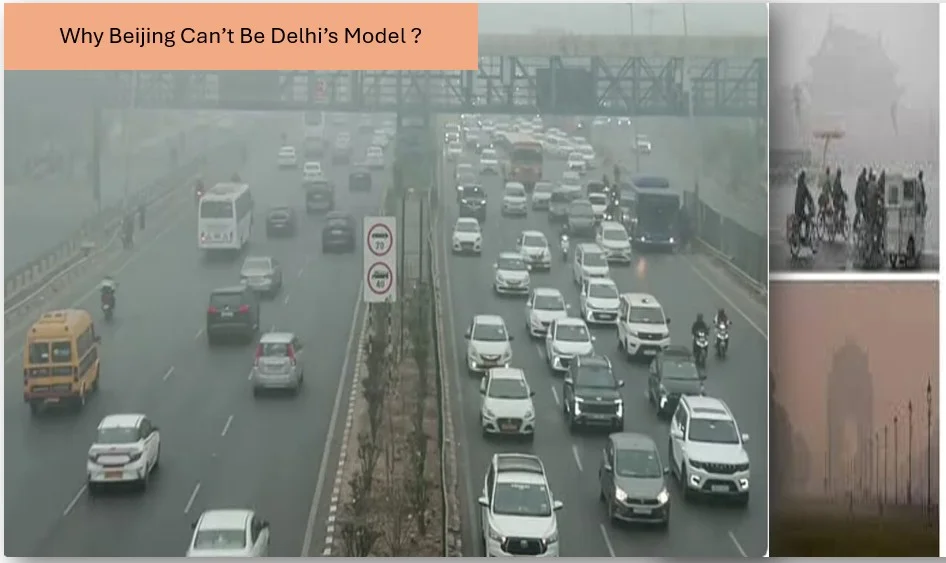
In the halls of urban planning and geopolitical strategy, a common comparison floats around: can New Delhi become as massive and expertly woven as Beijing? On the face of it, the appeal is obvious. In the new downtown Beijing there is a dream of hyper-modernity with its concentric ring roads and integrated public transport grid and an almost clinical level of urban order. For a Delhiite used to seasonal smog and ongoing traffic mess, it’s like some mystical place – The Beijing Model!
But a closer look at the socio-political DNA of both these countries may explain why Beijing is not merely an awkward template for Delhi to learn from but quite literally incompatible with India’s own experience. To understand why, we need to get past the concrete and glass to the core of how these two civilizations self-govern.
The Governance Gap: Consensus Versus Command
The most notable distinction is that of decision-making. Beijing is the pride and joy of a centralized, top-down political system. When the Chinese state makes a decision to build a new subway line or ginormous airport, it’s a very short trip from blueprints to ribbon-cutting. Disruption is mediated by state decree, and dissent almost never speeds up the process.
New Delhi, by contrast, functions in the “beautiful chaos” of a multi-party democracy. Every major infrastructure project in the Indian capital has to negotiate a labyrinth of public hearings, environmental litigation and pushback from politicians. That may be frustrating to those affected, but it is a basic defence. In Delhi, a citizen is able to petition the High Court to stay an infrastructure project that poses a threat to her neighborhood or the local ecology. What I am calling this “democratic friction” is a feature, not a bug, and it means that growth is — at least in theory — negotiated rather than imposed.
Migration and the ‘Hukou’ vs. The Right to Move
One of the reasons Beijing seems to control its urban compared with so much apparent ease is the Hukou system—a household registration device that restricts where citizens can work and receive social services. By managing the people who move from the countryside into the city (ie. forcing some to go back), the Chinese state can avoid having these sprawling “informal settlements” (a fancy way of saying slum) that plague many a megacity in the developing world.
India’s Constitution grants any citizen the right to move anywhere in the country and reside there. As a result, Delhi is an immigrant city, a melting pot where a laborer from Bihar and a techie from Bengaluru inhabit the same geography. The pressure on housing and sanitation is overwhelming, leading to the “unauthorized colonies” in which millions live. Whereas Beijing can merely “cap” its population or move out “non-essential” citizens to satellite cities, Delhi has to absorb incomers somehow. A model that closes its eyes to the possibility of free migration, is a model New Delhi simply can’t embrace without trampling all over it constitutional soul.
Layers of History and the ”Surgical” Technique
Beijing’s urban planning has long been of the surgical variety. Large areas of the historic districts — the hutongs — were bulldozed for grand boulevards and skyscrapers. The city was reconceptualized as an assertion of 21st-century power, often at the expense of its architectural legacy.
Delhi, though, is a crust of history. It’s a city of seven (or more) ancient capitals, where a 14th-century tomb could peacefully coexist alongside a metro station from the modern day. You cannot plan a city on some kind of “clean slate” if every square mile is home to a piece of the world’s heritage. Delhi’s quandary is considerably more challenging: It has to modernize around its history, not over it. The “Beijing model” — raze and rebuild — would be a cultural disaster for someplace like Delhi that draws its soul from an unbroken past.
Environmental Policy: Mandates vs. Participation
Both cities are notorious for grappling with the “Airpocalypse.” Beijing has made great strides in clearing its air, much of it with draconian measures — closing down thousands of factories overnight, ending coal heating and severely restricting car registrations through a lottery.
Delhi’s fight is far more complex, because it involves coordinating across state boundaries and getting buy-in from diverse groups of stakeholders — including farmers in neighboring Punjab and Haryana. In a democracy, you can’t just ban stubble burning and have no politically or economically feasible alternative to offer the voters who do it. Beijing was successful because it was a command economy; Delhi will be successful only if there is a “green social contract” where the public, the courts and the government move together.
Finding a “Delhi Model”
In the end, the fetishisation of the Beijing Model is an impulse seeking efficiency. But efficiency at the expense of equity and liberty is a high price to pay. New Delhi doesn’t have to be a mirror image of Beijing; it has only to be the best version of itself.
A “Delhi Model” would prioritize decentralized urban governance, heavy investment in green public transit that respects the city’s organic evolution and the formalization of its informal economies. It would be a model that accepts the city’s messiness as an indicator of life, instead of a failure to plan for it. Despite its current crisis and long-term vulnerability, Delhi has powerful resources at hand with which to invest in a future that would be secure, inclusive and above all, its own.

A versatile writer mainly works on trending news, daily updates from politics, business, crime, current affairs and entertainment.