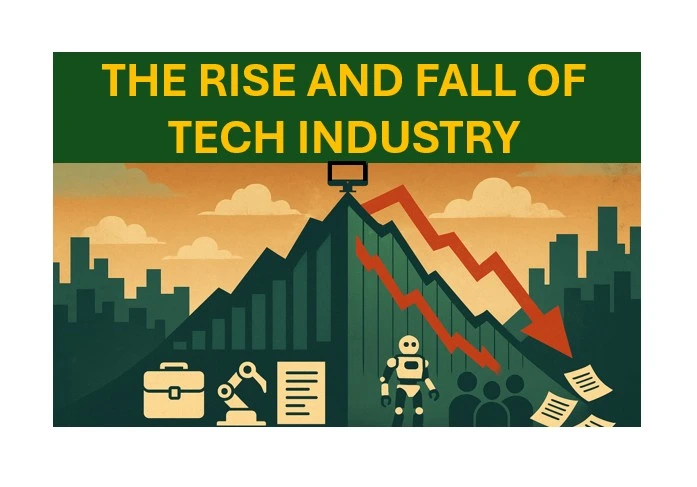

The layoffs in tech industry sectors can appear puzzling or even contradictory when they happen during times that have been otherwise declared “booming” markets. There are news headlines proclaiming record-breaking revenue, stock market expansion, and innovation happening at an accelerating pace, and yet layoffs of thousands of workers take place.
The perception that layoffs at tech companies seem very puzzling when they happen during times that have:
The explanation for this apparent incongruity between overall market conditions and layoffs has much to do with more than simply market conditions, since it is actually a complex blend of considerations that influence layoffs in these sectors of technology.
1. Expectations of growth as opposed to absolute performance
One reason layoffs often occur in thriving industries is that the tech industry is measured more by its performance compared to being measured by how well the company is performing. Publicly traded companies, such as those that belong to the tech industry, are measured by how well they will perform in the future. This means that even though the revenue may be increasing, if the revenue is not increasing as much as the analysts or investors expected, layoffs may be implemented.
2. Overhiring during boom cycles
The technology sector in particular is prone to overstaffing during the growth stage. When the costs of capital are low, there is an uptick in demand or the arrival of new technology such as AI, cloud computing, or the mobile platform, and companies feel compelled to scale. The act of hiring quickly is considered strategic. But as a company grows, the employee base stops being justified by market conditions, and the ensuing layoffs serve as an adjustment period even for companies performing well in the market.
3. Shifts in strategic priorities
Growth markets do not necessarily help every area of an organization in an equal way. Tech companies usually change their approach by shifting attention from projects in the prototype phase, failing platforms, or research projects in favor of sectors where shorter-term gains can be expected. This might involve eliminating an entire group of people for no reason other than the firm choosing to pursue a different path. This could mean cutting back in areas like hardware, consumer apps, or “moonshot” projects to pursue AI or enterprise software.
4. Productivity gains from technology itself
Ironically, technology itself causes layoffs. Automation, developer tools, artificial-intelligence coding, and the cloud enable companies to work more productively with fewer employees. The high demand for technology can quickly push the process. Business-wise, it makes sense to lay off employees after increased productivity, even if the demand for product or services continues to be high.
5. Cost structure & margin pressure
When technology companies reach the maturity stage, the companies start to receive pressure to act less like startups. This is because labor costs make up the biggest expenditures. Reducing the number of employees in the company enables firms to boost their operating margins. This is particularly the case, for example, when the interest rates rise. There might be layoffs despite meeting the revenue growth.
6. Geographic and organizational rebalancing
Not all layoffs are because of decreased demand. There are redistributions. Firms are cutting back in expensive areas but opening up in new areas that are cheap. Some organizations are streamlining their top tiers of management by outsourcing certain activities. These are layoffs for the organization, but the organization calls these restructuring. There can be a booming market but still contraction at the local or departmental level.
7. Gap between skills and needs
Technology changes very quickly, meaning that skills in this sector can go out of date faster than in other sectors. A firm can be doing well in terms of business but still need to let some of its employees go because of their skills not fitting the new focus. This might occur while the company hires new staff who have new skills.
8. Layoffs as a signaling mechanism
Finally, layoffs can act specifically as a signal, whether that be for investors or partners, or even for internal teams. It can show that the company’s leadership is serious about efficiency and focus. Even in a booming market, this message can be extremely valuable, showing that they aren’t complacent.
Conclusion
Tech layoffs in booming markets are less about economic distress but more about adjustment. They reflect expectation management, strategic shifts, productivity gains, and some unique financial logic of the tech sector. Though painful for individuals, these layoffs are often symptoms of an industry constantly reshaping itself, sometimes even when it’s thriving overall, with parts of the workforce being shed.

A versatile writer mainly works on trending news, daily updates from politics, business, crime, current affairs and entertainment.