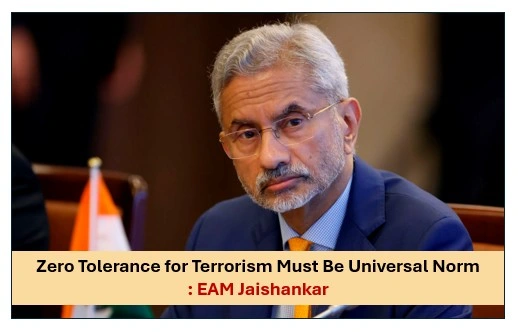

Few voices in the high-stakes universe of international diplomacy are more consistently blunt and unsparing than that of India’s External Affairs Minister, S. Jaishankar. Speaking at a high-level summit this weekend, Jaishankar once again shone the global spotlight on what has been the world’s most intractable security challenge. His message was clear: Zero tolerance for terrorism would have to be both a universal principle and policy — no ifs, buts or selective application.
His comments reverberate at a moment when the world is turning its attention increasingly to changing geopolitics and economic rivalries. But for India — a country that has lived with cross-border volatility for decades — the battle against terror has never been a “legacy issue.” It is a modern challenge, an evolving one, that demands the world to stop squinting through the bifocal of “your terrorist” versus “my freedom fighter.”
The End of “Strategic Ambiguity”
Strategic Ambiguity For years, what Jaishankar calls strategic ambiguity has foiled global responses to terrorism. A number of nations with their narrow political interest have indeed historically differentiated the terror groups as “good” and “bad”. If they attacked a rival, you ignored them or even tacitly supported them; if they attacked a domestic target you condemned them.
- Universality: An attack against one country is an attack against the international financial and social system.
- Accountability: Nations that offer extremist groups “safe havens” or financial lifelines must face diplomatic and economic ostracism.
- FATF Factor: India maintains sustained pressure on insisting that FATF standards be strictly implemented in order to strangle money laundering and terror financing at their roots.
“Terrorism is not a localised, isolated crime,” Jaishankar said in his address. It is a hate industry that feeds on the silence of the international community. The only way to defeat it is through a universal justice, which can replace selective outrage. ”
Technology: The Next Frontier of Terrorism
One of the notable features of Jaishankar’s recent rhetoric is his emphasis on modernisation of terror. He cautioned that the “zero tolerance” norm should be extended to the digital and tech worlds as well. By 2026, that battlefield had crossed the border into code and drones and decentralized finance.
The EAM outlined a number of new threats that the present international legal system is not equipped to deal with:
- Drone Mayhem: The employment of dronedrone usage to smuggle weapons and drugs across borders.
- Financing Cryptocurrencies : The move away from conventional banking to using coded digital logs, through which terror groups can transfer money without being detected.
- Social media radicalization: The support the use of advanced math to target vulnerable kids and stir up “lone wolf” terrorism.
In urging a “universal norm,” Jaishankar is, in effect, seeking an international treaty that treats cyber-terrorism with the same level of seriousness as traditional warfare. If the world can come together to regulate climate change or trade, he reasoned, it should demonstrate as much resolve in regulating the digital tools of destruction.
Challenging the “Safe Haven” Narrative
Without naming names — though that implication was clear, diplomats said, to every one in the room — Mr. Jaishankar vividly challenged countries who use terrorism as an instrument of statecraft. One of India’s long-standing complaints was the institutional support to anti-India groups in its immediate neighborhood.
India as Leader in the Global South
With India emerging as one of the strong voices of Global South, Jaishankar is framing fight against terror as not just important in its own right but an integral part of sustainable development. Indeed, he said, poor countries often suffer the most from extremism which scares away foreign investors, destroys infrastructure and siphons scarce resources away from health and education.
“Zero Tolerance” is now being co-related to the following under India’s leadership:
- Economic Stability: You can’t have a thriving “Blue Economy” or opening of a “Digital Silk Road” when shipping lanes and data cables are at risk from non-state actors.
- Human Rights: The EAM also pointed out that the core of all human rights is turning on the right to life —a recourse violated primarily and most horrendously by acts of terror.
India dismisses ‘Epstein Files’ Email referencing PM Modi’s Israel visit
The Road Ahead – From Words to Action
The task for Jaishankar — and for India — is to upgrade this “universal norm” from a set of lines in a speech to a legally binding principle in international law. This involves a multi-pronged approach:
- CCIT: The Comprehensive Convention on International Terrorism has been an Indian demand for decades. Also, a revitalised Jaishankar reflects renewed effort to arrive at a consensus on the definition of terrorism globally.
- Sharing Intelligence: Beefing up bi-lateral meeting between “Joint Working Groups” on counter-terrorism with Eropean, Middle Eastern and South East Asian partners.
- UNSC reform: India has maintained that UNSC would not be effective in combating terrorism if its permanent membership continues to reflect post-1945 inertia.
As the summit wrapped up, the mood among observers was that India is no longer asking for help with its security challenges; it is using demand power to push for a global structural change. S. Jaishankar has made perfectly clear: the world is as safe as its weakest link.

I am a versatile content writer from the MP region, covering politics, business, crime, current affairs, entertainment, video games, and sports with clear insights, engaging analysis, and timely, reader-focused updates.