Standing guard in the heart of North India, a silent sentinel that has watched Earth for 2.5 billion years is facing what many experts are calling an “existential crisis.” A recent highly contested ruling by the Supreme Court of India, meant to bring “uniformity” in how the Aravalli Hills are defined and protected but that has instead provoked a firestorm of protest from environmentalists, threatens inadvertently to open the floodgates to ecological ruin, critics say.
The November 20, 2024 judgment and clarification in December 2025 introduced a new threshold of 100 metres for what can be recognised as an “Aravalli Hill”. The court describes this as a step toward sustainable mining, but critics say it essentially removes protection from almost 90% of the mountain range.
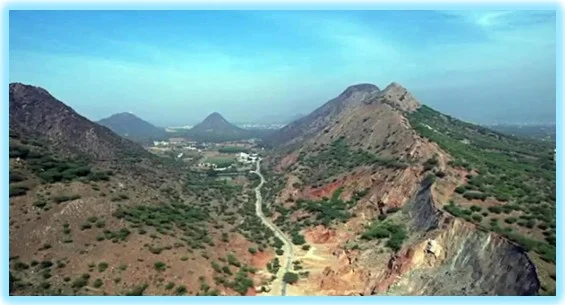
A “Death by Definition”
For decades, the Aravalli range — which spans Delhi, Haryana, Rajasthan and Gujarat — suffered in absence of a clear-cut definition under law. This enabled states to implement different criteria that could tip biased towards mining interests. To remedy this, the Supreme Court agreed to a suggestion that only land form rising 100 m or more above ground level may be deemed to be Aravalli Range.
The Alarming Reality:
Massive Exclusion: As per the Forest Survey of India, just 8.7 per cent of the mapped Aravalli landforms hit this new 100-m height threshold.
The ‘Ridge’ Crisis: In places like Faridabad and Gurugram in Haryana, practically the entire mountain range comprises of low-lying ridges and hillocks. Under the new definition, these would no longer qualify as “mountains,” opening them to real estate development and stone crushing.
Broken Continuity: Environmentalists insist that a mountain range is an organic ecosystem. By shielding only the “peaks,” the valleys and as well as smaller slopes — which are important for wildlife and water — remain open to harm.
The Three-Headed Beast: Pollution, Flood And Water
Prominent environmentalists such as country’s “Waterman” Rajendra Singh have openly shared their concerns that the reclassification could lead to catastrophic consequences.
The Water Crisis A Natural Sponge Lost
The Aravallis are not mere rocks but the main, if not sole groundwater recharge zone for the water-starved National Capital Region (NCR). The hills’ broken volcanic rocks act as a sponge, directing monsoon rain into underground aquifers.
“Calling only hills above 100m ‘Aravallis’ wipes out the zone that sustains our wells,” cautions climate expert Harjeet Singh. Without these hills, the water table — which already drops as low as 2,000 feet in some mining regions — might never recover.
The Pollution Shield: Ahead of Dust Storms
THE ARAVALLIS ARE a “GREEN WALL” which is an obstruction to the Thar Desert. They intercept the enormous dust storms that roll in from the west. If 90 percent of the habitat is leveled to build “sustainable mining,” nothing will prevent the desert from pushing further into Delhi, and beyond — making even more deadly each year’s smog during winter.
The Flooding: Natural Drainage Devastated
The hills and rivulets are natural sewers. When those are leveled for construction or mining, water from the rainfall has nowhere to run. This dramatically heightens the likelihood of flash floods in urban settlements like Gurugram where natural “nullahs” (drains) flowing from the Aravallis are already blocked by concretisation.
Sustainable Mining or “Red Carpet” for Destruction?
The Court’s order does place a temporary moratorium on the grant of new mining leases till such time “a Management Plan for Sustainable Mining” (MPSM) is formulated. Yet, opponents including former Rajasthan CM Ashok Gehlot have described the judgment as a “red carpet” for the mining lobby. They say that once a hill is “erased” on paper by pegging its height at below 100 metres, it escapes the robust protections of the Forest Conservation Act.
The #SaveAravalli campaign has taken off across social media and voters’ activists calling for a definition of the range that is “functional”, not just “vertical”.
What Happens Next?
Scientific mapping based on the 100 metre rule has been handed over to the Ministry of Environment and Forests (MoEFCC). The environmental community, however, is disputing the and wants a hearing on this order with input from …. They argue that the Aravallis must be designated a “Critical Ecological Zone” where height does not determine right to life.

I am a versatile content writer from the MP region, covering politics, business, crime, current affairs, entertainment, video games, and sports with clear insights, engaging analysis, and timely, reader-focused updates.