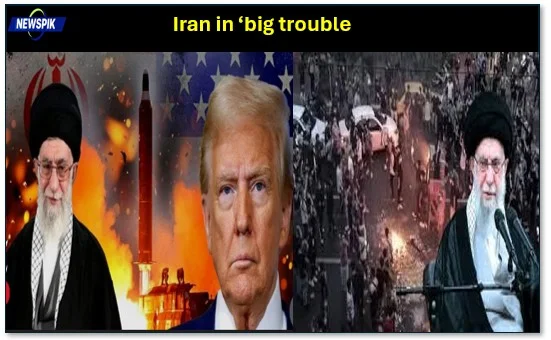

By early 2026, the politics of the Middle East has gone from a simmer to full boil. United States President Donald Trump has now made his most explicit threat yet, indicating that the White House may not be content to merely talk tough as a wave of domestic unrest washes over the Islamic Republic. By declaring that Iran is in “big trouble,” the administration has essentially laid down a red line, pledging military response if it finds that the Iranian government uses lethal force against its own people.
A Country on the Brink
The current crisis in Iran didn’t appear out of nowhere. But the country has been roiled since late December 2025 by widespread protests that began in response to a crumbling economy and the free fall of its currency — the rial hit an all-time low of 1.4 million to the dollar earlier this month. What started as rage over skyrocketing food prices and inflation has developed into a popular rebellion that is challenging the core of the Iranian regime.
In contrast to previous uprisings, these protests have broken out in traditional guarantors of regime stability, such as Supreme Leader’s home town Mashad. Tehran has responded the way it knows: with a nationwide blackout of the internet and a heavy security presence. But the scrutiny from the international community is sharper this time, and that has to do with President Trump’s blunt and periodic comments on the issue.
The Trump Doctrine: Vengeance Without “Boots on the Ground”
In a statement issued at the White House on January 9, 2026, President Trump stated that he has not forgotten about Pastor Brunson and emphasized that is doing “our best to get him home.” His message was conspicuously light on the diplomatic nuance: “You’d better not start shooting, because we’ll start shooting too.”
The President’s approach, if in fact he has one, seems to be to reiterate the “Maximum Pressure” campaign but with the added bonus of an explicit threat of kinetic action. He made clear that he doesn’t want to plunge U.S. ground forces into an Iranian quagmire, but was ready for a pounding the likes of which Iran has never seen: “If it happens we will do things with the likes of which they’ve never seen before.” This presumably is referring to a campaign of targeted bombing aimed at the regime’s strategic assets, its Revolutionary Guard infrastructure and economic centers using tactical nukes or other new technologies that can annihilate the entire power structure without having to occupy any of it.”
“I’ve made the statement very strongly, that if they start killing people, we are going to do something.″ “That does not mean troops on the ground but that means where they’re having people and things like this battle that they have with al-Qaida in 2009 and 2010 at sort of our — near us.” — President Donald Trump
The Echoes of June 2025
To grasp the gravity of these threats, look back to June 2025, when a 12-day war between Iran and Israel in which entire cities were destroyed permanently altered regional power relations. During that war, U.S.-led forces “wiped out” core Iranian nuclear facilities after a 60-day ultimatum to create a new nuclear deal ended without any agreement.
The Iranian leadership knows this is an administration that will pull the trigger. The 2025 strikes had left the “Axis of Resistance,” as the Iranian military called its allies and proxies in Syria, Iraq and Lebanon, weakened — and its air defenses exposed. Trump is now betting that if he reminds Tehran of this capacity, the threat of outside destruction will discourage the same bloody clampdowns seen in 2019 and 2022 being repeated.
Tehran’s Preemptive Defiance
The Islamic Republic’s response has been one of calibrated aggression. In the aftermath of the 2025 conflict, Iran’s new Defense Council threatened that it wouldn’t sit around and be struck. In a comment that has succeeded in sending shivers through international oil markets, the Council has said that “initial signs of danger” may lead to preemptive Iranian action.
Supreme Leader Ayatollah Ali Khamenei has cast the protests as a “conspiracy” by foreign enemies without specifically blaming the U.S. president, who has tweeted not only his support for them, but cognizance that internet was cut off to try and kill them in darkness. He said the blood of Iranians was on the hands of the US president after June 2025 attacks. This rhetorical back-and-forth has put the Iranian public in a bind, torn between a government that treats them like pawns and an American administration that purports to be on their “rescue” but also directly constricts the economy through sanctions.
The Global Stakes
But with the internet still dark over much of Iran, verifying the actual death toll is difficult. Rights organizations such as HRANA have cited dozens dead, including children, whereas the regime has admitted only to “vandalism” and “sabotage”.
For the rest of the world, the stakes have never been higher:
Oil Markets: Any strike on Iranian territory puts the Strait of Hormuz at risk, the world’s most crucial oil shipping lane.
Humanitarian Crisis: A full-blown civil war in Iran would produce a migration crisis that would make all previous regional exoduses look like puddles.
A Precarious Path Forward
President Trump’s strategy is a high-stakes bet on the power of deterrence. In pledging to work toward “hell to pay” for such violence against the protesters, he is trying to be a kind of guardrail for the opposition movement. Yet critics say that inadvertently, such threats could undermine local activists, and make it easier for Tehran to portray them as American agents.
Now, as we’ve continued on in January 2026, the world is waiting to see if the “big trouble” Trump describes will be another democratic opening for the Iranian people or a calamitous new phase of war in the Middle East. This time the third umpire in this titanic battle -Iranian people themselves- are on the ground – they walk on, not even bothered, as enemy shadow sway above them in form of supersonic missiles.

A versatile writer mainly works on trending news, daily updates from politics, business, crime, current affairs and entertainment.









