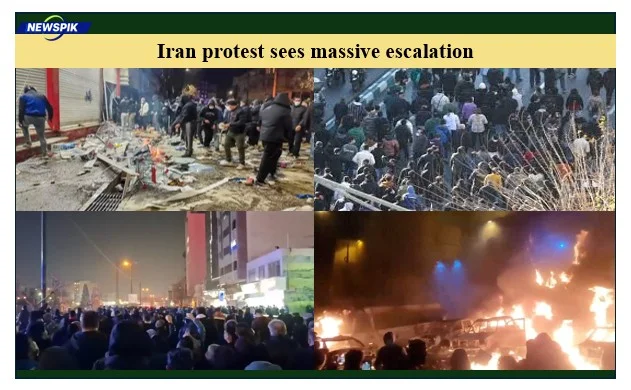

In the frigid early days of January 2026, the streets of Iran have become a stage for defiance. What started as a localized clamor over the collapse of an economy that had offered neither jobs nor justice has now spread to become the most sustained challenge to a political system that the Islamic Republic’s aging revolutionary theocracy hasn’t faced in its 40-year existence.
But as of Jan. 8, the situation also came to a head: A huge escalation set off by a “war cry” from the exiled Crown Prince Reza Pahlavi and then a total, state-imposed digital blackout that has dumped 85 million people into an informational void.
The Call from Exile: A Tipping Point
Ever since he was ousted the exiled Crown Prince Reza Pahlavi has been the symbolic leader, albeit a figurehead, for many Iranians abroad and within Iran his authority is frequently disputed. That debate ended this week. Pahlavi delivered some of that pressure himself, declaring in a high-staked video message his direct call to action: rousing Iranians to participate in coordinated “street-shouting” and mass demonstrations at 8 p.m. on Thursday and Friday local time.
The response was unprecedented. On the stroke of eight, neighborhoods across Tehran and dozens of other cities erupted. From affluent north Tehran to the blue-collar south, voices converged in one chant: “Death to the dictator!” and “Drink is the Last War!”
This wasn’t just a protest; it was a psychological break. In answering the call of a man whom the regime has spent 45 years branding as a “relic of the past,” Iranians signaled to their masters that they no longer recognized themselves in what is being offered by way of a political system. The “war cry” from abroad served as a catalyst, rallying disparate elements —from university students to merchants in the Grand Bazaar —around the banner of absolute regime change.
The Digital Iron Curtain, Online all across the country
Minutes after the protests reached their peak, the Iranian government deployed its most powerful domestic weapon: the “Kill Switch.” Monitoring groups including NetBlocks and Cloudflare tracked a near-complete shutdown of the online infrastructure in the country.
This isn’t swatting at a fly — it’s a bet that you can stop one by disabling all the worlds’ ovens.
Total Blackout: International telephone lines were severed and mobile data services disabled, preventing protesters from organizing movements or sharing footage of security forces at work.
A Familiar Playbook: In Iran, history shows that cutting off access to the internet is frequently done before a government metastasizes its use of extreme violence. A similar blackout in 2019, during the “Bloody November” protests, hid a brutal crackdown that is said to have left hundreds if not thousands of people dead.
The Drone Response: Hard-line state media, among them the Kayhan newspaper, openly boasted of deploying surveillance drones to locate protesters in darkness, a further chilling atmospheric effect.
Though largely blackout out, bits of information have leaked out on satellite links and even over Starlink devices. The human cost is already staggering, indeed, with human rights organizations reporting at least 45 deaths, and more than 2,200 detentions in the space of twelve days alone.
Loud Explosions In Venezuela After Trump Warns Of Ground Strikes
A Perfect Storm: The Economy, the War and Desperation
The current turmoil is the product of a depth of economic misery that Iran has not known in decades. The Iranian Rial has crashed to a historic low taking it past 1.4million to the dollar, making life-savings null and void and turning basic food supplies into an opulence.
That economic implosion comes after a ferocious 12-day war against Israel in June 2025, which depleted the regime’s resources and revealed its military weaknesses. The Iranian public, tired of funding regional proxy wars in Gaza and Lebanon, has turned its anger inward. These chants of “Not Gaza, not Lebanon, my life only for Iran,” have now become the anthem for this new movement above all else.
The Trump Factor: International Red Lines
Compounding the uncertainty is a dramatic transformation of the geopolitical backdrop. America’s second term President, Donald Trump, has delivered a blunt message to Tehran. He warned the Iranian leadership in a statement on Jan. 8 not to cause a “massacre,” saying that the U.S. would “hit them very hard” if they murdered protesters en masse.
That leaves Supreme Leader Ayatollah Ali Khamenei in a tough spot. If he orders a “Tiananmen-style” crackdown to rescue the regime, that would invite a direct military confrontation with a “locked and loaded” Washington. And if he’s restrained, the protests could build up enough steam that they become unstoppable.
Is This the End of the 1979 Experiment?
The 2026 protests, unlike uprisings in 2009 or 2022, have no time for the hesitancy of bygone days. There is no talk of the “reform” or “moderate” candidates in this picture. The entire rhetoric has changed to disintegration of the Islamic Republic itself.
The return of Pahlavi-period slogans and the readiness of people to face live ammunition in a complete communications blackout indicates that the threshold of fear has been crossed. As the “war cry” rings out in the streets of Tehran (the net is still down), we wait to see whether this “final battle” will indeed redraw the map of history in the Middle East.

I am a versatile content writer from the MP region, covering politics, business, crime, current affairs, entertainment, video games, and sports with clear insights, engaging analysis, and timely, reader-focused updates.