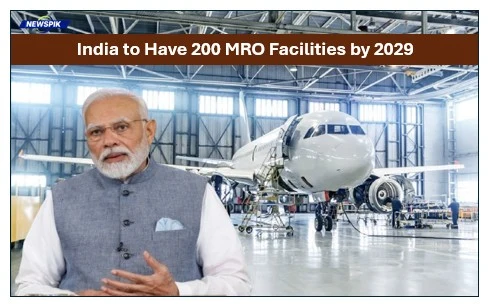

By 2029, India should have almost 200 Maintenance, Repair and Overhaul (MRO) centers, which is a big increase from now. The statement shows that the government wants to improve the local flight environment and make it less reliant on other countries to service planes.
The prediction was made at a big event for the civil aviation industry. Officials talked about how fast India’s aviation market is growing and how more planes need to be serviced as companies keep adding more to their fleets.
A government view of MRO as a key part of aviation independence
India wants to become a world hub for civil flight, and the government sees MRO growth as a part of that plan. India’s position on major flying routes around the world, its growing home market, and its companies’ record breaking orders for planes are all seen as big pluses.
Officials stressed that growing MRO capacity will help companies save money, keep more aviation related spending in the country, and cut down on aircraft downtime. India has already taken steps to encourage businesses to set up shop there, such as lowering taxes, loosening rules on foreign investment, and making rules easier to understand.
Pros say that numbers alone are not enough
Experts in the field think that even with the expected growth, India may not be able to become a real global flight hub with just 200 MRO sites. They say India will not be able to compete if it only focuses on quantity rather than quality.
One big worry is that many Indian MROs don’t have any world certifications. Indian airports have a hard time attracting foreign planes without permission from the world’s top flight authorities. These airlines are what make MRO hubs in places like China and Singapore popular.
Experts also said that India still relies too much on importing advanced parts, materials made for aircraft, and specialized tools, which drives up costs and lowers productivity.
After IndiGo crisis, aviation ministry gives nod to two new Indian airlines
There are still gaps in certification, skills and testing
The lengthy and pricey licensing process is another big problem. Building trust with world leaders, plane makers and foreign businesses takes years. Most of the time, MSMEs which are small but important parts of the supply chain, don’t have the money to go through this process.
A big hole is also thought to be the fact that India doesn’t have enough recognized tests and approval sites. Still, a lot of repairs and parts have to be tried out in other countries, which takes longer and costs more.
There are also not enough trained people working in the field, especially skilled people who can fix airplanes. People who know about this say that building more places won’t help if money isn’t also spent on training and skill development.
Power Banks Can No More Be Used On Flights. Check New Aviation Safety Rules
We need long term policy stability and new technologies
Leaders in the industry say that predictive maintenance, digital tracking and AI will play a big role in how strong they are in the future. Using these tools, on the other hand, requires a strong digital foundation and specific skills.
There are also calls for policies that are stable and easy to understand. Aviation projects take a long time to grow and buyers may be turned off by the frequent changes to regulations. Experts say that clear rules, faster decisions and better teamwork between the government and businesses are important.
From ₹5,600 to ₹420 Crore: How a Young Woman Built India’s Private Aviation
Goals are clear, and execution is being watched
It is clear that India wants to become a hub for civil aviation, and the expected growth of MRO centers is a big step in that direction. But experts warn that as infrastructure grows, it needs to be matched by global norms, skilled workers, and strong licensing systems.
As 2029 approaches, India’s MRO push will not only depend on the number of facilities it builds, but also on how well they can meet international standards and compete with global hubs that are already in place.

I am a versatile content writer from the MP region, covering politics, business, crime, current affairs, entertainment, video games, and sports with clear insights, engaging analysis, and timely, reader-focused updates.