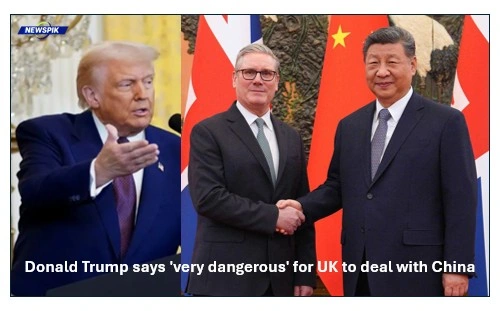

And the sands of global diplomacy rarely appear more shifting than they do today. In the strongest sign yet that potential U.S. allies are faced with an either-or choice, one of its leaders has warned the United Kingdom that it would be “very dangerous” for them to seek deeper economic ties with Beijing.
This is not a mere tactical disagreement; it is the battle that lies beneath all of the two nations’ hopes and frustrations, between a resurgent “America First” government and a desperate British prime minister who wants to jump-start her country’s stagnant economy, quickly and pragmatically. As Prime Minister Keir Starmer tries to melt the “ice age” of relations between Britain and China, he is stuck in the middle of a cold war between the world’s twin superpowers — each demanding its own sort of loyalty.
A Stern Warning from Washington
The remarks followed a much-ballyhooed film premiere at the Kennedy Center of a documentary about First Lady Melania Trump. Asked by journalists on the UK’s shift towards closer business links with China, the President was blunt.
These comments also come at an extremely pointed time. Their arrival comes a matter of hours after Prime Minister Keir Starmer’s meeting with Chinese leader Xi Jinping in Beijing, the first time since the British premier has visited the Chinese capital since 2018. Whereas Starmer was talking of a “strategic partnership” and an agenda to reduce trade barriers, Trump was effectively planting a flag in the sand saying that when it comes to its Western allies China is not a partner but a ruin.
Starmer’s “British Pragmatism” verses Trump’s Reciprocity
Keir Starmer’s visit to Beijing is a gamble. With the British economy mired in years of stagnation and China as the world’s second largest economy, Britain sees engagement with it as an unavoidable rather than a voluntary process. A “British pragmatist who applies common sense,” he has described himself, adding that the UK simply can’t turn its back on a market of 1.4 billion people.
Some of the notable breakthroughs that were announced while he was visiting are:
- Tariff reductions: Deals to cut duties in half on expensive British exports like Scotch whisky.
- Visa: No Fresh moves give UK nationals short-term entry without visa to China .
- Investment Pledges: Significant pledges from British companies, led by a multi-billion pound AstraZeneca investment plan.
But the “America First” orientation of Trump looks at these accomplishments with a distinct perspective. To the US administration, any commercial benefit to China is a strategic loss for the West. Trump has long maintained that Western countries “cannot look to China as the solution to our problems” when it comes to their economic ills, often pointing in his critique to national security concerns and the decline of domestic manufacturing.
The Canada Comparison: A Look at the Stakes
More telling than the warning to the UK, perhaps, was Trump’s reference to Canada. In recent weeks, the President has been even blunter in expressing his anger at Canadian Prime Minister Mark Carney’s rapprochement with Beijing
It is a lesson the UK should heed, as “tariff-first” diplomacy amounts to little more than trying to pick battles you are sure of winning. Even if London would like to have it both ways on the security front, maintaining its alliance with Washington while pursuing trade goals in Beijing, the Trump administration has made clear that it is willing to use economic leverage — as when Mr. Trump threatened “reciprocal” tariffs last spring — to keep allies in line. For a UK that is already vulnerable to tariffs in relation to other geopolitical disputes, the stakes of “going into business” with China are very high indeed.
Security, Human Rights and the Delicate Balance
The tension isn’t purely economic. The UK-China relationship has been bad for years because of:
- Hong Kong: The crackdown on pro-democracy backers and the imprisonment of people including Jimmy Lai.
- Cyber security: Fears over Chinese role in vital UK infrastructure and telecoms.
- Human Rights: Accusations over the treatment of Uighur minority in Xinjiang.
Starmer has maintained that there is no solution to these “differences,” except engagement. He said that “a respectful discussion” face-to-face is far more effective than screaming from the peanut gallery. However, the Trump administration deems such an approach as “appeasement” because it does not recognise that there is a structural rivalry between the West and the Chinese Communist Party.
Trump Imposes 10% Tariff On Denmark, UK, France For Opposing
The Road Ahead: Can the UK have Both?
As we slide into 2026, the United Kingdom must grapple with an existential diplomatic question: Can it credibly be Washington’s most trusted ally abroad while also serving as a critical European hub for Chinese investment?
The Trump administration’s position indicates the answer is no: in a world where the US sees accelerating global trade as a zero sum game, that “Special Relationship” is now being tested by an entirely different kind of pressure. The UK is trying to construct what Starmer describes as a “more sophisticated relationship” with Beijing, but Washington is indicating that in an increasingly bifurcated world.

A versatile writer mainly works on trending news, daily updates from politics, business, crime, current affairs and entertainment.









