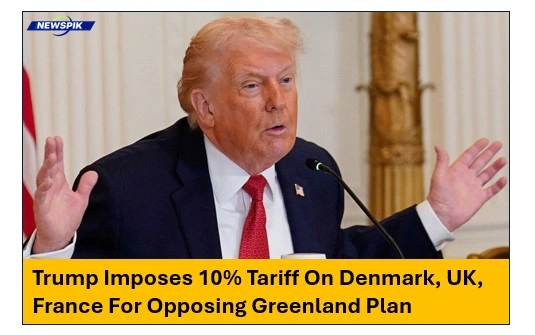

In a stunning move which has rocked the world economy and traditional diplomatic spheres, the Trump administration just implemented a 10% tariff on goods imported from Denmark, United Kingdom, and France! The move is explicitly in response to their outright rejection of the U.S. proposal to purchase Greenland.
Once laughed off as a rhetoric-laden fantasy, the United States buying up the world’s largest island has emerged in 2026 as one of America’s grandest and most painstakingly high-stakes pillars of foreign and economic policy.
The Greenland Kerfuffle: Why Tariffs Are the New Diplomacy
The initial friction came when President Trump suddenly decided to return the world’s attention to Greenland, and declared that its strategic value and untapped natural resources are so “essential for national security” that he wants to buy it. But the reaction from European allies was swift and unified. Denmark, which has sovereignty over the self-governing territory, has insisted that Greenland is not for sale — echoing similar comments by leaders in London and Paris.
In a recent statement, the White House called the 10-percent tariff “an essential step on fighting back against preferential treatments that allow Russia and other countries to dominate their economy in energy.” The administration contends that these nations are the roadblock to a deal that would protect the Arctic region from rising encroachment by other global powers. For the U.S., Greenland is not just a continent but also an instrumental frontier for missile defense, satellite tracking, and the development of the “Blue Economy.”
The selection of targets — Denmark, the U.K. and France — is especially notable. Denmark is leading the effort but Britain and France have been the greatest European champions of reminding Russia that it wasn’t following an accepted international norm or respecting another nation’s sovereignty. Imposing these tariffs, the U.S. is saying loud and clear that “business as usual” with its closest allies depends on to what extent they buy into this expansionist project.
Iran warns, US and Israel will be target if Trump administration strikes over protests
Ripple Effects Across the Atlantic
A 10% tariff is seldom a local event. Economically, the impact is huge: The U.K. and France are among America’s biggest trading partners. Whether it is British auto parts suppliers or French luxury retailers; Danish pharmaceutical businesses or American tech firms with plants in both the United States and Britain — companies on both sides of the Atlantic are girding for a period of extreme instability.
Chain Effects: Many American manufacturers depend on specialized parts from these three countries. A sudden 10% surge in costs would probably be passed through to consumers, potentially stoking inflationary pressures.
Reprisals: Historical pattern is for tariffs to be answered with counter-tariffs. Some experts say the EU and UK could retaliate by going after American-designed products from bourbon to motorcycles or even tech services, pushing a trade rift into a full-fledged fight.
The ‘Arctic Premium’: This new economic tension is being called the “Arctic Premium.” Now investors must bake the geopolitical risk of a Greenland dispute into their long-term European strategies.
There is also a human dimension to this change, beyond the numbers. Small businesses that rely on niche European imports — high-end bakeries making croissants with French butter, for example, or specialty engineering firms using Danish tech — are now also dealing with a sudden squeeze on their margins.
What Trump Wanted for Greenland and What It Means for the US
The Geopolitical Gamble: Security Versus Sovereignty
At the root of this pushback, is a fundamental disagreement over the future of the Arctic. For the Trump administration, buying Greenland is a proactive defense move with moving parts — ensuring that the U.S. has a foothold in an increasingly contested (and warming) part of the globe. As ice caps melt and a technological revolution brings new shipping lanes, the region is emerging as one of the world’s next competitive battlegrounds.
But for Denmark — your neighbor, really — it is a question of self-determination. The people of Greenland want increased autonomy, not merely ownership to be transferred from one superpower to another. European leaders have cast their opposition in the language of defending the “rules-based international order,” arguing that if a close ally can be forced through economic duress to give up territory, then no nation’s borders are truly safe.
A tricky situation for both, UK and France. As members of NATO, they are signed up to a collective defense agreement with the United States. But this trade-focused “diplomacy” has frayed those bonds to a degree not seen in decades. The question now is whether these countries will crack to economic pressure or if the tariffs will only cement a united European front against American Arctic designs.
Trump slaps tariff on Iran’s trade partners. How will it impact India?
What’s Next for Global Trade?
But with the February 1st deadline fast approaching, this is something now being closely monitored by the international community. There is still a window to negotiate, but the White House says the 10% rate is merely the first rung and could climb as high as 25 if successful path forward isn’t found.
This is a much different approach than traditional land grabs. The U.S. is not going to negotiate a treaty through long-term diplomacy; that would be the old-fashioned thing to do, and these are new times that demand creative thinking by people who can generally count on paneled walls in their offices if not solid-gold toilets in the bathrooms. Whether the “Greenland Plan” ushers in a historic expansion of American borders or a historic breach in Western alliances is the core question of 2026’s dawn.
And for now, the world has to get used to a new kind of reality in which trade policy is the weapon of choice in territorial disputes. Consumers here and producers there are the first to feel the heat of a cold-weather conflict with no apparent thaw in sight.

A versatile writer mainly works on trending news, daily updates from politics, business, crime, current affairs and entertainment.