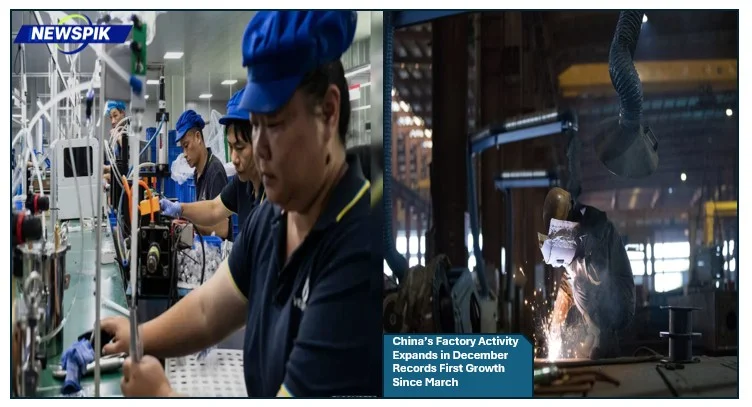

The manufacturing industry in China was responding positively in December, with the factory operations growing for the first time since March, indicating early indications of recovery pace in the second-largest economy in the world that has experienced months of lethargic demand, poor exports, and dull domestic consumption.
The official Manufacturing Purchasing Managers Index (PMI), as indicated by the National Bureau of Statistics (NBS) of China, rose above the expansion level of 50 for the first time in nine months. When the reading is more than 50, it represents growth, and when it is less than 50, it represents contraction. The rebound in expansion implies that the policies have been in place to stabilise production and business confidence in the industry.
Production and New Orders Improve
The industrial production was reinforced by the increase in the output level supported by the improvement in logistics, demand in the manufacturing sector during the holiday season, and the slight recovery in foreign orders. The production index was also on the rise, showing improved factory utilisation and workflow in some of the main industries, including machinery, electronics, automotive, and energy equipment.
One of the indicators of demand momentum, namely new orders, also made some headway in December and overturned some prior declines. Despite the still vulnerable state of domestic demand because of prudent consumer expenditure, the battle against the decline in economic growth through stimulus measures such as an infrastructure push, relaxed financing partly and direct subsidizing support to manufacturing is boosting the mood.
The export orders that had burdened Chinese manufacturers due to global inflation, geopolitical hassles, and weakened Western demand also improved marginally. Analysts believe the recovery is a sign of the stabilisation of global trade and the optimisation of the mood in the United States and some areas in Asia, but it has its challenges.
Policy Measures Start Yielding Results
Over the course of 2025, Beijing has employed various supportive policies to cushion its industrial-based economy, such as easing credit conditions, promoting small and medium-sized businesses, advancing advanced manufacturing and green technology, and renewing its focus on domestic innovation. The government has also been promoting investment in high-end manufacturing, and electric vehicles, renewable energy, semiconductors and smart equipment to offset structural slowdowns.
The December growth indicates that such measures are perhaps coming into force. Economists report that while confidence among the factory owners has improved, it indicates that the future of the business is expected to improve further as early as early 2026, however they advise that a lasting recovery will only be achieved by further support of the policy and greater activity by the private sector.
Challenges Still Persist
Although December has been a good month in the manufacturing sector of China, there are still headwinds within the industry. The distress of the property market is still a burden on the overall economic development in steel, cement, construction-related machinery and materials, etc. Also, consumption expenditure in households has not yet recovered completely, and this puts consumer-based manufacturing industries under strain.
There is also international insecurity. Export growth may be limited by geopolitical strains, trade protectionism, the slowing of the European economies, and limited corporate expenditure in the global market. In addition, the increased energy and raw material prices may take their toll on profit margins unless the demand is expected to go up substantially.
Analysts point out that the PMI growth in December is also positive, but it is very small. The only difference will be sustained momentum over several months to reinforce the view that the sector has indeed been in a real recovery cycle and not a business boom back.
Non-Manufacturing and Services Indicators
There was also stabilisation in the non-manufacturing PMI of China ,indicating better performance in services and building. The growth of digital services, transport recovery and tourism-related activity has also helped keep the greater economy buoyed in infrastructure development projects.
The services sector saw consumer mobility at the end of the year and a slow recovery in business operations. The weak residential real estate was offset by construction activity, which was supported by government-backed infrastructure funding.
Market and Business Response
These December data were taken with an element of careful optimism by business leaders. After a long period of stagnation, many manufacturers took a sigh of relief at elevated levels of order inflows and increased production stability. Some, however, pointed to the need for predictable policies, enhanced financial availability, and improved consumption growth through sustenance.
Financial markets were also positive about the expansion since it promised some stabilisation and not economic worse off. Investors will be keen on policy announcements to come, especially before the new fiscal year planning cycle.
Outlook for 2026
Moving forward, economists expect China’s manufacturing prospects in early 2026 to be underpinned by sustained domestic policy support, a resurgence of consumer confidence, stabilisation of the property market, and global trade conditions. The authorities are likely to continue their efforts in industrial modernization, promoting technological advancement, supporting private enterprises, and driving new-economy industries.
As long as the production rates keep getting stronger and the new orders remain stable, the factory economy of China will slowly shift to a more stable path of recovery. Still, a high level of vigilance will be required due to the complex external environment and structural issues that persist.
The December growth is also a significant symbolic moment: it is the first time in months that the Chinese industrial engine is picking up. It is still to be seen whether this impetus will translate into sustainable development in the next few months as policymakers, businesses and international partners adapt to the changing economic environment.

A versatile writer mainly works on trending news, daily updates from politics, business, crime, current affairs and entertainment.