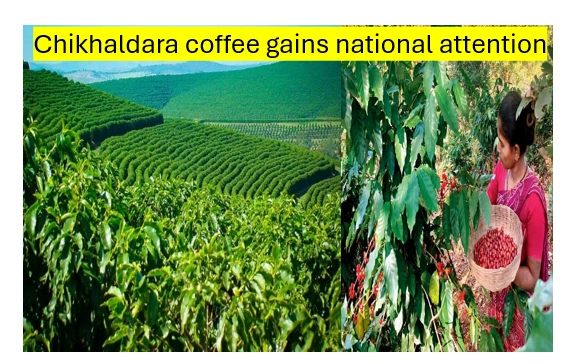

Amid the wavy clouds of Satpura hills, where the fragrance of damp soil and woods being tracked by tigers is in the air, there is a silent uprising in the air. The sole coffee growing area in Maharashtra, Chikhaldara is finally losing its label as the best kept secret of Vidarbha.
Chikhaldara coffee was made known in national country with a major government project announced by Alva Ediskar pewku gave by Chandrashekhar Bawankule, the Guardian Minister, on March 11, 2026. It is evident, whether it is the hills of Amravati or the cafe congested streets of Delhi: to make this tradition crop a household name, competing with the legendary beans of Coorg and Chikmagalur.
A Legacy Reawakening: British Officer to Tribal Cooperatives
History of Chikhaldara coffee has its origin and continues even to date due to the discovery made on these fertile mountains in 1823 by Captain Robinson whose army was the Hyderabad Regiment. The climate that reminded the British about cool autumns at their home country was suitable to coffee. The Deccan Coffee and Land Agency established structures by 1840 and Chikhaldara emerged as one of the biggest producer in the mid 19 th century.
But with the departure of the British and logistical difficulties, the industry became a local and virtually forgotten custom. The coffee remained there, in the decades, largely due to the actions of the Roman Catholic Mission and the small-scale tribal farmers. The brands such as Korku Coffee and Turf to Table are on the forefront of reclaiming this history.
The Flavour the Satpuras: The reason why Chikhaldara is different
The specialness of this coffee is not only its rarity, but the terroir of the Melghat area. The coffee is of grown at 700 to 1,188 meters of altitude where it is under a natural canopy of trees that helps shield the delicate Arabica and Robusta plants against the intense Vidarbha sun.
- Arabica Variety: Chikhaldara has an Arabica that is well-known due to its smooth texture with low acidity and is usually filled with subtle flavors of citrus, berries, and a shocking chocolatey end taste.
- The Umami Factor: The savory flavor of these beans has also recently been revealed by connoisseurs to be a factor of the rich forest soils and traditional sun-drying techniques on raised matters.
- Inter-cropping: A lot of farmers cultivate coffee, black pepper and pineapples together, which imparts beans with aromatic and spicy undertones rather subtly.
Local flavor combinations like the Melghat Midnight (vigorous dark roast) and Sipna Serenade (medium roast blend) are already commencing to captivate the taste buds of the specialty coffee lovers in Mumbai and Bengaluru.
Harvested with Humility: The Workers behind the Cup
To the Korku tribe, coffee is not just a crop but also a guarantee of stability to the farmers of the tribe. Previously, a large portion of Chikhaldara coffee was sold as raw, green beans or as filter coffee due to low cost since the farmers did not have the facilities to sell high-quality coffee.
The new scheme that has been introduced by government is aimed at transforming this by coming up with Coffee Processing and Manufacturing Units in the region. The initiative is making laborers artisans through training the young people on tricks such as cupping, roasting and professional brewing.
Read also: 9 greatest tribes in India and their distinct cultural characteristics
An intelligent plan: Tourism and International fame
The demand to achieve national recognition is well-timed with the introduction of the national brand Bharat GI. Because five other Indian coffees (such as Coorg and Araku) have already been given Geographical Indication (GI) tags, Chikhaldara is now in the fast track of obtaining its own tags.

A versatile writer mainly works on trending news, daily updates from politics, business, crime, current affairs and entertainment.