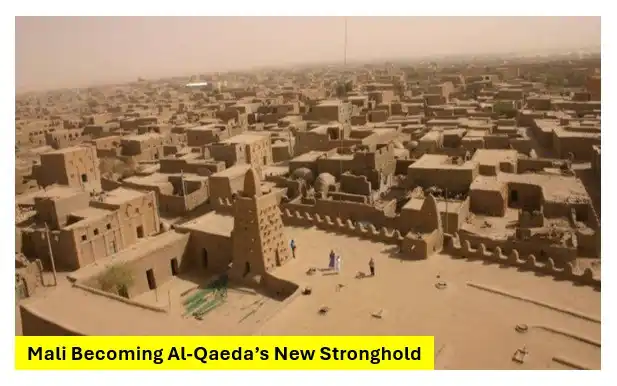

The situation in Mali needs to be dealt with right away, even though everyone is focused on the Persian Gulf. For a while, the market seemed to show that people of different faiths and beliefs could live together.
In Bamako, there are markets behind the Friday mosque where you can buy prayer beads, the Quran, and horns, skulls, and quills of wild animals that are used in folk religion along with medicinal herbs and betting slips for French horse races. The street then goes around and back to the National Assembly and the offices of 107.4 FM, which is the state-run radio station Radio Islamique de Bamako. In 1991, Lieutenant-Colonel Amadou Touré led a coup that got rid of both dictatorial government and the broken socialism that had made Mali, a landlocked country in West Africa, one of the poorest countries in the world.
Fighting across the Sahel, terrorists from Jama’at Nusrat al-Islam wal-Muslimin
Fighting across the Sahel, terrorists from Jama’at Nusrat al-Islam wal-Muslimin (JNIM), which is run by Al-Qaeda, beat Mali’s small army and its Russian military forces last week in the city of Kidal in the north. Bamako has been under siege for months.
Even as Islamists tightened their control over the city, the International Criminal Court said it would pay $8.4 million to 65,000 people who were hurt by violence in 2012 by groups that were not JNIM. Twenty-three thousand people have fled Timbuktu, the city where the worst crimes happened, because it has been under attack since 2023. Last week, flights to the city were stopped.
read also:
- Iran’s Foreign Minister Araghchi is going to Beijing
- Why France didn’t vote in the UN on payments for African slavery
- The United States wants to break China’s drone dominance
Not paying attention to the ball
The Persian Gulf is getting all the attention of the world, but Mali is in serious trouble and needs immediate help. This is the first time since the fall of Kabul in 2021 that a terrorist group is close to taking control of a nation-state. France sent troops to Mali in 2012, and after ten months of fighting, jihadists were driven out of Timbuktu. JNIM hid out in the desert and waited. In 2021, there was another coup, and French troops left Mali. The Russian soldiers that came in to replace them were cruel and didn’t do their job.
For decades, signs of a new problem have been clear
There had been warning signs for decades. The researcher Benjamin Soares saw the first public sign of Islamist pressure around 1992. It said, “In the name of God, the Compassionate, the Merciful,” and it asked the management to stop promoting and showing pornographic films. If not, we’ll break into the movie theatre and steal everything we can find.
Every Friday, speakers on Radio Islamique would be very angry about the opening of casinos and places where couples could rent rooms by the hour, as well as the choice to let bars and restaurants stay open during Ramzan.
Then, influenced by Pakistani Tablighi Jamaat teachers, a member of the Tuareg rock band Tinariwen gave up his clothes, Rolex, and instruments in favour of a Kalashnikov. That person, Iyad Ag Ghali, is now leading the Islamist movement in the Sahel to the brink of success.
The desire to be a messiah
This kingdom started with a dream, like all of them. Late one night, while reading an account of the Prophet Muhammad, the preacher Al-Hajj Umar ibn Said al-Futi al-Turi had a vision: he would become, as he wrote, “The Muhammad of the Sudan,” bringing the Fula people together as a great country and making Islam pure again. He thought that the Fula of the Sahel were like the Arabs before Islam: they were inconsistent in their faith, believed in animist beliefs, and were split up by group feuds. Jihad would save them, just like it saved the Arabs.
From 1849 until his death in 1864, Umar built a kingdom that spanned about 2,500 km², from Dinguiray in the west to Timbuktu in the north and from Ségou on the banks of the Niger in the south.
Around the year 800 CE, traders brought Islam to the area. They came looking for pearls, ostrich feathers, slaves, and gold mines, which provided two-thirds of the needs of the medieval world. The religion became a part of everyday life and gave people access to trade and credit networks that had an impact from Europe to Africa. In the year 1324, Islam became the official faith of the Mali kingdom.
The Sahel had been a single area for a long time because of big powers. Traders looking for ivory, ostrich feathers, slaves, and gold—which met about two-thirds of the needs of the medieval world—brought Islam to the area around the eighth century. Over the next few hundred years, the faith spread and opened up trade and payment networks that reached from Africa to Europe.
Mansa Musa was the most Islamic leader of the Mali empire. It was during his famous trip to Mecca in 1324 that the kingdom was known to the rest of the world. The new leaders of Mali said they were related to Bilal ibn Rahbah, who was mentioned in the Quran and was sometimes called Bilal al-Habshi. Bilal was a former slave who held a high position of trust under Muhammad.
At the end of the century, the French troops would put up the heads of Tuareg fighters in the streets of Timbuktu.

A versatile writer mainly works on trending news, daily updates from politics, business, crime, current affairs and entertainment.