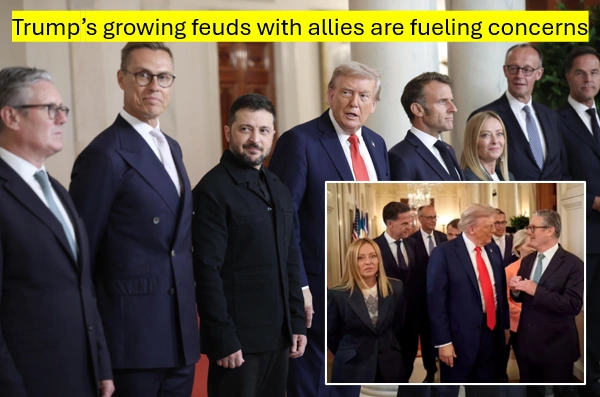

Trump’s treatment of the Iran conflict, army reductions, and disagreements with NATO and Gulf partners are making people worry that the war could hurt America’s global relationships in ways that last longer than the war itself.
After weeks of fighting, the US and Iran are slowly moving toward a possible de-escalation. However, experts warn that the war may have more long lasting effects on diplomacy than on the economy or military.
More and more, President Donald Trump is getting angry with traditional friends in places like Europe, the Gulf, and the Indo Pacific. This has made people even more afraid that Washington is becoming an uncertain security partner at a time when the world is becoming less stable.
The conflict with Iran started when the US joined Israeli attacks on Tehran at the end of February. It has already caused problems with energy supplies worldwide, shaken financial markets, and worsened political rivalries. But the way Trump has handled the situation has also shown that the US led alliance system that has underpinned Western security for decades is becoming increasingly fragile.
By threatening to reduce the number of troops in Europe and playing down Iranian attacks on Gulf partners, Trump has made friends even more worried that US security promises may not be reliable anymore.
Europe is scared as Trump puts more pressure on NATO partners
Washington and European cities became very angry with each other after Trump said he was going to pull 5,000 American troops out of Germany because Chancellor Friedrich Merz had publicly criticized him over the Iran conflict. The Pentagon also scrapped a plan to send Tomahawk cruise weapons to Germany, which shows that NATO is under more and more pressure.
Trump has long criticized NATO countries for what he sees as not spending enough on defence and not helping the US troops enough. During the Iran war, these complaints came up again, but this time they were more aggressive because some European countries allegedly refused to let the troops in and help with logistics.
The White House said that some partners had not fully supported US actions. Trump himself made it sound like Washington might not always be committed to NATO’s Article 5 mutual defence rule.
As if the economic effects of rising oil prices from Iran blocking ships through the Strait of Hormuz weren’t bad enough, European governments are now working even harder to improve their own defence unity and depend less on the US military to protect them.
Analysts say that the situation in Iran has stoked a debate in Europe about “security autonomy,” which means that Europe may need to protect itself in the future without always having US support.
At the same time, European leaders are still limited by their need for American threats against Russia, which means that a full strategic break is not likely to happen any time soon.
Read also: China opens its market to Africa with no tariffs, while Trump pushes for new import taxes
As Washington plays down Iranian strikes, tensions rise in the Gulf
The stress goes beyond Europe. Gulf Arab states, especially the United Arab Emirates, are also worried about how Washington will react to threats from Iran during the war.
Attacks by Iran using missiles and drones on the UAE, including ones that burned down buildings near the Fujairah oil port, caused worry in the whole area. But Trump played down the events in public and kept saying that the peace with Iran was still in place.
For Gulf friends who count on US security promises a lot, the reaction made them wonder how far Washington would go to protect partners in the area in future crises.
The doubt was worsened by Trump’s shifting views on Project Freedom, the planned US Navy operation to allow commercial ships through the Strait of Hormuz again after Iran imposed limits on it.
The plan was put on hold for a while when Saudi Arabia and Kuwait restricted US military use of their airspace and facilities. This showed how little support there was in the area for stepping up the pressure on Iran. Even though the limits were later lifted, possibly allowing the operation to continue, this event showed that Gulf countries are becoming more wary of getting deeper into a fight.
Read also: Why did Cole Tomas Allen go after the Trump dinner? Figuring out the shooter’s goal
Allies and enemies in the Indo Pacific region reevaluate American power
The political consequences can also be felt in Asia, where American friends like South Korea and Japan are increasingly doubting Washington’s strategy’s stability.
Because of the Iran war, the US had to move its military from the Indo Pacific to West Asia. This made people worry about America’s ability to both scare China and handle problems elsewhere in the world. Along with Trump’s tariffs and repeated criticism of partnership agreements, the fight has made Asian partners even more worried about the US’s long-term obligations.
To protect themselves from instability in Washington, Japanese leaders have talked freely about boosting links with other middle powers, such as Britain, Canada, Australia and European countries.
At the same time, China and Russia look ready to take advantage of the strategic gaps created by unease among allies. Higher energy prices worldwide have been good for Moscow’s economy, while Beijing has sought to present itself as a more stable and reliable partner.
Analysts of strategy say that the US’s partners are no longer just worried about one fight. Instead, Trump’s approach to Iran has made people even more skeptical about whether America still sees allies as long term strategic pledges or more as short term relationships based on instant political and economic calculations.

I am a versatile content writer from the MP region, covering politics, business, crime, current affairs, entertainment, video games, and sports with clear insights, engaging analysis, and timely, reader-focused updates.









