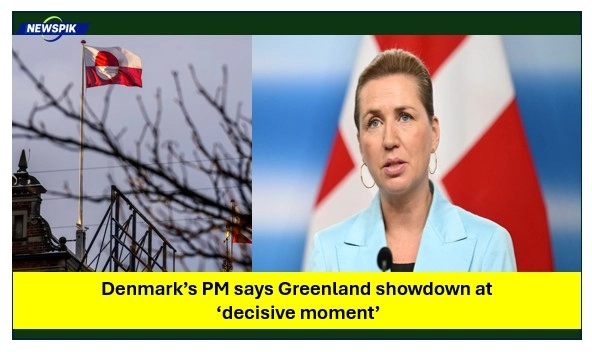

In a week that has seen the Western alliance rocked to its core, Danish Prime Minister Mette Frederiksen has said the Kingdom of Denmark is at a “crossroads,” and we are at a “decisive moment.” In comments to an audience of American think-tank leaders and journalists on January 11, 2026, just before high-stakes meetings in Washington, Frederiksen said that the diplomatic confrontation over Greenland has gone from a quirky real estate dream to an outright assault on international law and the future of NATO.
The flare-up of tensions follows the chillingly clear statement by US President Donald Trump that he has now taken a renewed interest in the Arctic territory, saying to the U.S would act “whether they like it or not” and not ruling out doing so “the hard way”—in other words through military force.
‘A “Fateful Moment” for the Western Alliance
For Frederiksen, the stakes of this confrontation go far beyond the borders of the world’s biggest island. In a contentious exchange with Danish political leaders, she described it as a “conflict over Greenland” that strains the conventional meaning of modern alliance-hood.
“We stand in a critical situation and have a serious moment,” Frederiksen told the nation. Her worry reflects a significant change in American foreign policy. If the United States — a founding member of NATO — starts to threaten the territorial integrity of allies, this could “bring the whole order that we have developed in
The language around “decisive moment” spoken by Prime Minister Johnson is a reminder to the rest of the world: if a superpower can decide unilaterally what happens to another sovereign territory held by an ally, then every small nation is no longer safe under this order of nations.
What Trump Wanted for Greenland and What It Means for the US
The “Hard Way” vs. Sovereignty
The infighting came to a head in response to recent remarks from Trump that the U.S. “needs” Greenland for national security. The White House cites increasing Russian and Chinese military activity in the Arctic as a reason why America should control Greenland’s strategic landscape and its enormous, untapped mineral wealth.
Yet, the leaders of Greenland and Denmark have remained united in their refusal.
Greenland’s Position: Prime Minister Jens-Frederik Nielsen, writing with the leaders of all five major political parties in Nuuk submitted a straightforward joint statement: “We don’t want to be Americans, we don’t want to be Danes, we want to be Greenlanders.”
The Right to Self-Determination: Frederiksen has reiterated the notion that it is for Greenland and Danes to decide the future of Greenland.
Europe Rallies Behind Copenhagen
With Danish Foreign Minister Lars Løkke Rasmussen and Greenlandic Foreign Minister Vivian Motzfeldt heading today to Washington to meet U.S. Secretary of State Marco Rubio, they’re riding a huge wave of European backing.
But now, in a rare display of continental unity, leaders from France, Germany, Britain, Italy and Poland have signed a joint letter defending Greenland’s sovereignty. Swedish Prime Minister Ulf Kristersson issued a strongly-worded statement expressing “serious concern about the threatening rhetoric from the White House” and describing a potential US military occupation as nothing short of a “key violation of international law” that could pave the way for global instability.
The friction can be felt even within NATO’s military hallways. Nato’s Supreme Allied Commander, General Alexus Grynkewich, added that “there is no immediate threat to any Nato territory”, but he admitted that “healthy conversations” about the status of Greenland are being held at the North Atlantic Council in Brussels.
The Raw Materials Scramble
More and more, outside of military strategy, the “showdown” concerns the future of the world economy. As the Arctic ice melts, Greenland’s stocks of rare earth minerals, oil and gas have turned into the modern equivalent of gold.
The U.S. is eager to lock in these resources as a way to lessen its reliance on Chinese supply chains. Denmark and the EU, by contrast, see Greenland as a key partner for their own green energy transition. Frederiksen’s “decisive moment,” however, also evokes this economic tug-of-war — will the Arctic be a zone of international cooperation or a 19th-century-style resource grab?
What Happens Next?
The world is watching, now in the direction of Washington. The rhetorical war could well cool off or move to the ”showdown” phase following meetings between the Danish-Greenlandic delegation and Marco Rubio.
Volker Tuereci, whom the Danish prime minister had “sold to” US President Donald Trump as a part of his country, said Frederiksen was not truly offended and Denmark wants dialogue but won’t be bullied into selling land. As she rightly said, “it’s what’s right and it’s what is wrong” — and soul of the North can’t be bought.

I am a versatile content writer from the MP region, covering politics, business, crime, current affairs, entertainment, video games, and sports with clear insights, engaging analysis, and timely, reader-focused updates.









