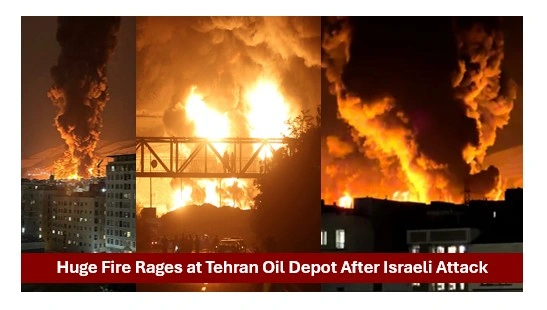

And on Sunday, March 8, 2026, the horizon over Tehran was not only burning; it was bleeding. The sky above the Alborz Mountains was black, most of the time dreadful indigo, but in the sky a fierce and toiling orange flame flashed through; and towering columns of fire shot out of the Shahran and Shahr Rey oilfields. In 2026, after a terrible week of Operation Epic Fury, the war between Israel, the United States and Iran has hit a terrifying new low: the methodical destruction of the oil core of the state.
To the people of Tehran, the technicality of military infrastructure and surgical strikes comes out empty. The sound was not to them a report on a news ticker; it was a rhythmic beat of thuds shaking windowpanes and pushing children screaming into hallways. This was no assault on a regime, it was the night that the lights, and the warmth, of a city had started to flicker.
A City Under the Shadow of Fire
The Israel Defense Forces (IDF) confirmed that the strikes were aimed at storage complexes of fuel used by the Iranian military but the strikes occurred on several locations at the same time. The Shahran depot in the northwest and plants in the refinery complex in the south were reduced to huge pyres. Although the Iranian Ministry of Oil was fast to point to the fact that the refineries have been untouched and that fuel stocks were not run out, the columns of opaque smog declared otherwise to the ground-based observers.
It was as though the sun coming up in the south at midnight, said Amin, a 34-year-old shopkeeper who ran out of his apartment in the Shahran depot. The warmth… you could smell it on your face ten blocks distant. We are no longer thinking about politics or the Supreme Leader. We are wondering whether we can cook to-morrow or not, or whether the air we are breathing will kill us before the missiles will.
The human cost of this growing shadow war is getting too hard to disregard. Only a few days after a fateful attack on a girls school in Minab that killed more than 150 people, a case to which the US and Israel have exchanged the blame with Tehran, the sight of civilian-neighbouring infrastructure in flames has pushed the local people to a boiling point.
Also read: Middle East Erupts as Israel and the United States Strike Iran
The Strategy of Attrition
In military terms, the attacks signify a change in the Israeli-American thinking. The coalition is expected to cripple the logistics of the oil depots of the Islamic Revolutionary Guard Corps (IRGC) by attacking the depots. According to the IDF, these tanks are its direct and frequent fuel sources of the military apparatus launching drones and missiles on Israel and US bases in the Gulf.
In a speech made on Saturday, Prime Minister Benjamin Netanyahu cast the strikes as a liberation and urged the Iranian people to understand that they are close to the moment of truth. But in the small streets of Tehran, where acrid fumes of blazing diesel fill the air, the discussion of liberation seems remote. Rather, an increasing feeling of isolation is experienced.
Read more: Iran bombs oil refinery in Bahrain
Between Revenge and Survivance
There are rumors of a wilderness of seeking de-escalation though the attacks were ferocious. In a rushed television speech, President Masoud Pezeshkian apologized to the Gulf countries on the misunderstanding that had resulted in the Iranian missiles striking their lands. He gave an indication that he was willing to revert to diplomacy, but his voice was apparently drowned out by the more radical elements of the Revolutionary Guard that are still threatening to bring the US bases to a complete ruin.
The war is a nightmare in geopolitics to the international community. It is an emotional and logistical one to the people of Tehran. The Grand Bazaar, which is normally a beehive of business people, has had their numbers reduced. There is hoarding of limited resources available to people e.g. dry goods, water, and portable heaters because the fear increases that the power grid will be the next item of surprise offered by Netanyahu.

I am a versatile content writer from the MP region, covering politics, business, crime, current affairs, entertainment, video games, and sports with clear insights, engaging analysis, and timely, reader-focused updates.