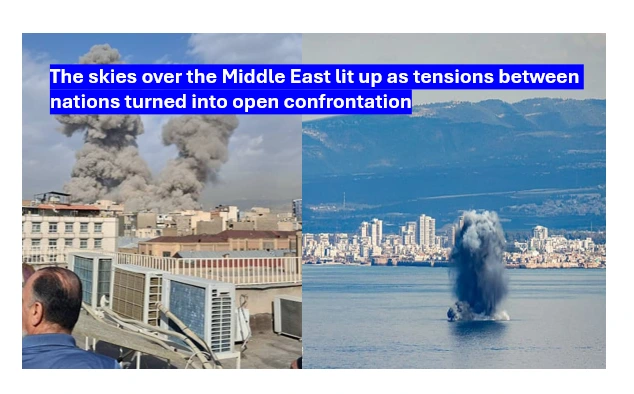

Overnight, Israel began what it called a preemptive strike against Iran, and the US confirmed that it had joined the operation. This was a big military escalation. There were reports of strong blasts in Tehran, the capital of Iran, and several other towns. This was one of the most important direct battles between the long-time enemies.
Officials in Israel said the operation was meant to weaken Iran’s nuclear and ballistic missile capacities. The army leaders of the country said that the move was needed to stop what they called an imminent threat. Washington revealed soon after the strikes started that US troops were taking part in what it called a large-scale military operation aimed at key sites.
As the first wave of strikes hit, air defences were activated across many parts of Iran. State media in Tehran said that the storm had many effects in cities, and the government told people to stay inside. Several airports in several towns stopped planes due to safety concerns.
Iran fires back with missiles and drones
Within hours of the first attack, Iran began rocket and drone strikes in response. In many Israeli towns, sirens sounded to warn people to seek cover. The Israeli forces said that rockets were being stopped by their air defence systems.
Also, missiles were fired at US military bases in Gulf states like the United Arab Emirates, Bahrain, and Qatar. Officials in those countries said they activated their air defence systems to protect their skies from threats. In some places, debris fell after captures, leading to emergency responses and tighter security.
In Israel, the government shut down schools and limited big public meetings. In some areas, some types of public transport were temporarily stopped as a safety measure. Across the country, hospitals were put on emergency alert in case someone was hurt.
Closures of airspace and problems in the region
The increase caused problems right away all over the Middle East. Several countries temporarily shut down their airspace, which caused many flights to be cancelled and foreign travel to be rerouted. As the security situation got worse, major companies stopped flying to and from the affected areas.
Because of worries about wider unrest, shipping lines in some parts of the Gulf were also watched more closely. The events had a significant impact on energy markets, raising concerns that the fighting might last longer than expected and affect oil exports from the area.
In many cities, security forces stepped up checks around foreign offices and important assets. Travel warnings were issued by governments, advising people to stay put and closely monitor official reports.
World leaders want to de-escalate the situation
World leaders quickly spoke out against the strikes. European countries, such as France, Germany, and the UK, asked both sides to remain calm and prevent the situation from worsening. Statements stressed the need for international action to prevent the situation from escalating into a broader war in the region.
Russia spoke out against the strikes and said they were destabilising. They also asked for a quick end to the fighting. As worries grew that the war could last for a long time, international groups started meeting in an emergency.
There was no announcement of an instant truce, and both sides made it clear that they were ready to keep fighting if needed.
Read also: Trump tells Netanyahu Iran nuclear talks must continue
Civilians Get Ready for Long Term Uncertainty
Aside from the armed conflict, citizens in the area are facing increasing insecurity. In Iran, emergency services worked all night in the towns that were hit, while officials assessed the damage to the infrastructure. State television said that people had been killed, but exact numbers could not be proven right away.
Millions of people in Israel spent hours in bunkers as the alerts went on all day. Officials told people to stay alert and get ready for more missile fire. People in the Gulf states said they felt safer and could see the troops in key places.
Even though diplomatic lines are still open, the situation is still very unstable because of the ongoing retaliation strikes. Israel and the US working together to take action has made a big difference in the tensions in the region, and there are worries that things could get worse in the next few days.
As fighting between the two sides continues and pressure from around the world grows, the Middle East is at a very important juncture. There is a big chance that things will get worse, which could affect a lot of people.

A versatile writer mainly works on trending news, daily updates from politics, business, crime, current affairs and entertainment.









