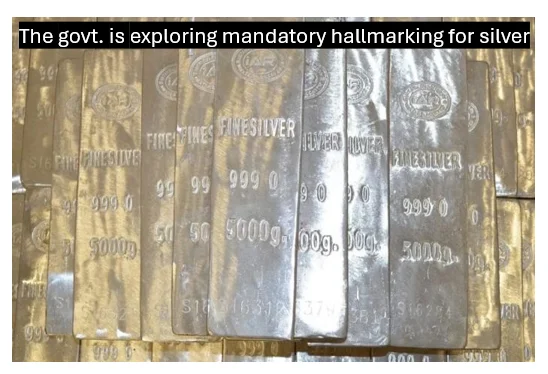

A study from Koan Advisory says that infrastructure gaps could hurt small businesses and artists, and suggests that the industry will take three to five years to adjust.
As the government prepares to make silver hallmarking mandatory, a new report from a public policy firm in Delhi highlights several economic and practical problems. The report suggests that the industry should have three to five years to change.
On the 79th anniversary of the Bureau of Indian Standards (BIS) in January of this year, the director general told reporters that BIS planned to make silver hallmarking mandatory, but that the date had not yet been set.
When valuable metals are hallmarked, it’s a promise that they are pure or fine, which helps people avoid scams. Since 2021, BIS has made hallmarking gold a must. Since 2005, however, hallmarking silver has been optional.
In September 2025, the BIS required that freely hallmarked silver items have a unique identity (HUID). This is a six-digit numerical code that can be used to identify and track any piece of jewellery.
What Does “Mandatory Silver Hallmarking in India” Mean for the Indian Economy and Business?ThePrint got a hold of a Koan Advisory study that said: “While industry stakeholders support the goal of improving transparency and consumer protection, making hallmarking required for silver jewellery and artefacts could create significant operational and economic challenges.”
The study also highlighted major gaps in the current hallmarking system that could make it easier to switch from gold to silver hallmarking.
India, for example, only has about 230 BIS-recognized Assaying and Hallmarking Centers (AHCs) for silver jewellery, but 1,622 AHCs for gold jewellery.
From 2021 on, India made gold hallmarking a law. It has worked really well, and problems with fake baggage have gotten a lot better over time. The purity of gold is shown by its carat weight. 24 carats is 99.9 percent pure gold.
Data from the Koan study shows that AHCs are only found in about 90 of India’s approximately 800 districts, which is about 10% of the total number of districts. A lot of industrial and retail groups will have to rely on centers in faraway districts as a result.
According to the Koan report, “Given the operational success of mandatory gold hallmarking, which now covers almost half of all Indian districts, it is logical for the government to consider expanding it to silver, since silver is a popular metal for jewellery and artefacts and has much lower unit costs than gold or platinum.”
Economically possible
The study says that the economics of making silver jewellery are very different from those of the gold market.
According to government figures, India will use up to 7,000 tonnes of silver each year. In contrast, the country will need 600–700 tonnes of gold in 2026.
About 20 to 30 percent of silver is used in industry, and another 20 to 25 percent is kept as metal to be invested in. The last 3,500 to 4,000 tonnes are used to make silver jewellery, objects, coins, and other similar items.
About 700 tonnes are made in the United States, and the rest are brought in from places like Mexico, China, Argentina, and Chile.
read also
- How did gold and silver price change in the past week?
- Silver Prices Crash After Record Rally, Investors Reassess Buying Strategy
India, on the other hand, uses about 800 tonnes of gold every year, the study says
According to the study, silver is also less thick than gold. This means that 10 times as much silver is used annually as gold.
Given the large number of light silver items on the market, it suggests that at first, items weighing less than a certain amount should not be required to be hallmarked.
The answers to our industry study show that a lot of silver necklace items are between 5 and 10 grams, which means that the cost of hallmarking each piece is a big part of the value of the item, the report says.
The study also says that most silver items cost between Rs 300 and Rs 2,000, and a lot of them are very light, weighing less than five grams. The study says that the Rs 50 per piece hallmarking fee, along with the costs of shipping, packing, and handling, makes up an unfairly large part of the value of a light item that costs Rs 500.
It would also be hard for stores to manage their highly spread product networks if they had to follow mandatory hallmarking rules.
The study also says that many silver shops keep stock in a lot of different stores, regional warehouses, and third-party transportation facilities in many different places. Stock is often moved between sites based on demand.
The study says that in order to do this, a lot of goods would have to be gathered together, sent to centers for testing and marking, handled, and then sent back out to the network.
Vedika Pandey, who helped write the Koan study, told The Print that the large number of current AHCs for silver might make the switch take longer than planned. She suggested that the government give silver makers three to five years to get used to the new system and set up an Industry Study Group to help with the shift.

A versatile writer mainly works on trending news, daily updates from politics, business, crime, current affairs and entertainment.