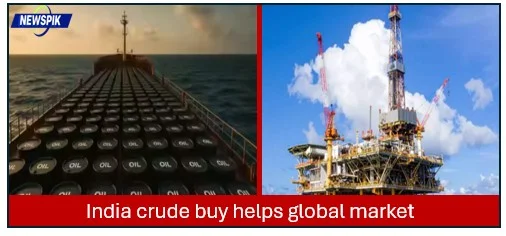

In the high-wire arena of global energy, few tales are quite as complicated — or quite as regularly misunderstood —as that of the oil trade between India and Russia. In early February 2026, the Kremlin made a point that often gets drowned out in the fuss of geopolitical news: India’s enduring purchase of Russian crude is not just a bilateral business deal but an essential anchor for the global energy market as a whole.
Kremlin official Dmitry Peskov and Russian Foreign Ministry spokesperson Maria Zakharova have both made a point to say this relationship is “of mutual benefit” and that it ensures stability in the international market. Though the political rhetoric around this trade can get hot, the economic reality is rooted in a delicate balancing act between suppliers in Europe and India that keeps price shocks from reaching consumers from Mumbai to Munich.
The Stabilization Effect: Avoiding a Global “Price Explosion”
To see why Russia would say India is helping the world, one needs to consider what would happen if India did not do so. As the third largest oil consumer in the world, India needs an enormous and steady supply of crude to keep its economy — and aspirations for a 5 trillion GDP — humming.
When sanctions from the West began to impact Russian exports in both 2022 and 2023, there was a genuine concern that millions of barrels of Russia’s oil might simply disappear from the global supply. Had that oil been “locked in,” world prices (Brent) could as easily have headed to $150 or even $200 a barrel. Instead, Indian refiners moved in to redirect the flow of Russian Urals crude.
India stopped a global shortage event by drawing down that supply itself. It was this “rerouting” that help ensure the global supply-demand curve remained in balance, according to Russian energy experts. In effect, India functioned as a giant pressure-relief valve for the global economy. By purchasing Russian oil, India opened up other sources — such as Middle Eastern and American crude — for countries no longer willing or able to trade with Moscow, helping stave off a bidding war that would have crushed developing nations.
The Refinery Reality: The Importance of Technical Specs
Whether in the naughty corner or not, Indian officials believe they can shop around and replace one oil with another, as if types of oil were as interchangeable as brands of bottled water. Some Russian energy analysts, such as Igor Yushkov of the National Energy Security Fund, have recently noted that this is an industry with its very human technical “human” side: Refinery Compatibility.
- Russian Urals: Usually a medium-heavy, sour crude that Indian refineries are ideally configured to handle.
- U.S. Shale: Predominantly light, sweet crude.Fields such as Eagle Ford in Texas lead production of light sweet crude.
For an Indian refiner to abruptly flip 180 degrees, making the wholesale switch from Russian to American crude is no mere political decision; it’s a huge engineering task. It would mean switching chemical “recipes,” which could raise the cost of refining and reduce the output of certain products, like diesel. India’s flows of Urals crude keep big refining hubs, including those in Jamnagar and Vadinar, running at full tilt — which helps ensure that global supplies of petrol and diesel are not disrupted.
The “Trump Factor” and Sovereign Interests
The conversation had taken an extraordinary twist in February 2026 after the U.S. administration claimed that Prime Minister Narendra Modi capitulated to a “historic” shift from buying Russian oil to get lower trade tariffs. But the Kremlin’s reply was surprisingly restrained. “We have always considered India as a sovereign nation with its foreign policy pursuing national interests and reckoned that India, as any other country in the world, has the right to buy whatever it deems good or necessary for its economy,” Kremlin spokesman Dmitry Peskov said.
Conclusion: Stability in the world is balance
The Russian claim that India contributes to the balance of power in the world is not mere diplomatic flattery. It reflects a recognition of India’s role as a “stabilizing consumer.” In a world where geopolitics is volatile, India’s practical politics leaves energy a commodity instead of an armament. By keeping the oil flowing, India is not only fueling its own trains and factories; it’s also providing a rare cushion to the world economy amid the daily cascade of bad news.

A versatile writer mainly works on trending news, daily updates from politics, business, crime, current affairs and entertainment.









