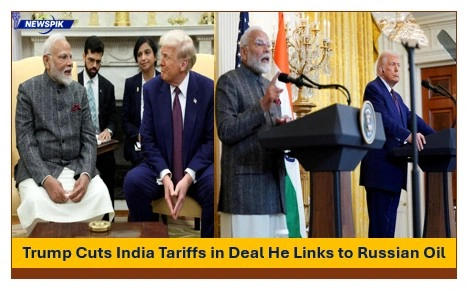

In an abrupt move that has rocked global markets and re-scrambled the way we thought about “art of the deal” diplomacy, President Donald Trump has announced sharp cuts in tariffs on a variety of Indian exports. The economic impact for New Delhi is huge, but it’s the geopolitical “why” that has people talking. In a typical example of transactional diplomacy, the President has directly tied this trade liberalization to the question of India’s continual participation in the global energy landscape – in particular, its import and processing of Russian crude oil.
This isn’t just a regular trade deal; it is a high-stakes recalibration of how the United States treats it relationships with the world’s most populous nation and its most sanctioned energy exporter.
The Heart of the Deal: What’s at Stake?
The details of the deal are aimed at some of the key areas that have long been irritants in the relationship between Washington and New Delhi. Indian exporters of steel, aluminum and some agricultural products have struggled for years to gain access to the American market. The tariffs are expected to be more than halved, from 8.5% to under 3%, according to Indian trade ministers who have heralded the proposed cuts as a “new dawn” in relations between the two countries.
In return, India has committed to reduce its own protective duties on top-of-the-line American electronics, Harley-Davidson motorcycles and some dairy products. Yet the heart of the deal is in energy.
The Russian Oil Linkage
“The most interesting and controversial part of this news is Trump admitting that India imports energy from Russia. Instead of continuing the old administration “quiet pressure” or threat-of-secondary-sanctions strategy, Trump has adopted a “management” approach.
The thinking seems to be: If India keeps buying Russian oil, which will otherwise keep global energy prices in check and prevent a big price spike, it should do so in a manner that serves the broader American strategic interest elsewhere.
Trump slaps tariff on Iran’s trade partners. How will it impact India?
Why Now? The Strategic Rationale
To make sense of this move one needs to view the world from the perspective of the current administration’s “America First” realism. Trump has often said high energy prices are the “silent killer” of the American middle class.
- Global Supply Stability: If India abruptly stops importing Russian oil, then the global supply would constrict and gasoline prices at American pumps would likely explode.
- Decoupling From China: The United States is doubling down on its “friend-shoring” strategy with India by wooing it through trade concessions. The hope is that pharmaceutical and tech component supply chains will be moved out of Beijing, into Mumbai and Bangalore.
- Policy Purpose: Tying trade to energy gives the U.S. a chair at India’s energy planning table and creates a foothold for future American LNG (Liquefied Natural Gas) exports as India upgrades its infrastructure in the years ahead.
India–US Trade Deal: How the Needle Has Moved in Bilateral Trade
The Human Toll: From Mumbai Factories to Midwest Fairs
Beyond the desiccated numbers in trade deficits and macroeconomics, this deal has a very human face. In the industrial pockets of Gujarat and Punjab, SMEs which produce special steel products are now back in demand for the American market.
“We had to price ourselves out of the U.S. market for years because of the 25% surcharge,” says Rajesh Mehta, a manufacturer in Pune. This reduction means, instead of hiring less workers and working with old machines.
Instead, in the U.S., consumers could see a reduced cost of such products that are dependent upon Indian raw materials. From rebar used in infrastructure projects to the chemicals found in everyday household goods, a repeal of these “invisible taxes” (to use Trump’s own term) is supposed to have the effect of cooling off inflation.
Making Sense of the Controversy: Critics and Defenders
The agreement has its critics. Critics of the administration both among human rights advocates and more traditional national security hawks in Washington say this move is effectively placing a “blessing” on India funding the Russian economy during a war.
Trump Imposes 10% Tariff On Denmark, UK, France For Opposing
What lies ahead: The Indo-US Relationship Next Stages
And the way the U.S. engages “middle powers” has been redefined as a result of this deal. It presages a future in which foreign policy is less about shared ideology and more about shared balance sheets.
And now, attention turns to the flow of tankers from the Baltics down to the Indian coast and then through the Strait of Malacca; and to the flow of shipping containers from Chennai back westward across that ocean all the way to Los Angeles. If it works, Trump will have also anchored a base for steady energy production and created an enormous new market for American goods. Failure may complicate the U.S. moral standing on the world stage when it comes to international sanctions.
But regardless of the outcome, one thing is clear to me: business as usual diplomacy is over.SOM has been replaced by a gritty world of transactional politics, in which oil, steel and strategy are fundamentally interconnected.

I am a versatile content writer from the MP region, covering politics, business, crime, current affairs, entertainment, video games, and sports with clear insights, engaging analysis, and timely, reader-focused updates.