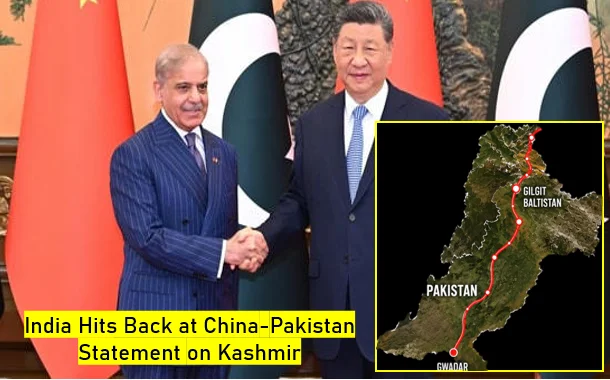

India harshly criticized China and Pakistan’s most recent joint statement on Tuesday, denying that it had anything to do with Jammu and Kashmir. The Ministry of External Affairs (MEA) said that what the two countries said was unwarranted. They also said again that Jammu & Kashmir and Ladakh are vital and unalienable parts of India.
Shehbaz Sharif, the prime minister of Pakistan, went to Beijing and met with Chinese President Xi Jinping and Premier Li Qiang. This led to the response. The Kashmir issue was raised again in the joint statement issued after the meeting, which also called for greater cooperation under the China to Pakistan Economic Corridor.
India replied strongly, sticking to its long held stance that other countries have no right to comment on India’s authority and territorial integrity.
India Raise Concerns About CPEC Route
India was also very against the increased push for the China to Pakistan Economic Corridor, even without bringing up Kashmir. India thinks that Pakistan is unfairly occupying land that is being used for CPEC projects, according to the MEA.
As part of the Belt and Road Initiative, CPEC is one of China’s most important building and transportation projects. The corridor comprises a network of roads, rail lines and energy projects connecting Xinjiang, China, to Gwadar, Pakistan.
India has been against the project for a long time because parts of it go through Kashmir, which is controlled by Pakistan. New Delhi has always said that any building or improving facilities in the disputed area is an attack on India’s sovereignty.
China and Pakistan’s most recent statement emphasized accelerating CPEC’s high quality development and facilitating greater regional connectivity. Both countries also discussed improving the Karakoram Highway and further enhancing Gwadar Port.
Read also: China and Pakistan Offer 5-Point Peace Plan to Stop Iran War and Protect Key Oil Route
Pakistan and China Reaffirm Their Strategic Partnership
China and Pakistan discussed the closeness of their military ties during talks in Beijing. President Xi Jinping of China said that the relationship between China and Pakistan was unbreakable and that Pakistan was a all weather strategic partner.
It was decided that the two countries would work more closely together on infrastructure, agriculture, security, and AI. Pakistan also promised China that Chinese workers and capital would be better protected after years of attacks by militants on Chinese citizens.
The joint statement also showed that both sides agreed on problems in the area and worldwide. Pakistan reiterated its support for the One China policy and China thanked Pakistan for its efforts to promote peace in the region.
Analysts think that Beijing’s increased focus on CPEC indicates it wants to make major investments in Pakistan again, even though there are concerns about security and economic problems. Gwadar Port remains an important part of China’s long term plans to connect the region.
Kashmir is still a very dangerous place to be
Since 1947, the Kashmir problem has been one of the main sources of conflict between India and Pakistan. India says that Jammu and Kashmir is an important part of the country, but Pakistan keeps bringing up the problem at foreign meetings. In shared official comments, China has also sometimes agreed with Pakistan’s point of view.
India has repeatedly denied these claims and said that both countries are meddling in its private matters. In the past, when China and Pakistan talked about Kashmir together or backed CPEC projects in contested areas, they had similar political conversations.
This is exactly what New Delhi is saying now. The government is saying again that the status of Jammu and Kashmir cannot be changed. Officials also made it clear that India doesn’t agree with any other country trying to change the rules in places that are controlled by Pakistan.
Read also: US-Pakistan relations may weaken India’s ‘muscular’ counter-terror response
Diplomatic tensions are likely to stay high
The most recent conversation shows that global conflicts are still high in South Asia, especially around Kashmir and plans to link the area. China and Pakistan want to work together more on economic and military issues, but India is still strongly against any action it sees as threatening its territory claims.
Experts say that the CPEC will remain a touchy matter for India since it goes through Kashmir, which is controlled by Pakistan. China sees the passage as an important part of its trade and influence plan in the area as a whole.
Since all three countries are sticking to their guns, political problems over Kashmir and CPEC are likely to keep coming up in regional politics.

A versatile writer mainly works on trending news, daily updates from politics, business, crime, current affairs and entertainment.