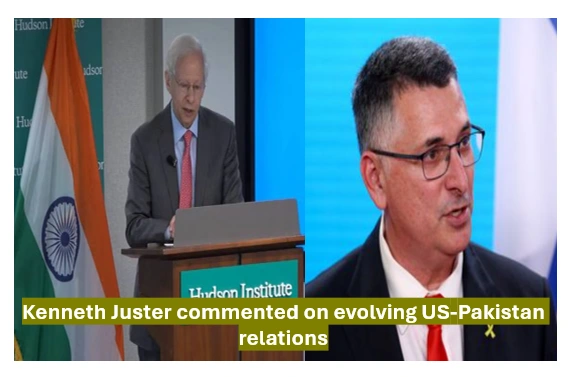

In a speech at the Hudson Institute, Kenneth Juster discussed China as India’s “biggest threat,” New Delhi’s growing foreign presence, and Prime Minister Modi’s efforts to connect with Indians living abroad.
As a result of President Donald Trump’s efforts to improve relations between the US and Pakistan, India may not need to be as “muscular” in its fight against terrorists in the future, says Kenneth Juster, a former US ambassador to India.
Juster said these things on Thursday at “The New India Conference” at the American right think group Hudson Institute. He was an ambassador from 2017 to 2021.
He said that the change could have real effects in the event of future disasters
“Because Pakistan has good ties with the US, India might not be able to respond as strongly to the next major terrorist attack across the border.” At the very least, he said, “Unlike other times, like when I was ambassador and there were the Pulwama and Balakot attacks, India may not be sure if the US will back a strong response to terrorist groups based in Pakistan.”
These words were made two weeks before the anniversary of Operation Sindoor, which was India’s response to the Pahalgam attack in Jammu and Kashmir on April 22, 2025, which killed 26 people.
Juster also said in his speech that many people were surprised by how close the US and Pakistan are becoming.
“On Pakistan’s successful courting of the Trump administration, which now includes being a go-between in the talks between the US and Iran, this is obviously annoying to India and a surprise to many of us,” he said.
Read also: India-US trade deal: White House revises fact sheet
“China is India’s biggest threat”
Along with changes in geopolitics, the envoy said that China is still India’s biggest danger.
Juster said, “China remains India’s biggest threat in the region.” He said that Beijing’s close ties with Islamabad were “a cause of great concern to Delhi.” India still wants to have a cautiously stable relationship with China, “even though it will never be a relationship of trust.”
India’s strong links with Russia are also due to its support for a multipolar world. Juster said that these are useful for many reasons, such as keeping defence supplies safe, getting energy, and keeping Moscow from getting too close to Beijing.
At the same time, he said that people in New Delhi were becoming more aware that “Moscow is a declining power” and that too much support for Russia could hurt relations with the West.
The ambassador said that India’s foreign reach has grown to include West Asia, Africa, Latin America, and Southeast Asia, in addition to its work with major powers. India is also a member of more and more multinational and “minilateral” groups.
He also said that Prime Minister Narendra Modi has built up the Indian community through big events held outside of India.
Juster said, “This is part of an effort to make people proud of their Indian heritage.” He also said, “It can have a positive effect on the policies of the host countries toward India, and I think it’s been hugely successful.”
A lot of what he said was about how India’s foreign policy has changed under Modi. He said it has become more aggressive and open.
“Modi has shown more self-confidence in reaching out to a wide range of countries around the world,” Juster said. “This has broadened India’s foreign policy and given it a greater sense of purpose in working with others.”
Read also: As Trump’s US Embargo Begins, Iran Warns of Retaliation Across the Region
India’s rise was still one of the most important events of the 20th century
He said, “India’s rise will be one of the most important geopolitical stories of this century because of its large population, market size, technological talent, and growing military.” He also said, “It’s in the best interests of both the United States and India for America to be a positive part of that story.”
Juster said that India now sees itself “as a civilisational power that wants to play an increasingly important role in world affairs.” His country has clear goals: to become a developed country by 2047 and to be a strong voice for the Global South.
Still, Juster talked about problems with India’s economic plan. He said that even though New Delhi wants to be a world power, it has been slow to join big trade groups.
India has not been ready to join a regional free trade deal so far, he said, pointing out that it had pulled out of the Regional Comprehensive Economic Partnership (RCEP) and was not interested in the Comprehensive and Progressive deal for Trans-Pacific Partnership.
He added, “If India stays outside of these regional frameworks, it will not be able to fully meet its goal of being a global supply chain hub.”
The Indian government pulled out of talks for the RCEP, a free trade deal with 15 other countries, in 2019 because it was worried that it would hurt the country’s trade balance and dairy industry, and because China was a threat.
I am a versatile content writer from the MP region, covering politics, business, crime, current affairs, entertainment, video games, and sports with clear insights, engaging analysis, and timely, reader-focused updates.