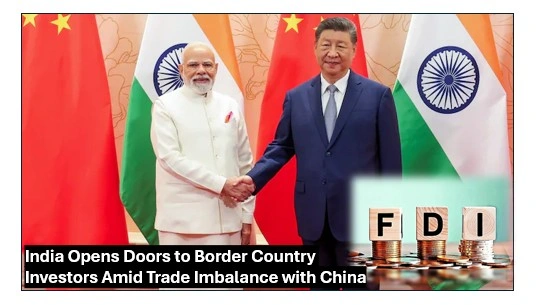

The Indian government has made a big change to its foreign direct investment (FDI) policy. This change will affect China and other countries that share a land border with India. The Union Cabinet, led by Prime Minister Narendra Modi, agreed to changes that allow investors from nearby countries to buy up to 10 percent of Indian companies without first seeking government permission, as long as they don’t run the business. This decision is different from the old rule that said even the smallest investments from those countries had to be approved by the government.
The government has made it easier for smaller investments and sped up the approval process for bigger, limited foreign investments in key areas. The goal of these changes is to attract more foreign capital, accelerate technology adoption, and boost India’s industrial growth.
Small stakes investments are made automatically
Investors from countries that share a land border with India, such as China, Bangladesh, Pakistan, Nepal, Bhutan, Myanmar and Afghanistan, can now put up to 10 percent of their money into Indian companies without first obtaining government permission. This automatic method should make it easier for foreign capital to move into places where investors don’t have control.
Previously, Press Note 3 of 2020 stated that even a single stake from a company with ties to these countries needed to be approved. That measure was implemented during the COVID-19 pandemic to curb hostile acquisitions and opportunistic purchases amid global market instability.
Officials say that better rules on “beneficial ownership,” or figuring out who really owns or runs an investment, will help officials tell the difference between real investors and people who want to change key assets.
Faster approvals for important areas
The new policy sets a 60 day deadline for choices in key manufacturing sectors, such as electronics, capital goods, and other technology related fields, that need to be reviewed by the government. The goal is to make it easier for businesses to join global supply lines, team up with others, and bring new technologies to India. But Indian residents or Indian businesses must still own and run the business majority of the time.
Businesses told the government that long approval times were slowing growth and sending investors to look for opportunities in other countries. This is why the promise of faster handling was made.
The small part China plays in India’s FDI
Even though the strategy has changed, China still doesn’t have many direct investments in India. According to government figures, China is the 23rd-largest investor in India. From April 2000 to December 2025, China accounted for just 0.32 percent of all FDI stock in India. Over more than 20 years, that adds up to about $2.51 billion.
This small share shows that India is cautious about Chinese investments, especially after the 2020 border clashes that worsened ties between the two countries and led to stricter investment rules. Even with the new changes, China is still expected to spend mostly through global funds or company structures rather than buying shares directly in Indian companies.
Read more: US hails India trade deal, $500 billion investment pledge
India-China trade is growing despite tensions
China’s share of India’s FDI is very small, but trade between the two countries remains large and growing. Despite India’s substantial imports from China, the latter still holds the position of India’s second-largest trading partner.
India’s trade deficit with China for the 2024–25 fiscal year reached roughly $99.2 billion. This was driven by a 14.5% decline in exports to China, totaling $14.25 billion, while imports from China increased by 11.5%, amounting to $113.45 billion. Between April and January of the 2025–26 fiscal year, exports totaled $15.88 billion, while imports hit $108.18 billion.
The trade gap stayed big at $92.3 billion
Analysts say this trend shows how much India relies on Chinese made things and parts, even though China doesn’t spend much directly in India. The rising trade gap shows that the economies of the two countries are still not balanced.
Also read: China sees 1st fiscal revenue drop
Keeping growth and safety in check
The government’s move to loosen limits on FDI is part of a broader effort to balance economic growth and national security. India remains cautious about outside influence in critical sectors. However, government officials believe that permitting smaller, non-controlling investments could be beneficial. This is viewed as a means to draw in investment, broaden technological access for the general public and bolster Indian businesses.
India aims to attract global investors by signaling its openness to business, all while retaining control over critical assets through adjustments to its foreign direct investment (FDI) policy. This approach could potentially bolster India’s economic relationships with neighboring countries and facilitate a more integrated presence in international markets.

I am a versatile content writer from the MP region, covering politics, business, crime, current affairs, entertainment, video games, and sports with clear insights, engaging analysis, and timely, reader-focused updates.









