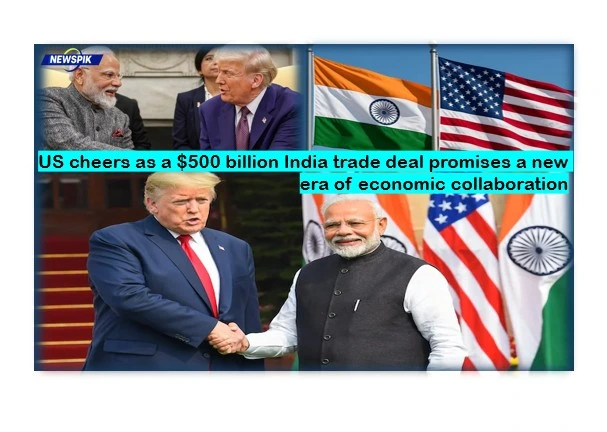

In an era of churning alliances and economic sclerosis, the long-awaited appearance this week of a historic trade agreement between the United States and India is a welcome change — or at least it feels that way, amid heated rooms in which policies have been debated until they got sucked dry. On Feb. 2, 2026 President Donald Trump and Prime Minister Narendra Modi smoothed over months of enmity in a trade deal that included substantial reductions in barriers to commerce combined with a massive $500 billion commitment to invest in the American economy.
For those following the headlines, this is hardly merely a story about spreadsheets and logistics; it’s one of two of the most powerful leaders in the world leaning into a personal rapport to solve a geopolitical puzzle. By lowering tariffs and rebalancing energy dependence, this deal is a strategic pivot that could reset the 21st-century global order.
From Friction to Flow: The Tariff Makeover
The new deal shatters this barrier with the surgical precision that has left markets cheering:
The Bottom Line: Starting Sunday, most Indian products entering the US will be subject to a composite duty rate of 18%, making them more competitive with rivals China (37%) and Vietnam (20%), as well as even neighbors like Pakistan (19%).
This is a huge win for India’s labor-intensive sectors. The reduction provides immediate relief across the country, from the textile centers of Tirupur to the jewelry craftsmen of Jaipur. The Indian stock market seemed to react positively to the news, with Nifty up by nearly 5% and the Rupee registering its biggest gain in more than three.
The $500 Billion Pledge: A Buy American Promise
As the US lowered its gate, India made an appealing promise in exchange. Prime Minister Modi has promised that India will pursue more than $500 billion in purchases of US goods and services in the coming years. It’s not just a lump sum of cash, but rather a road map toward deeper industrial integration.
Where will the money go?
The investment commitment is centered around four key pillars:
- Energy Transition: The biggest geopolitical shift may be India’s decision to stop importing Russian oil. Instead, India will increase imports of U.S. crude and liquefied natural gas (LNG), plus possible volumes from Venezuela.
- Tech and AI: For US giants in semiconductors and AI, the deal also signals an opportunity to stop viewing India as a market only for goods sold but for India to be counted among the leading countries of choice if they are looking at “China +1” strategy.
- Defense and Aviation: As India modernizes, much of this $500 billion should fall into Boeing airplanes and American defense systems.
- Agriculture: India has indicated it is ready to reduce its own barriers for American farmers — a decision President Trump’s Agriculture Secretary, Brooke Rollins, praised as a way to “pump cash into rural America.”
From the Bear to Forward Defence: The Strategic Pivot
Apart from the dollars and cents, the most “human” part of this deal has been the kink about some tiny realignments of India’s foreign policy. For decades, India has played off the West against Russia. But this deal represents a dramatic shift. In announcing that it will phase out Russian oil — which was flowing at the rate of 1.2 million barrels per day just one month ago — India is in effect choosing its strategic partnership with the United States over cheap energy from Moscow.
This was not an easy one to swallow. Indian officials have long defended their country’s “strategic autonomy,” and critics at home have accused the government of “capitulating” to pressure from the United States.
“When two large economies and the world’s largest democracies come together, it is natural for us to discuss jointly addressing global challenges,” Prime Minister Modi said on X (formerly Twitter). That’s a feeling that taps into a pragmatic reality — friendship is nice, but it’s better when the friendship means $500 billion in growth.
Issues in prospect: Going can they cut the mustard?
As with any agreement of this scale, the challenge will be in the details. Critics also note that a $500 billion pledge is a big number. Today, US exports to India are less than $50 billion a year. Trade would have to quintuple in order to reach the new target.
Domestically in India, the response has also been mixed. Tech and textile tycoons are cheering, but unions of farmers have expressed concern. Allowing highly subsidized American food into India could be a recipe for disaster for the 176 million small Indian farmers.
A Glimpse into the Future
The fact that a meeting took place between External Affairs Minister S. Jaishankar and Secretary of State Marco Rubio so soon after the announcement is an indication that this is just the beginning. The two countries are already heading toward formalizing cooperation on critical minerals — the “new oil” of the 21st century.
This agreement is about more than trade, however; it’s a statement that the relationship between the United States and India is what will be the defining partnership of this century.

A versatile writer mainly works on trending news, daily updates from politics, business, crime, current affairs and entertainment.