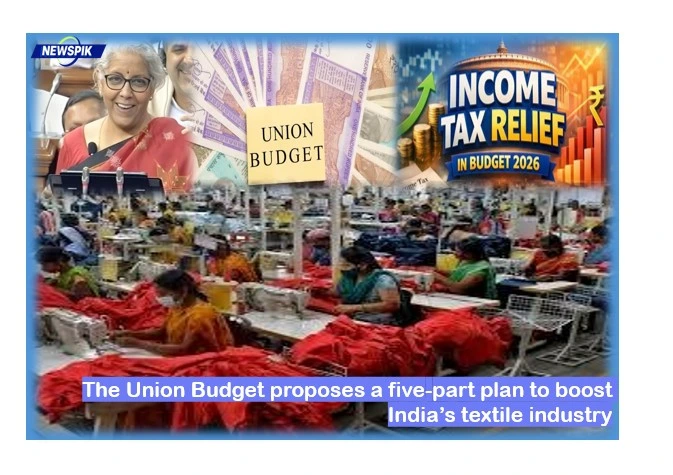

Textile sector of India is not just an industry, it is the social history of the country. From the old weaving looms of Varanasi to the high-tech export hubs in Tirupur, textiles are India’s second-largest employer, after agriculture. More recently, though, this behemoth has been challenged by global rivals and the ebb of synthetic fibers.
Latest Union Budget has come up with a strong, five-point master plan, which is intended to convert India from an old age manufacturing armoury into a world’s force for technical textiles. This is not just about subsidies; it is about a structural retooling that aims to braid together sustainability, scale and skill.
PM MITRA Parks: Architecture of Scale
India’s textile supply chain has been fragmented for decades. A cotton bale might be grown in one state, spun in another, woven together in a third and sewn into fabric in a fourth. This logistical nightmare comes with a heavy price tag and enormous carbon footprints.
The PM MITRA program is intended at an integrated ecosystem building. The government is cutting logistics costs by bringing spinning, weaving, finishing and printing together within one huge geographical park. The budget incorporates major expenditures for:
- Plug-and-Play Infrastructure – Enabling MSMEs to commence production without the back-breaking cost of constructing factories.
- Common Effluent Treatment Plants (CETP): Tackling large-scale environmental problem in textile dyeing with common green technology.
The Technical Textiles Mission: Apparel Is Not All
India has long been a master of “Aesthetic Textiles” — sari fabric, shirts and home merchandise. But the global lucrative (high-growth) market is in Technical Textiles - products for healthcare (meditech), construction (buildtech) and automotive sector (mobiletech).
The NTTM has been strengthened in the Union Budget. This aspect of the plan emphasises:
- Import Substitutes: Today India imports so many types of special fabrics which are used in industrial application. The Budget encourages the local production of these high value and critical materials.
- Standardisation: Implementing strict quality standards, which will enable “Made in India” technical fabrics to sell on the floor of a European or American medical and automotive market.
Raw Material Security: Breaking the Cotton-Synthetic Divide
One of the most silent features which has created maximum impact in the budget is- raw material parity. World fashion is typically Man-Made Fibers including polyester and nylon, India continues to be a cotton centric market.
To rectify this, the budget targets the inverted duty structure. By recasting customs duties on PTA and MEG, the main ingredients for synthetic fibres; viscose staple fibre which goes into making textiles and textile prices, etc., the Indian weaver is being made more competitive to produce synthetic and blended fabrics.
Digitalization and the MSME Lifeblood
Millions of small-scale entrepreneurs form the backbone of the textile sector. The fourth pillar of the budget is to create a digital and financial empowerment for these MSMEs.
Key features include:
Credit Guarantee Schemes: Enabling a small loom owner in Bhiwandi to get finance for upgrading to “shuttle-less” looms without having to mortgage their house as collateral.
E-Commerce for Traditional Industry Artisans and Weavers with automobile, pharmaceuticals or persons engaged in making chili powder to sell them through e-commerce will help towards this direction. This skirts the exploitative middlemen and links a weaver in a far-off village to a customer in New York or London.
Skill India 2.0: Designing vocational training for operators of textile machinery, so that the “demographic dividend” is in fact skilled to operate modern high-speed machinery.
Sustainability and Circularity: The Green String
The last pillar of the plan is the most far-sighted, though. The world is now beginning to recognize the textile industry as one of the worst polluters in its class. There are sops in the Union Budget for Circular Textiles.
This involves:
Rethinking infrastructure: Encouraging the development of facilities designed to turn “pre-consumer” scraps of fabric back into fiber.
Solarization Grants for textile units to go solar, as reducing “carbon per garment.”
ESG Compliance Facilitation Indian exporters in meeting the growing stringent Environmental, Social, and Governance (ESG) norms mandated by global brands in EU and North America.
The Human Element: Why This Is Important
Though hidden beneath jargon like “customs duties” and “integrated parks” are actual humans. At its core, this five-part plan is a social safety net. When a PM MITRA park is launched, it not only makes cloth; it offers safe employment to a woman in rural district with little other hope for financial freedom.
A budget that allocates for the National Handloom Development Programme, saves an art from that is ten generations old. It keeps the “Golden Thread” of Indian craftwork from snapping under the strain of cheap, fast-fashion imports.
The challenge is now in the execution. For this blueprint to succeed, the state governments must be amenable, and the “last-mile” weaver must feel the lower cost. If pursued in earnest, this plan could restore India to its historical position as the “Clothier to the World” — not by means of cheap labor but with innovation, scale and sustainability.
Budget 2026 Expectations Live: Union Budget 2026 date set for Sunday?

A versatile writer mainly works on trending news, daily updates from politics, business, crime, current affairs and entertainment.









