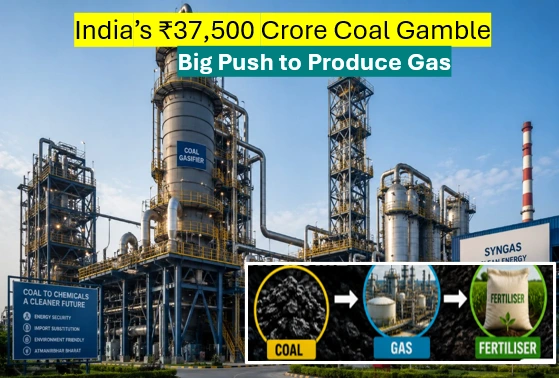

India has approved a huge 37,500 crore plan to turn coal into manufactured gas and fertiliser products. This is one of the country’s biggest energy change plans to date. By making better use of India’s vast coal stockpiles, the move is intended to reduce the country’s reliance on expensive imports such as LNG, urea, ammonia and methanol.
Concerns about delays in the world’s fuel supply due to rising regional conflicts, especially in West Asia, led the Union Cabinet to approve the plan this week. Officials believe the project will improve India’s energy security and reduce the country’s import bill over the next few years.
To turn coal into synthetic gas, also called syngas, the process is called coal gasification. After that, this gas can be used to produce fertilisers, chemicals, and industrial fuels, or to generate electricity. People think that this technology is better and more efficient than burning coal the old way.
Why India Is Going Back to Coal
The world’s largest coal reserves are in India; they are estimated at around 401 billion tonnes. India also has large lignite reserves. Even though the world is moving toward green energy, India still relies heavily on coal to meet its energy needs due to growing industrial demand and rising power consumption.
The government believes that converting coal into petrol can help meet the needs of both energy security and improved fuel production in industry. India aims to gasify about 75 million tonnes of coal annually under the new plan. This is part of a bigger goal for the whole country to gasify 100 million tonnes of coal by 2030.
Officials say India currently receives a lot of goods, such as LNG, urea, and methanol. The government says that over half of the demand for LNG and almost all of the demand for ammonia is still met by importing them. Cutting down on this dependence has become a top concern.
The project is also happening at a time when fuel costs around the world are still changing a lot. India’s economy, inflation, and trade balance are all affected by any problems with the foreign energy supply. Policymakers hope to protect the country from future shocks from outside by turning local coal into fuel for industrial gas and fertiliser.
Read also: Coal India stake sale to BCCL
Massive investments and fresh chances
The government thinks that the new plan will eventually bring in investments worth about ₹3 lakh crore. The program’s financial help will cover about 20% of the cost of plant tools. This will make it easier for both public and private businesses to get into the field.
NTPC, a huge energy company run by the government, is already getting ready to grow into coal gasification. Reports say that over the next few years, the company wants to make between 5 and 10 million tonnes of manufactured gas each year.
Other public companies, such as Coal India, are also investing more in gasification based fertiliser projects. The Talcher fertiliser project is a big example. Its goal is to use coal gasification technology to make urea.
Experts in the field say that the plan could create tens of thousands of jobs in the mining, chemistry, building, and infrastructure industries. Large scale gasification plants will require new industrial environments, transportation systems, and pipelines to connect to coal rich areas.
It’s cleaner than coal, but there are still some questions
Even though the government believes that coal gasification will be cleaner than burning coal directly, environmental concerns remain. Coal is still a fossil fuel, and many experts say that building up green energy sources is more important for long term survival than building up coal based infrastructure.
But people who back the plan say that gasification is a better way for countries like India to make the switch, since coal remains the main source of energy for industry there. Many large economies, like the US and China, are also exploring ways to convert coal into gas while meeting their energy security goals.
According to research, replacing old coal infrastructure with cleaner technologies could help reduce pollution while still allowing countries to make better use of their resources.
India is increasing its use of green energy, but experts say the country still needs stable industrial fuel sources to support industrial growth, chemical production, and rising power needs. People see coal gasification as a possible middle ground option.
Read also: The Black Diamond: The Resilience of India as a Coal Superpower in the World
A Move in Strategy That Will Have Long Term Effects
India is making a major change to its energy and industry policies with the ₹37,500 crore coal gasification project. Instead of depending on chemicals and energy that are brought in from other countries, the government wants to build up the country’s own resources.
The plan could change how India makes fertilisers, industrial gases, and petroleum fuel if it is carried out properly. It might also make the country less vulnerable to energy problems around the world and changes in the price of fuel.

I am a versatile content writer from the MP region, covering politics, business, crime, current affairs, entertainment, video games, and sports with clear insights, engaging analysis, and timely, reader-focused updates.