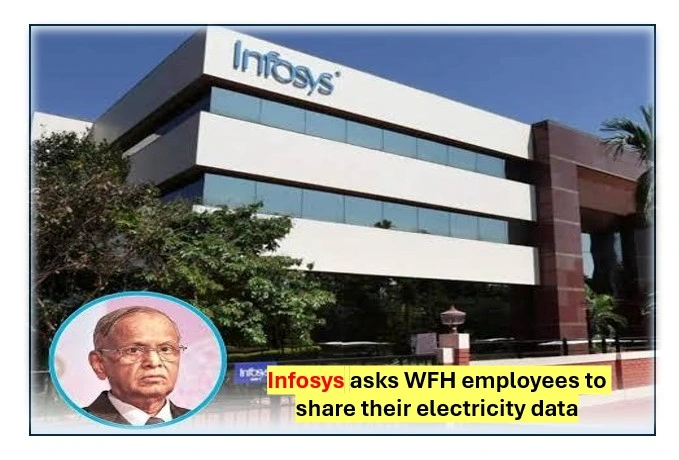

One of India’s largest IT services companies, Infosys Ltd, has once again instigated a new debate among India Inc. and social media users following a request by Infosys to share data related to household electricity consumption by its employees who work remotely.
The demand has been conveyed internally to the Infosys employees, who work either under its hybrid work model that requires them to mostly work from home during the week, coming into the office at least ten times a month, and so on, and has reportedly received a lot of attention due to its unusual nature.
What Infosys Asked Employees to Do?
In fact, as reported by multiple sources, Infosys’s CEO of Finance Jayesh Sanghrajka has written a company email to employees stating that they “have started a work-from-home electricity consumption survey.”
The survey is not confined to just attaching a monthly bill, but also seeks detailed information on households’ consumption of electricity within their homes, including:
- Laptops, lighting, fans, air-conditioners, heaters, etc., which are normally used at home during work hours
- The wattage of lights and devices
- The presence of solar power or any renewable source of energy.
Employees’ personal ideas or examples regarding energy saving:
The information would also aid the company to form a clearer idea about the insignificant amounts of indirect emissions resulting from remote working, which is not taken into account through traditional corporate sustainability reporting.
The company has clarified that this process of data collection is done to ascertain energy consumption because of ‘work from home’ and not to monitor the behavior of its employees as individuals.
Why Infosys is Doing This?
The Infosys survey has been styled as part of its long-running sustainable programme and its commitment to Environmental, Social, and Governance (ESG) goals. The organization framed this survey as a mechanism by which it can better manage its total carbon footprint with a focus on a future where millions of employees across the world are engaging with a hybrid form of working as a long-term solution.
In his internal mail, Sanghrajka emphasized a point that as hybrid work becomes a part of the firm’s main activities, now its “Environmental impact extends beyond its offices to employees’ homes,” since “the electricity used while working from home also represents its impact” and “accurate data on work-from-home energy consumption is key to improving and updating its Sustainability Reporting Methodology.”
Infosys states it will utilize the data to develop more efficient sustainability programs as well as reduce their greenhouse gas emissions through an increase in clean energy production. The organization also indicated it sees sustainability as a social responsibility, and it is an idea it has advocated for over the years. The organization asserts that it has cut per capita energy consumption by almost 55 percent since 2008, as well as sourced almost 78 percent of its power from renewable sources over the last year.
Again, it’s not the first time that Infosys has tried to estimate its work from home-related emissions, again being one of the pioneers in reporting its work from home emissions during 2020-21 by estimating it through an internal survey conducted by it itself.
Reactions and Privacy Concerns
“This has generated mixed reactions, both from within Infosys’s ecosystem and outside. Some experts have commended Infosys for being committed to sustainability, adding these figures because of those ‘hidden’ emissions that occur due to remote work. This is seen as a progressive move, especially when one considers that Environmental, Social, and Governance reporting is assuming greater prominence across clients and investors worldwide.”
However, some individuals have conveyed disquietude regarding this aspect with regards to social media and also with employees. The opponents opine that when workers are asked to share their personal electricity invoices with the company, this may appear as an invasion. The critics also state that this hybrid concept provides companies with lesser expenditures with regards to offices and even elevates workers’ expenditures, including their electricity invoices – and now employees are expected to share even this information.
Some have speculated that such a survey might provide fodder in the future in the caustic debate in corporate culture circles on the appropriate environment-related trade-offs between remote work and working in an office, such as between higher home electricity use as a justification to go into the office more.
Broader Implications
The Infosys method also points to a larger trend with respect to all sustainable businesses around the world, where there is a clear push toward measuring Scope 3 emissions, i.e., indirect emissions within a particular organization’s ecosystem, which can often be the most difficult to calculate. In a work-from-home culture, energy consumption through households will also be a factor that organizations will consider with respect to carbon emissions.
From an investment point of view, there is an opportunity within more ESG disclosure, which can help a company’s sustainability by giving institutional investment teams, or clients focused on climate targets, a more positive view of the company. However, the appearance of seeking this kind of personal data is something a company needs to be very careful about.
What Comes Next?
Infosys is still in the process of collecting data in this regard, and it has also encouraged its employees to embrace EE practices in their respective workplaces outside of the organization itself. While it is yet to be seen how effective this undertaking will be in furthering CSR in relation to sustainability, it is something of an interesting case in terms of balancing remote workplaces with environmental considerations.
The only thing that is yet to be seen is how many others will follow suit, but one thing is for sure, such a move by Infosys has definitely sparked debate on how far a company can engage in relating personal and company responsibility, especially in the context of climate change issues that everybody is concerned about today.
Tech Layoffs Continue in 2025- Full List of Companies Cutting Jobs

A versatile writer mainly works on trending news, daily updates from politics, business, crime, current affairs and entertainment.