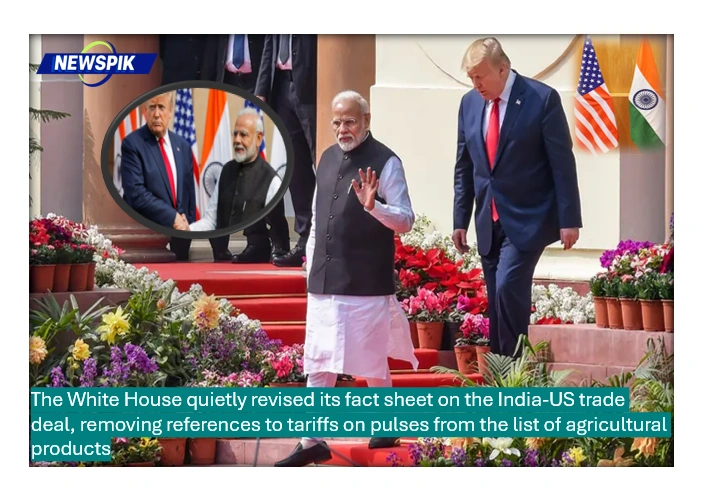

When you’re dealing in the high-stakes arena of international diplomacy, sometimes what is not said can carry as much weight as what is. On Feb. 10, 2026: The White House quietly released a revised fact sheet about the “Historic Trade Deal” between the United States and India. Almost within 24 hours of the first announcement we already had several key clauses — in particular agricultural tariffs on pulses and digital services taxes, which were very controversial — stripped out, or majorly watered down.
The abrupt editorial reversal has touched off a fiery debate among policy analysts and trade experts, who say the “interim agreement” remains a fluid document that both countries are still tinkering to insulate their most politically sensitive domestic priorities from foreign competition.
The Pulse of the Matter: To Save Indian Farmer
Among the more conspicuous cuts from the revised document was a removal of “certain pulses” (like lentils and chickpeas) from the list American agricultural products that were to be subject to a reduction of tariffs.
In the United States, improving access to India’s enormous consumer market is a top goal for the U.S.D.A., and this could help it achieve just that. But for India, pulses are more than pulses: they are a staple and a foundation of the rural economy. India is the world’s biggest producer and consumer of pulses, and New Delhi has traditionally protected tens of millions of small-scale farmers by imposing steep tariffs to prevent them from being undercut by cheaper imports.
With the fact sheet scrapping “pulses,” the White House has in effect conceded India is not yet prepared to lower its gates in this prickly sector. The revision implies that while India may be open to an offer of lower duties on tree nuts or soybean oil, the “dal” on every Indian dinner table is still out of bounds for now.
India-US trade deal will be signed off : Expected by Mid-March
Digital Diplomacy: The Tax Tug-of-War
The second major turnaround has to do with the digital economy. The initial fact sheet confidently announced that “India will roll back its digital services taxes.” The revised version toned this up, replacing the unambiguous assertion in favor of EU-US data flows with the more guarded commitment to “negotiate a robust set of bilateral digital trade rules.”
This shift is a result of an intricate legal and fiscal environment. India had previously phased out its 6% equalization levy (commonly referred to as the “Google Tax”) on digital advertising in 2025. But the U.S. is still pressing to eliminate other taxes affecting American tech giants like Amazon and Meta.
The change from “removal” to “negotiation” is an indication of India standing its ground. New Delhi sees these taxes as necessaryto levelthe playing field for domestic tech companies and ensurethat global corporationsat leastpay their due to the national treasury. The amended language gives India the “policy space” it needs in order to keep having those talks without having seemingly sold down the river immediately its fiscal sovereignty.
To Safeguard the Safety of American Workers, Inversion of “Commitment” to “Intent”: The $500 Billion Question
In addition to the specific commodities, the tone of the agreement itself got a linguistic makeover. The original text asserted that India “committed” to buying more than $500 billion worth of American energy, technology and coal over the next five years. The new version has India “proposing” to buy these products.
In trade deal lexicon, “commit” means a binding obligation with possible punishment for not complying, while “intend” is aspirational. This switch most likely occurred after Indian negotiators flagged that such a vast figure—about double India’s current imports from the U.S.—should be read as a target based on market demand, rather than an iron-clad purchase order.
Why the Revisions Matter?
These revisions are something more than “typo corrections.” They are a careful recalibration of the balance between President Donald Trump’s “America First” trade policy and Prime Minister Narendra Modi’s “Atmanirbhar Bharat” (Self-Reliant India) vision.
Looking Ahead
The next several weeks will be critical as negotiators from both sides return to the table and work out definitions, like what would constitute “digital trade rules” or “preferential market access.” The aim is still to get a fully agreed interim deal by mid-March 2026.

A versatile writer mainly works on trending news, daily updates from politics, business, crime, current affairs and entertainment.