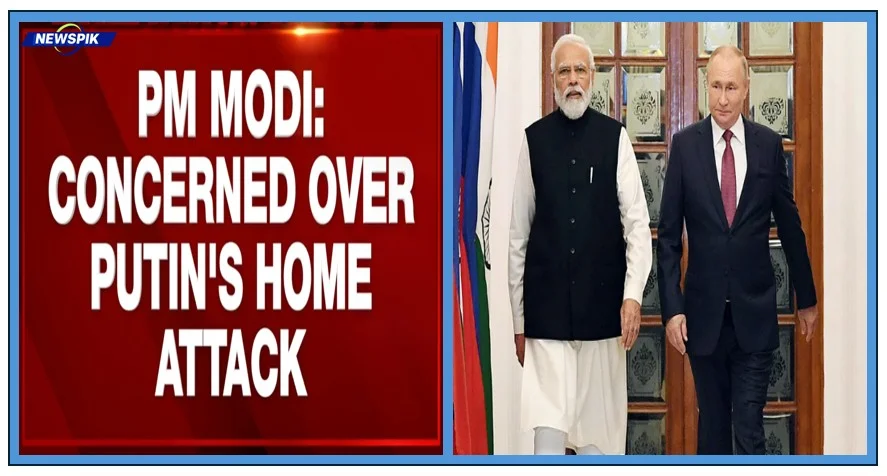

At a time of rising geopolitical tensions, Prime Minister Narendra Modi has expressed serious concern about reports of a drone strike targeting the Russian President Vladimir Putin’s official residence. The announcement, which came in a social media post, mirrors India’s long held‘middle-path’ diplomacy position as it underlined that any escalation involving the leaders’ personal safety could derail fragile peace process efforts underway since global powers brokered a truce.
The alleged attack, which Moscow has branded as “state terrorism,” involved a swarm of 91 long-range drones aimed at the presidential residence in the Novgorod region. Russian air defenses are reported to have liquidated the threatened strikes with no casualties, but the psychological and diplomatic impact has reverberated in world capitals, including New Delhi’s prompt response.
An Appeal to Step Back and Talk
PM Modi gave a measured but firm reply. Speaking on X (née Twitter), he said: “[W]e are deeply concerned by reports of the artillery attack and destruction of the President of the Russian Federation′s official residence. Diplomatic efforts in this respect are the most viable to end violence and create peace.”
Such a pronouncement is consistent with the Prime Minister’s oft-repeated mantra that “this is not an era of war.” But in stressing the importance of diplomatic efforts, Modi is also offering his own bit of advice to both Moscow and Kyiv: The two warring sides should avoid “red-line provocation” that would make it next to impossible for a return to the negotiating table. For India, the security of leaders and not being hit directly on high-profile sovereign symbols is key to keeping an atmosphere where talk remains a possibility.
The Flash Point: Peace talks on the brink
The timing of the alleged attack is especially fraught. It follows a renewed push by the international community — including an explicit move by the administration of U.S. President Barack Obama—to find a “landing zone” for the conflict. There have already been reports that Russian foreign minister Sergey Lavrov has issued a warning that Moscow will “rethink” its position after the incident, an action which risks reversing months of progress in face-to-face talks.
India’s Strategic “Side of Peace”
India has been under tremendous pressure to take sides throughout the conflict. But at the India-Russia Annual Summit in New Delhi earlier this month, PM Modi transformed India’s position with a cut-to-the-chase distinction: “India is not neutral; India stands side-by-side for peace!”
This philosophy guided his response to the Novgorod mishap. In expressing worry about the attack on Putin’s residence, Modi is not necessarily lining up behind Russia’s account of events—dubbed a “fabrication” by Ukraine to justify additional strikes—but rather pushing back against the idea of such an escalation. The Indian fear is that once the conflict ceases to be driven predominantly by territorial fighting and becomes more about assassinations of heads of state, a process could be set in motion that will never lead to a ceasefire.
Fraying Narratives and the Specter of Information War
As with many developments in the Russia-Ukraine war, the circumstances on the ground are murky under a fog of war.
The Russian Claim: Moscow says Kyiv sent 91 drones on a coordinated mission to attack the Valdai residence. They say this is a dangerous provocation to derail peace negotiations.
The Ukrainian Denial: President Volodymyr Zelensky of Ukraine has categorically denied the allegations, dismissing them as “typical Russian lies.” Kyiv says the story is a “false flag” meant to justify a new Russian offensive against Ukrainian government buildings in Kyiv.
VIEW FROM AMERICA President Donald Trump has said he is “angry” about the reports, saying attacking a leader’s home “crosses a line”.
In such a cacophony of reports, it is PM Modi’s comment that will work as a stabilising factor in the end. He did not explicitly assign blame to Ukraine, nor did he wholly endorse the Russian version; instead, he emphasized his view that there was a humanitarian and diplomatic imperative to avoid increasing actions that could damage efforts to secure peace.
Why It Matters for Global Stability?
And the attack on the residence of a head of state, real or perceived, is new ground in the rules of engagement. This is a nightmare scenario for a country like India that holds strong strategic ties with the West as well as with Russia.
The situation could easily spiral from here: If the Kremlin chooses to “retaliate” according to these reports, then the war will be on a much more deadly and escalation ladder, even possibly with Kyiv “center of command” attacks. While PM Modi’s intervention is an effort to leverage India’s moral and diplomatic clout to nudge both sides back, and safeguard Indian interests there, it has been couched as a humanitarian appeal. He urged all parties to “keep the focus on diplomacy and stay clear of any actions that may hinder that work.”
The Path Forward: Diplomacy Under Stress
Amid hopes for a resolution, an ‘extra mile’ with reference to the “shadow of the gun,” as 2025 comes down toward its end. India has been pushing for a forum that includes both Russia and Ukraine, arguing that a durable solution would be elusive on the battlefield.
PM Modi’s “deep concern” serves as a warning to the international community that the window for peace is not open for long. While the world anxiously looks on at what unfolds from those Novgorod dispatches, New Delhi continues to rely that diplomacy’s – not always easy, nor ego-fulfilling process of often frustrating hard work – is the only way forward.

I am a versatile content writer from the MP region, covering politics, business, crime, current affairs, entertainment, video games, and sports with clear insights, engaging analysis, and timely, reader-focused updates.