RBI Introduces New Minimum Balance Rules for all bank accounts, which shall be effective from December 10 onwards. Recently, the Reserve Bank of India has introduced a decision to standardise the minimum balance provision for all savings and current bank accounts. This is going to be levied from 10 December 2025. This uniform threshold is going to be imposed across all institutions, and thus, this is going to clear the confusion that was earlier there across various bank-specific norms. Now, as per the customers’ perspective, this is going to affect the household budget directly. Also, it is going to affect the cash flows of small businesses. As a result, it is going to have an effect on the way people choose and use their bank accounts.
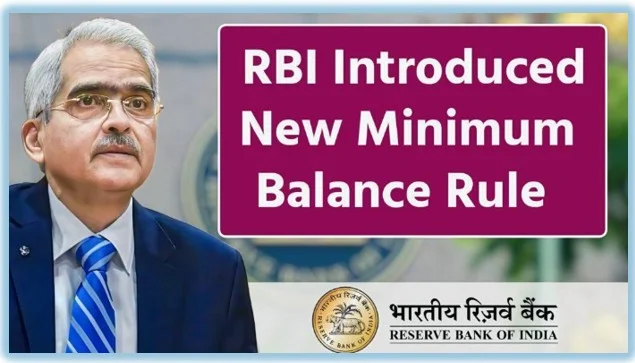
This rule of keeping a minimum balance existed for multiple decades. However, these rules were uneven, and there was no uniformity, and the banks have adjusted these rules based on customer segment, location of the bank and the service expenses of the banks. As a result, this used to confuse two customers with similar bank accounts but in different banks, since they used to face different penalties. RBI has thus introduced this change to aim for a simplified landscape. Now, there is a clear benchmark defined by the RBI – ₹3,000 for urban savings accounts, and ₹1,500 for rural and semi-urban accounts. Higher slabs are there for current bank accounts, ranging from ₹12,000 to ₹30,000, depending on the city tier. This has signalled a shift towards predictability, motivating the customers to be more alert in terms of their finances. Penalties are also capped at certain ranges based on shortfalls and are similar across all banks.
Why did the RBI impose the new guidelines?
This policy has made a structural change in the Indian banking system. The trend for digital payments has exploded over the past decade, but there is a cost of maintaining physical branches, which is somehow being neglected in recent times. Customer support and cash logistics rose sharply. The banks have argued repeatedly that these inconsistent balance maintenance rules have made it difficult for them to price their services fairly. As per industry experts, the operational expense of banks at the branch level has surged. This is more relevant in urban areas where rental space and staff costs are comparatively high.
With the availability of UPI apps, mobile banking dashboards are readily available to customers. Transparency is thus the key. The RBI has thus chosen to intervene for a better provision to manage bank account balance regulations. A former RBI official has stated off record that the major aim of this implementation is not to penalize the customers but to raise the financial awareness among common people while removing the grey zones in places where deductions felt unexplained and arbitrary.
Impact on senior citizens, households and rural customers
This standardization is a clear demarcation of the fact that customers will no longer feel the requirement to switch banks to escape higher charges. Now, irrespective of the logo you own on your passbook, the expectation from the banks remains just the same. Impact may be limited for the urban salaried households. However, the real pressure will be on the pensioners, rural customers and families who have been using bank accounts only for pensions, subsidies and remittances under the revised framework.

I am a versatile content writer from the MP region, covering politics, business, crime, current affairs, entertainment, video games, and sports with clear insights, engaging analysis, and timely, reader-focused updates.