The Aravalli Range — among the earth’s oldest geological formations — has again emerged as a flashpoint in legal and environmental battles. In the wake of a landmark Supreme Court judgement, late in 2025, a new “100 metre rule” has been drawn to explain what is legally considered an ”Aravalli Hill“.
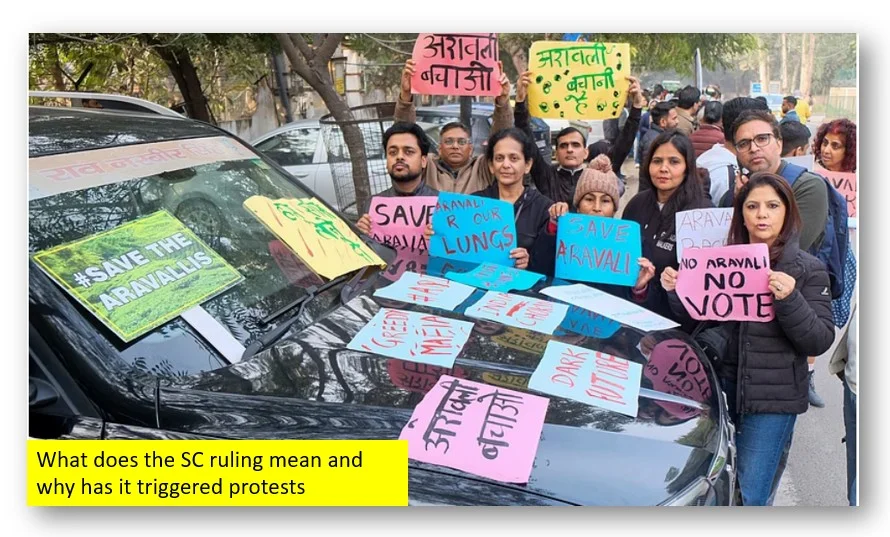
The government says this brings in some sorely needed administrative clarity but the ruling has led to protests against it across Delhi, Haryana and Rajasthan. Here is a closer look at what the rule entails and why it has prompted such disruption.
What is the Aravalli 100-Metre Rule?
The definition of the Aravalli hills differed from state to state for decades, creating a legal vacuum that was exploited for illegal mining and construction. To address this, the Supreme Court in November 2025 approved a uniform definition suggested by a high-level expert committee:
The 100-metre Threshold: Any hill feature that stands 100 metres or more above the local-area ground level is henceforth legally an “Aravalli Hill.”
The Range Definition: A group of two or more such hills (real gems) a distance of less than 500m between them is titiled as “Aravalli Range”.
Areas Not Out Of Bounds: The verdict clearly enunciates that there shall be no mining in “core areas”. including Tiger Reserves, Wildlife Sanctuaries, wetlands and main water recharge zones but size does not matter.
The Management Plan
The Court has also ordered the drafting of a Plan de Manejo de la Minería Sostenible (PMMS). No new mining leases can be issued in the region until this plan is submitted by Indian Council of Forestry Research and Education (ICFRE).
Why are there protests over the ruling?
Environmentalists, local communities and politicians took to the streets in protest when the government renewed the leases despite a ban on new ones. The devil is not in what the rule contains but, rather, in what it arguably does not.
The “Invisible” 90%
According to an estimate from the Forest Survey of India (FSI), as many as over 12,000 hill features are listed in the Aravallis and only around 1,048 formations (little over 9% of total) meet the condition on height – that they must be at least 100 metre tall.
The Fear: Opponents fear that by drawing the line at 100 metres, the other 90% of more modest hillocks, ridges and rocky outcrops could lose their status as “forest” and thus be exposed to sale for real estate or quarrying.
Threat to Groundwater and Desertification
The Aravallis constitute one of the most important water-recharge regions in North India. Rainwater seeps into the broken rocks of the hills and refills underground aquifers that feed cities such as Gurugram and Faridabad.
PROTEST Let’s start with smaller hills (less than 100m) are equally important for recharging water and not just the taller ones. If these are razed for construction, the water table in the National Capital Region (NCR) will sink and the eastward march of Thar desert will be accelerated.
Impact on Local Communities
In places like Mewat (Haryana) and Alwar (Rajasthan), close to 100 villages have reason to believe that land losing its category will soon rotter the local ecology and historical sites. Protesters say that the Aravallis are a “living ecosystem” — not merely a series of heights on a map.
The Government’s Defense
Environment Ministry and Union Environment Minister Bhupender Yadav have attempted to assuage these fears, with both arguing that the 100-metre rule is applicable strictly for mining reasons and it does not remove general forest protections.
Enforcement: The govt believes that a mapping of the hills through survey of India toposheets makes enforcement against those who indulge in illegal mining objectively verifiable and transparent as opposed to using ground surveys, which may be based more on surmise.
Balance: The Court’s approach seeks to avoid a “blanket ban,” which has long (and only) helped run violent and illegal mining mafias, in favour of a “regulated, sustainable” mode.
Conclusion & Next Step
The Aravalli 100-metre order is a double-edged sword. While it provides a scientific underpinning to halt the anarchy of illegal mining, it may well overlook the “subtle” part of the mountain range that has kept North India’s environment in equilibrium.
The fate of this judgment now entirely depends on the yet-tobe-prepared Management Plan for Sustainable Mining. If this plan includes the protection of low-lying ecological pathways, it could save the range; if not, those protests are going to get hotter.

A versatile writer mainly works on trending news, daily updates from politics, business, crime, current affairs and entertainment.