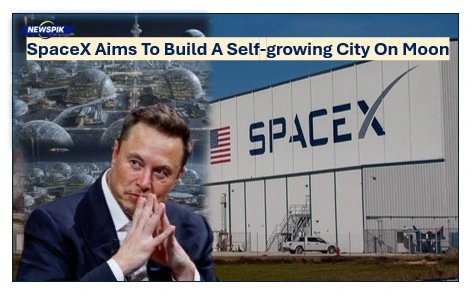

Elon Musk’s space company has changed its long-term plans from Mars to the Moon, where he’ll create a self-growing city, which Musk believes will be better for humanity than Mars colonisation. Musk admitted that he can build a permanent settlement on the Moon quicker than he could build a Martian colony, and said that SpaceX has now shifted focus onto the Moon with the goal of having a self-growing city built in under ten years, compared to the estimated time frame of building a Martian settlement which could take decades.
Why? Speed, logistics, and the future of civilisation
According to Musk, the launch windows for missions to the Moon occur very frequently, and it takes relatively less time to travel there than it does to go to Mars, due to the fact that when launching from Earth, flights between planets can only occur every 26 months (due to planetary alignment) and will take approximately six months to reach Mars. Conversely, once a flight to the Moon has been launched, there are approximately 10 days between flights from Earth to the Moon and the flights will only take approximately two days to reach the Moon.
The term “self-growing city” has been a focus of this announcement, however there’s still very little information about how a self-growing city could autonomously grow through methods such as using robotics, in situ resource utilisation and possibly more. Inflatable habitats have been part of the discussion but are likely still unproven.
SpaceX starts NASA’s Pandora mission to look for alien worlds far away
Mars is Still Part of Musk’s Vision, Just Delayed
While Musk has shifted his focus from Mars, he still considers Mars a very important part of SpaceX long term vision. Musk has said that SpaceX will still build a city on Mars and they will begin preparing to build one within the next five to seven years. Right now though, SpaceX will be focusing on the Moon first.
This shift in focus not only changes the timelines but also emphasizes staging for Moon and beyond. The disclosure of Musk’s updated time frames indicates that the Mars colonisation is an eventual goal but due to the fact that all SpaceX resources and focus will be directed at the Moon development first, then Mars colonisation will occur significantly later.
AI on Mars: Indian-Origin Scientist Behind Perseverance’s Smart Drives
Uncrewed Lunar Landing as Milestone
In reworking their plans, SpaceX appears to be moving towards an uncrewed lunar landing which could happen as soon as March of 2027; this will play an important role in their plans for more extensive settlement of the Moon. This would be considered one of SpaceX’s major accomplishments as they work on landing people back on the Moon for the first time since the Apollo program ended.
The last time someone walked on the Moon was in 1972, and the emphasis being placed on lunar settlement by SpaceX lines them up perfectly with many of the international lunar development goals, such as NASA’s Artemis program, where SpaceX is also heavily involved as one of the main contractors.
The strategy shift towards a lunar landing by SpaceX comes during a time of increased competition for the Moon among countries around the world. China has significantly expanded its lunar program and has called for a renewed commitment to developing long-term settlements beyond Earth orbit. Musk’s pivot towards the Moon aligns directly with the current U.S. space policy, which emphasizes lunar missions ahead of trips to Mars.
This announcement follows reports about SpaceX’s announcement to investors about shifting its long-term objectives for the Moon being its top priority at this time, where their previous focus on sending people to Mars has now taken a back seat.
Elon Musk’s ‘Space Based AI’ Revolution Is A Threat India Must Prepare
Broader Implications and Future Challenges
Although it demonstrates an ambitious vision, there is little information available regarding the autonomy of the lunar city’s technology, funding and governance. Experts believe that breakthroughs will be needed in autonomous robotic technologies, materials engineering, energy generation systems and international off-Earth supply chains for a city that can build itself.
Furthermore, in addition to the delayed timelines of Musk’s projects for Mars or his other projects, critics also caution about uncertainty with any long-term plan for a human settlement.
However, this transition from Mars to the Moon demonstrates a larger transition within the private space industry – one that prioritizes a more easily reached interim goal in humans establishing an increasingly larger presence off of Earth.

I am a versatile content writer from the MP region, covering politics, business, crime, current affairs, entertainment, video games, and sports with clear insights, engaging analysis, and timely, reader-focused updates.