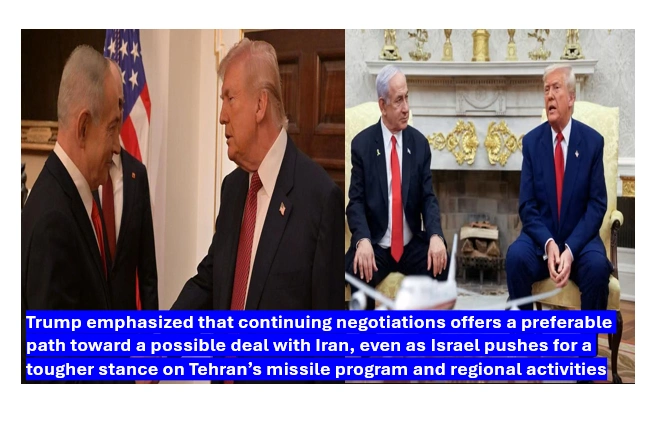

It was a chilly winter’s afternoon in Washington D.C. but the temperature inside one conference room in the United States Capitol was soaring. On February 11, Israeli Prime Minister Benjamin Netanyahu was welcomed at 1600 Pennsylvania Avenue by President Donald Trump. The world, waiting for a joint declaration of military resolve, got something more nuanced. In what appeared to be a strategic “preference” for diplomacy over immediate escalation, Trump declared he believed that talks with Iran should continue, despite his Israeli counterpart’s lobbying for a tougher stance.
The session, their seventh since Trump returned to the Oval Office at the start of 2025, went on for more than three hours and was entirely behind closed doors. The “low-key” format — which did not include the customary joint press appearance — emphasized how cautious advisers are about discussing Tehran’s nuclear ambitions and regional power.
The ‘Preference’ for a Deal: Trump’s Pragmatism About Campaign Promises
With Mr. Trump’s previous record of “maximum pressure” and the military strikes of June 2025 that hit Iranian nuclear sites, President Trump has been embracing his image as a dealmaker more and more. Shortly after the gathering, Trump issued a statement on Truth Social to elaborate his position:
This is an important shift in position. It indicates that while the U.S. “armada” of carrier strike groups is still in the Persian Gulf, the White House isn’t yet prepared to walk away from the Omani-mediated dialogue that picked up earlier this month. Trump is focused on an “Great Deal” in which Iran does not possess nuclear weapons and no long-range missiles, but instead he would like this to come through leverage rather than a regional war that could stretch for years.
Netanyahu’s ‘Security Needs’ Teeter Over the Shadow of a 12-Day War
Prime Minister Netanyahu landed in Washington with a different set of priorities. The 12 Day War in July 2025 is fresh in israels memory. Iran fired large salvos of ballistic missiles during that conflict that strained Israel’s defense systems.
During his powwows with Trump and Secretary of State Marco Rubio, Netanyahu multiplied the “principles” that were no longer open to discussion.
At the root of it is this alleged “total freeze” on enrichment inside Iran Although Israel demands a total stop to uranium enrichment in the Islamic Republic.
- Missile Program: Unlike the original JCPOA, Netanyahu has argued that any new deal must address Iran’s ballistic missile capabilities.
- The ‘Axis of Resistance’: Jerusalem is seeking agreement that leaves Tehran no choice but to cut ties with proxies like Hezbollah and the Houthis.
Netanyahu’s office published a short readout of the meeting, saying that he “stressed Israel’s security needs in the context of the negotiations.” The two agreed to keep in “tight contact,” and yet the absence of a joint statement suggested a lingering chasm between what Trump wants from his friend Netanyahu — swift success at diplomacy — and what Netanyahu insists must be the bottom line: absolute security.
India dismisses ‘Epstein Files’ Email referencing PM Modi’s Israel visit
Sanctions, Submarines and SMRs: The Leverage Game
The administration has adopted a strategy of carrot-and-stick tactics that is more aggressive than those of its predecessors but also more diplomatically inclined than during his first term.
A Regional Puzzle: Gaza and the ‘Board of Peace’
The issue of Iran does not stand in isolation. The leaders also discussed the fragile Gaza truce and the new “Board of Peace” during the three-hour meeting. Netanyahu officially signed onto this initiative during the weekend meeting, which is being billed by the Trump administration as an alternative to classic UN-led diplomacy.
The Board is supposed to administer regional stability and reconstruction, but for Trump, it’s also a vehicle to create a “coalition of Abraham Accords” partners to “contain” Iran. If a deal is struck, it will likely be sold as a feat of this new regional architecture.
Iran warns, US and Israel will be target if Trump administration strikes over protests
Looking Ahead: Is a Deal Possible?
The coming weeks are critical. Iran’s foreign minister, Abbas Araghchi, has indicated a willingness to talk but asserts that Iran’s “missile capabilities are nonnegotiable.” Meanwhile domestic pressure in Iran is growing, with rolling blackouts and a sputtering economy that could force the hand of the Supreme Leader.
President Trump is hoping that his singular mix of tenderness and bellicosity will succeed where others failed. But the road is risky. The prospect of a deal, but only if the talks in Oman do not falter, could vanish at any moment; all that would be left would be the “armada” in the Gulf.

A versatile writer mainly works on trending news, daily updates from politics, business, crime, current affairs and entertainment.