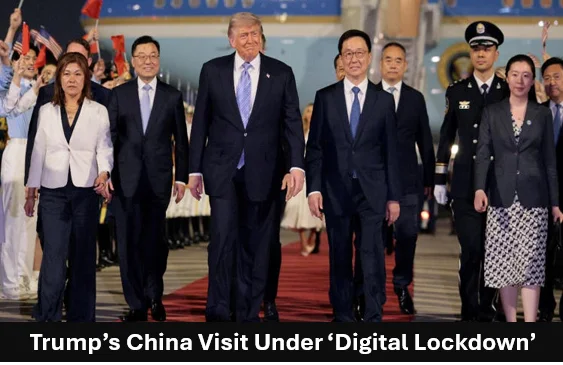

The news quickly turned from politics to technology when US President Donald Trump arrived in China for a big international visit. A strong American group accompanied him. It included some of the biggest names in business and technology, such as Elon Musk, CEO of Tesla, and Tim Cook, CEO of Apple. Not the people who were going that caught people’s attention, but what they were not bringing.
It is said that members of the US group went into China during a tight “digital lockdown,” which meant they had to leave their cell phones, computers, and other common electronics behind. Instead, they were given temporary safe devices made just for the trip. This shows how worried people are becoming about digital dangers and spying during foreign talks.
The new rule for travelling is no cell phones or laptops
For years, American officials have seen trips to China as high-risk for hacking. This most recent trip showed how seriously those worries are now being taken.
Reports say that officials and business leaders were told not to bring personal gadgets into the country. Instead, they were given temporary gadgets, also called “burners,” that didn’t do much. Security teams set up these devices ahead of time and only put on them the most important apps and contact tools.
The goal was easy to understand: lower risk. If a device is stolen while travelling, it can be thrown away afterward without putting private or public data at risk.
Diplomats and business leaders who visit countries thought to be high-risk for digital monitoring are using this approach more and more. But seeing it happen to such a famous group of people, including some of the world’s most powerful CEOs, made the danger even more serious.
Read also: Iran’s Foreign Minister Araghchi is going to Beijing Trump’s visit
Why China put in place such strict safety measures
For a long time, the US government has thought that electronic devices brought into China could be hacked, monitored, or infected with malware.
Security experts have said many times that charging stations, public Wi-Fi networks, and even hotel internet systems can be used by hackers. Even simple things like putting a phone into a USB port you don’t know could make private info available.
Officials were allegedly told not to connect their devices to public networks and to only use secure lines of contact during the trip.
Former US security officials have said many times that when going into a country with advanced monitoring, it’s best to assume that everything could be tracked, including calls, emails, texts, and even your moves.
That way of thinking seems to have affected every part of this visit.
Inside the “Digital Lockdown”: Safe Zones and Temporary Tech
Reports say that the digital safety measures went beyond just getting new phones.
It is thought that the US team set up safe contact areas where private talks could happen without worrying about being listened in on. These safe areas are meant to stop electronic spying and are often used for foreign trips.
Officials could safely use private tools to talk to Washington from inside these zones.
Also, the temporary devices that were given to representatives were said to have been made using pre-approved software systems. This means that cybersecurity teams can later check them for signs of hacking or malware that was hidden.
In simple terms, the gadgets were used like throwaway items—they were helpful during the trip, but they weren’t trusted afterward.
It’s becoming more and more clear in global relations that protecting information is just as important as protecting people.
Read also: The US wants to break China’s drone dominance, but it won’t be easy
Musk, Tim Cook, and the biggest names in American business all back Trump
The fact that top US business leaders were there made the trip even more important.
There were a lot of important leaders from big American companies with Trump. Many of these companies do a lot of business with China. There are still a lot of big and important companies in China, like Apple and Tesla.
Because of this, it is strategically important to keep in touch with Chinese government officials and business leaders.
At the same time, these businesses are facing more and more pressure from Washington regarding technology exports, the growth of artificial intelligence, and their reliance on the supply chain.
With them on the trip, it was clear how closely business and government are now tied.
This wasn’t just a political trip; it was also a business trip, with trade and technology deals worth billions of dollars in the background.

I am a versatile content writer from the MP region, covering politics, business, crime, current affairs, entertainment, video games, and sports with clear insights, engaging analysis, and timely, reader-focused updates.