
As the India approach gains steam, a top company official talks about plans for manufacturing, new mass-market electric vehicles, and an export hub.
As part of its larger plan to bring more jobs to India, VinFast may look to build batteries for electric vehicles there, according to a top company source. This would show a stronger long-term commitment to the Indian market. If the move goes through, it would also be a big step toward making its products more Indian made.
Fortune India asked VinFast India CEO Tapan Ghosh about the chances of localising key parts, such as batteries, which make up a big part of EV costs. Ghosh said that the company is actively looking into these possibilities. “We are working on localisation.” At the moment, it’s 15%, and we’ll speed up our work with local sellers and form partnerships. These are the things that are still being worked on. About 30% of the total cost goes to the battery. “We’re also taking that into account,” he said.
Battery localisation and cost management are being looked at
Battery packs make up about 30–40% of the total cost of an electric car, which shows how important integration is for lowering prices and increasing profits. Ghosh also said that VinFast currently gets its batteries from its parent company’s factory in Vietnam. However, the company may look into assembling them locally in the future, but they didn’t say when.
He made it clear, “The plans are still on the drawing board and have not been sealed.”
VinFast is also expanding its business in India by investing in its Thoothukudi factory, which is being turned into a global production hub that can make 50,000 machines per year. This is in addition to the localisation push. Over the long run, the plant will likely meet both local and international needs. This will make India an important part of the company’s global EV strategy.
A dual MPV approach is aimed at both domestic and group customers
VinFast is improving its game in India by offering two types of products: ones for personal and ones for business use. The company is not setting strict sales goals, but instead adjusting production to meet demand. The VF MPV 7 and the soon-to-be-released Limo Green are at the heart of this strategy. They are both based on the same basis but are designed for different types of customers.
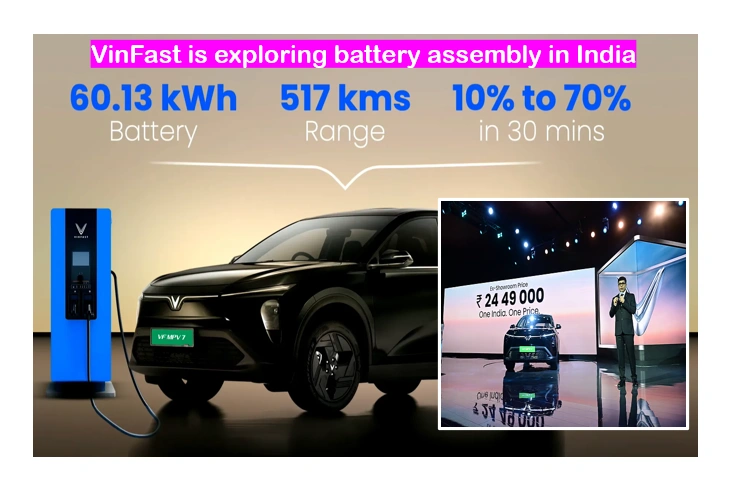
The VF MPV 7, which costs ₹24.49 lakh (ex-showroom), is the company’s first luxury electric MPV. It has a 150-kW engine and an ARAI-certified range of 517 km. The Limo Blue is only for fleet owners and has a lower price point and a more practical layout. The Limo Blue is aimed at individual users.
“It will cost less than the MPV7,” Ghosh said, adding that the model has a “wholly different identity” for business use and is ARAI-approved for group operation. Limo Green units are already being sent to stores by the company, and sales should start in a few weeks. “There is a business called GSM that works with Vingroup.” “They have their own plans, which will be made public later,” he said, implying a bigger mobile play.
Read also: Government increases EV subsidies, encourages automakers to use greener fuel
10–14 lakh EVs, network growth to serve more people
Beyond its current range, VinFast is thinking about expanding into the ₹10–14 lakh EV segment to reach a bigger market. However, it will continue to focus on high-end cars and won’t be making any cars below ₹10 lakh in the near future. The company has already released the VF6 and VF7 in the ₹17–28 lakh price band. It is now looking at other areas below ₹16 lakh and above ₹24 lakh for the future.
VinFast wants to grow, so it plans to release two new products every year. In the second half of the fiscal year, it will also bring electric two-wheelers to India. To keep up with this growth, it is adding more stores—75 showrooms and over 230 service workshops, some of which are third-party partnerships—with a focus on tier-2 and tier-3 areas. The business is also getting ready to enter the market for electric two-wheelers (E2W).
The company is also putting money into charging stations through its affiliate VGreen. VGreen has set up about 300 charging stations and is looking into ways to expand to more fuel stores with HPCL’s help.
India still only has 4–5% EVs, so VinFast sees a lot of room for growth. “India is a market that cares about values.” Ghosh said, “We think we stand out because we offer an affordable price along with a high level of long-term value.”

A versatile writer mainly works on trending news, daily updates from politics, business, crime, current affairs and entertainment.