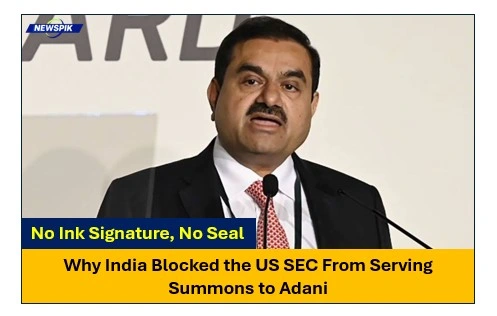

The US Securities and Exchange Commission (SEC) issued court notices to businessman Gautam Adani and his nephew, Sagar Adani, but India’s Ministry of Law and Justice failed to serve them due to procedural issues. The refusal was due to important papers sent by the US agency not bearing an ink signature or official seal.
Officials familiar with the situation say the law ministry returned the request twice, stating it did not meet the requirements for documents needed for foreign legal cooperation. The decision prevented the SEC from officially contacting the Adani family through Indian officials.
The issue has grown worse, and there is a disagreement between the legislative and executive branches. This shows how hard it is to follow the rules when there is a lot of money involved and more than one country is involved.
The Hague Convention is at the heart of the dispute
There is an international agreement called the Hague Convention that says how to serve legal and non legal papers between member countries. This is how the summons was sent. As a member, India has strict rules for checking these requests and sending them on.
It was said that the Indian law ministry didn’t like that the SEC’s cover letter didn’t include the original name in ink and that the required forms didn’t have an official seal. The authorities said they couldn’t check whether the request was real or provide service without these.
The SEC, on the other hand, says that the Hague Convention doesn’t require ink marks or seals and points out that similar papers have been accepted by other countries in the past. Even so, the Indian government stood by its position and returned the papers without taking any further action.
Elon Musk Holds Surprise Talk At The World Economic Forum In Davos
SEC Looks for Another Legal Way
After being turned down several times and having to wait months, the SEC has gone to a US federal court to ask for permission to serve the summons in other ways, such as through internet service or legal agents based in the US.
In court documents, the regulator said it had been trying hard since the beginning of 2025 to use official international routes, but now it doesn’t think service via Indian authorities is likely. The SEC said that the Adanis know what’s going on and that an alternative service would make sure that the case moves forward fast.
The legal case concerns claims that Gautam and Sagar Adani violated US securities laws by providing false information about a 2021 bond offering by Adani Green Energy. In a separate case, the US Department of Justice has brought criminal charges related to suspected bribes. However, these cases are technically separate.
Taken by Adani Group and Effects on the Market
After news of the SEC’s moves spread, Adani Group shares dropped sharply, suggesting investors were concerned about the long term legal uncertainty. During one selling session, a number of publicly traded companies in the group lost a lot of money.
In response, Adani Green Energy issued a statement clarifying that it is not a claimant in the SEC case. The company made it clear that the dispute is only legal and does not contain any claims of bribes or corruption against the company.
The group has repeatedly stated that all its disclosures were made in accordance with the law and that it will protect itself through other legal means.
What merger of Ambuja Cements, ACC, Orient Cement means for Adani shareholders
Legal and diplomatic effects on a larger scale
The segment shows how hard it is for officials from other countries to follow the law exactly in each one. The Hague Convention provides a framework, but different interpretations of its rules can cause delays and even a standstill.
Lawyers say that India’s strict rules on paperwork show that the country is wary of its own people getting involved in court proceedings in other countries. But the SEC’s choice to look into other ways to offer services shows that it doesn’t like how long the process is taking.
The US court’s decision on alternate service could be a big step forward for future cross-border laws, especially when it comes to big businesses and money issues.

I am a versatile content writer from the MP region, covering politics, business, crime, current affairs, entertainment, video games, and sports with clear insights, engaging analysis, and timely, reader-focused updates.