
Within the last ten years, India’s state government budgets have grown by huge amounts. But a closer look at how the money is being spent shows a worrying trend: even in the country’s richest states, investment spending is going down.
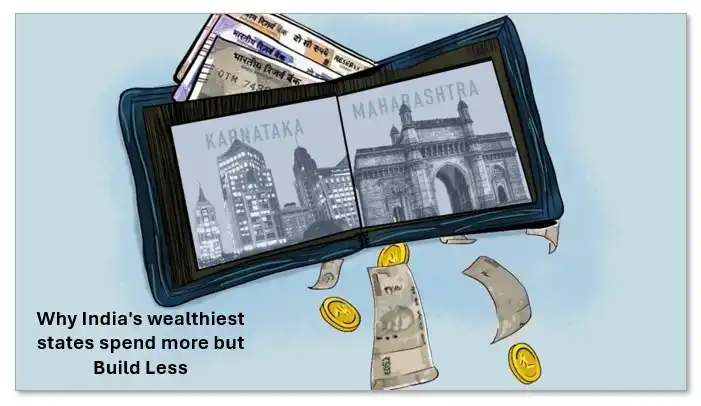
Take a look at Karnataka and Maharashtra, two of India’s most developed and financially stable states. Since 2017–18, both have seen their total spending more than double. Karnataka’s spending went from Rs 1.86 lakh crore to Rs 4.48 lakh crore by 2026–27, while Maharashtra’s went from Rs 2.84 lakh crore to almost Rs 7.7 lakh crore during the same time period.
Even though budgets are getting bigger, the share of money that goes to capital expenditures (which includes building infrastructure, making assets, and supporting long-term growth) has gone down a lot.
Instead, more and more of the state’s money is going to paying off debt and spending money on things that bring in money. This makes it harder to invest.
The quiet drop in state spending on projects
When you look at capital spending as a share of overall spending, you can see the change.
In 2020-21, more than 24% of all spending in Karnataka was on major projects. But since then, this percentage has been slowly going down.
It went down to 15% in 2024–25, but it slowly went back up to about 16.7% in 2026–27. The same thing is happening in Maharashtra. In 2021-22, capital spending hit 21.7 percent of the budget. It then dropped sharply and stayed between 12 and 15 percent for the next few years.
Capital spending has gone up a little, but not a lot. Still, it’s clear that investment spending has become less important compared to the size of state budgets. This is important because capital investment has one of the biggest fiscal ratios of all types of government spending.
Putting money into things like roads, irrigation systems, urban transportation networks, and energy infrastructure makes things more efficient and encourages private investment. When the share of this kind of spending goes down, government spending has less of an effect on long-term growth.
you may also like:
The spending trap for money
It has been seen that investment spending is going down. This is a sign of a deeper structural change in state budgets, where income spending is pushing out capital spending.
Costs related to bringing in money include pay, benefits, grants, welfare programs, and running the government. Even though these costs are necessary for the government to run, they are mostly long-term debts that don’t leave behind many long-term economic assets. In Karnataka, revenue expenditure made up 78 percent of all spending in 2017–18. This percentage is expected to rise to about 82 percent by 2026–27.
Maharashtra, on the other hand, has an even clearer trend. In 2017-18, income expenditure made up 87 percent of the budget, and it is still around 85 percent of overall spending today. This means that less than one-sixth of the money being spent now goes toward making long-lasting public assets.
This trend is partly caused by the fact that state governments are taking on more aid duties. Also, tough elections have made it more important to put in place social programs, cash payments, and supports. But because of this, investment spending has been slowly going down, even in states that are generally better at managing their money than most.
When paying off debt gets in the way of building
The growing load of paying off debt is a big obstacle to business
Over the past ten years, the budget gaps in both Karnataka and Maharashtra have grown significantly. The state of Karnataka’s budget imbalance has grown from ₹33,359 crore in 2017-18 to over ₹90,000 crore in 2026–27. Their debt has grown even more quickly, from Rs 38,789 crore to about Rs 1.5 lakh crore.
Interest payments go up as loans get bigger
In the same time period, Karnataka’s interest costs have more than tripled, going from Rs 14,159 crore to about Rs 45,600 crore. The amount of interest that Maharashtra has to pay has gone up from Rs 34,127 crore to almost Rs 79,000 crore.
But what’s even scarier is how quickly these fees are cutting into spending on research. Interest payments are taking up more and more of state budgets, making it harder for money to be used for new investments.
When states have to spend more of their budgets to pay back debt, they have less money to build infrastructure or make more things.
Karnataka and Maharashtra are still two of India’s most important business hubs. However, their budget paths show a growing fiscal paradox: while public spending is rising quickly, the amount spent on building the future is decreasing.
In the long run, what governments spend their money on is more important than how much they spend. When interest payments are equal to or higher than spending on infrastructure, you can see that something is wrong. India’s richest states and state budgets in general are facing a choice that is becoming more and more clear: spend more on spending today or invest more in output tomorrow.

A versatile writer mainly works on trending news, daily updates from politics, business, crime, current affairs and entertainment.