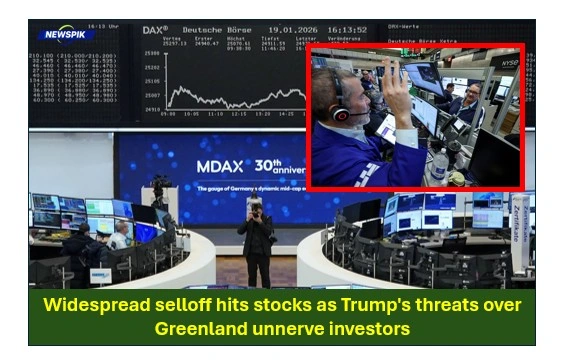

A surprise geopolitical quake swept away the global financial terrain. President Donald Trump, in a surprise move to both allies and analysts, announced a bevy of escalating tariffs on European countries and tied them directly to his desire for the United States to purchase Greenland.
Here, analysis of the market reaction, the particular economic levers in motion and why this “Greenland Gambit” has reverberated through Wall Street.
The Arctic Chill: What Will Happen to Global Markets as Trump’s Greenland Strategy Backfires?
It was the first full day of trading after Martin Luther King Jr. Day and Wall Street saw the sharpest one-day tumble since October. The catalyst was not a surprise recessionary indicator or a corporate earnings miss, but rather a weekend social media post from President Trump that turned an age-old territorial curiosity into a flash point in the world’s second-largest economy.
The President noted that eight European countries—Denmark, Norway, Sweden, France, Germany, the United Kingdom, the Netherlands and Finland would immediately be hit with a 10% tax on all goods exported to the U.S. from these nations beginning February 1. Even more ominously, he threatened to raise those taxes to 25 percent on June 1 unless a deal was struck for the “complete and total purchase” of Greenland from Denmark.
From Diplomacy to Economic Coercion
Twice removed from office, and instinctively a disrupter rather than an empire builder, Johnson is three years into what started out as a quirky policy project during his previous stint in government but has become “transactional colonialism” — many are now calling it that, on both sides of the so-called special relationship. And by using the economic import muscle of the U.S. economy against its own closest NATO allies, the administration is pushing the envelope on what’s legal under international law and testing how much pressure the transatlantic alliance can withstand.
The market’s gut check, however, is less about the frozen tundra of Greenland and more, in our view, about the “uncertainty tax” this move extracts on global trade. Investors detest unpredictability. The possibility of 25 percent tariffs on German cars, French luxury goods and British aerospace components has upended analysts’ valuation models for some of the world’s biggest companies.
Greenland ‘will stay Greenland’, former Trump adviser declares
Key Sectors and Safe Havens What This Means for the Markets
The “Magnificent Seven” tech giants, which rode a wave of AI-whipped optimism into the new year, led the way down. Apple, Microsoft and Nvidia were among the biggest decliners as traders weighed what potential European response could mean for global supply chains and sales. In contrast, “fear gauges” spiked. The Cboe Volatility Index (VIX) popped above 20 suggesting an increased level of panic amongst institutional investors.
While equities bled, the traditional safe havens gleamed. Futures for gold and silver soared to record highs of more than $4,760 and $95 an ounce. The message from the commodities market was unambiguous: Whenever the world’s reserve currency issuer cooks up a “man-made crisis,” there are investors out there who want to own things that cannot be devalued by a social media post or an arbitrary tariff decree.
Trump Imposes 10% Tariff On Denmark, UK, France For Opposing
A Crack in the NATO Alliance?
The geopolitical consequences have also been swift. In an unusual moment of complete concord, the eight targeted countries released a joint statement that cautioned these threats “threaten to risk a dangerous downward spiral.” NATO Secretary General Mark Rutte has tried to play the role of mediator, but the White House rhetoric — which included leaking messages from French President Emmanuel Macron conveyed in private — smacks of a big neon bridge being burned.
The timing is particularly sensitive. With world leaders heading to Davos for the World Economic Forum, there is only a bad debate about how to minimize damage. Treasury Secretary Scott Bessent has described the tariffs as ”national emergency action,” however European leaders including Ursula von der Leyen have responded, effectively warning that they might not see America as a trusted security or economically.
What to Watch For in the Long Run: De-Dollarization and Vengeance?
Analysts caution that the “Sell America” trade may prove to be a self-fulfilling prophecy. If the U.S. keeps wielding its financial system as a weapon against allies, it only incentivizes those same allies to seek out alternatives. Already we are witnessing an acceleration of “de-dollarization” trends, with European officials already discussing the reactivation of anti-coercion intellectual property instruments that could strike $93 billion in U.S. imports by early February.
To the ordinary investor, a “Greenland Gambit” might signal wider range of volatility lays ahead. The old assumption — trade wars were for strategic rivals like China — has been upended. Now a territorial dispute over the Arctic can cause a systemic shock to the average American’s retirement account.
With the February 1 deadline looming, it is far from clear whether we are witnessing a masterstroke of “Maximum Pressure” from President Trump that will ultimately compel a deal or a historical miscalculation that will shake the very edifice of global order to its core. So far, the markets are betting on the latter.

I am a versatile content writer from the MP region, covering politics, business, crime, current affairs, entertainment, video games, and sports with clear insights, engaging analysis, and timely, reader-focused updates.