India has just signed a historic Free Trade Agreement (FTA) with New Zealand and the agreement is the third major trade agreement of 2025 in the country, following other successful deals with Oman and the United Kingdom earlier this year.
The agreement will greatly intensify bilateral economic activity, broaden the market opportunities to exporters and reduce tariffs in major areas, moving towards greater strategic and business interaction between the two Indo-Pacific partners.
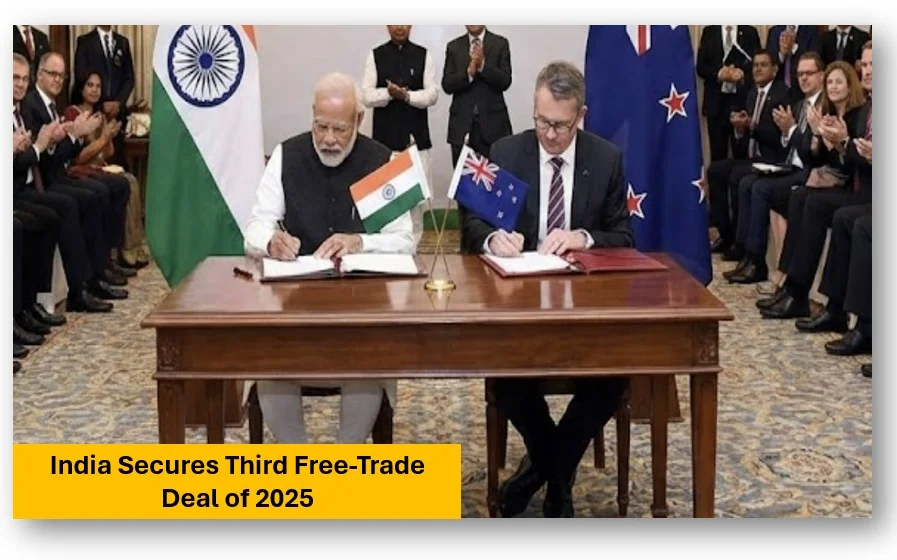
A Revolutionary Break after the Lapse of Years
The India-New Zealand trade relationship has experienced very little movement over the past ten years, with negotiations having stalled several times because of the loopholes in the tariff expectations and also the agricultural sensitivities. Authorities affirmed that the most recent set of negotiations, which were concluded in Wellington this week, provided that the issues of contention, which had existed throughout the years, were resolved, especially in dairy and horticulture and manufacturing elements and professional services.
The breakthrough comes when India is speeding up its presence in world trade, and is concentrating in destinations that can be exploited in the long run, and that have high value. In the case of New Zealand, the agreement would provide access to one of the fastest-growing consumer markets in the world and enhancing supply chain security to go beyond regional reliance. The agreement, according to the government officials, is an indication of a change in economic diplomacy and trust between the two countries.
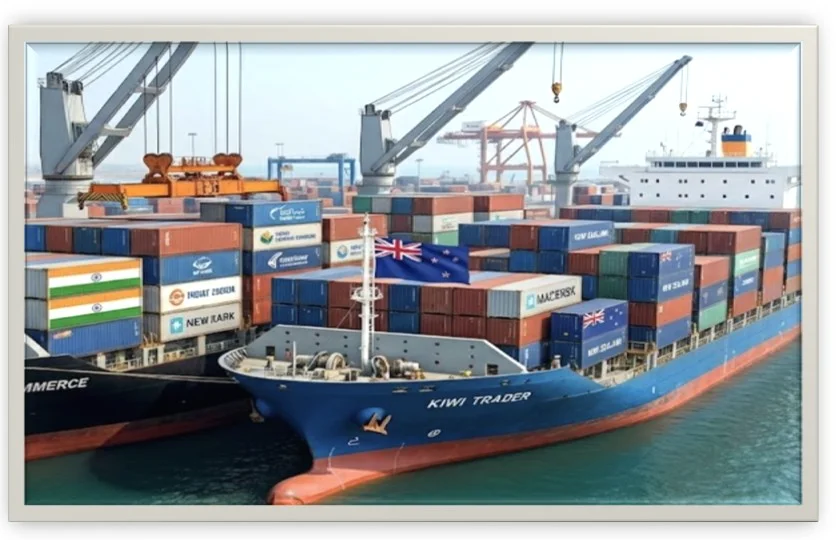
Market Access at the Core and Tariff Cuts
The FTA provides a gradual process of liberalisation of tariffs on the various categories of exports, such as agricultural goods, pharmaceuticals, textiles, machinery, and processed food. The benefit to New Zealand is that it will have increased access to the growing market in India of the dairy-derivative commodities, whilst India will get increased access to other areas, like:
- Information technology
- Medical and health care products
- Fashion and lifestyle production
Officials indicated that tariff cuts would be executed in stages to protect the interests of the domestic industries, and further protection has also been introduced on sensitive product lines.
When a senior trade representative was asked about the agreement he said that it was a balanced and strategic agreement and that India had looked to long term sustainable export benefits and not an increase in volumes. In the case of India, the agreement also helps to consolidate its position in a competitive farming-importing zone where the exporters can now find other markets to increase their exposure.
The Indo-Pacific Strategic Alignment
Other than trade, the agreement has serious strategic implications. The agreement is an indication of further economic integration between India and New Zealand, as the region enters an additional period of geopolitical rivalry, given that both nations are democracies dedicated to enhancing regional unity, maritime security and rules-based trade.
The agreement will fast-track cooperation in:
- Clean technology and renewable energy.
- Training and career mobility.
- Food-processing solutions and Agritech.
- Start-up exchanges of innovation.
According to the diplomats, FTA may lead to increased defence and maritime interaction in future as India develops relations with Australia, Japan, the United States and ASEAN economies.
An Exporter Boost and a Growth in Jobs
The India-New Zealand trade deal, estimated by the government, would see the two countries increase their bilateral trade volumes by huge volumes within the next five years with the Indian exporters of pharmaceuticals, processed foods, machinery, home furnishings and IT having a large share. Authorities anticipate the creation of employment in several varieties of industries, such as the manufacturing industry and logistics, warehousing and back-end services associated with new trade flows.
The agreement has been received well by the industry bodies as it gives the industry a powerful base to increase its exports to a market where historically there has been a small presence of India. Dairy substitute and organic food exporters, textile, ayurvedic supplements, chemicals and automotive parts may also stand to gain directly as a result of lower tariffs and compliance.

A versatile writer mainly works on trending news, daily updates from politics, business, crime, current affairs and entertainment.