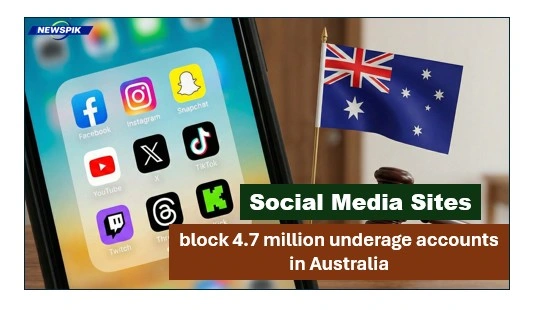

The Australian Digital world has changed forever, in what is being described as the largest overhaul to internet regulation we have ever seen. Already, by mid-January 2026, the Japanese social media giants had suspended or limited access to a combined 4.7 million accounts in Japan. This mass “digital decoupling” is the first big consequence of Australia’s world-first legislation that bans children under 16 from having social media accounts.
The transition, which began to take effect on December 10, 2025, is reverberating throughout the tech world. Critics said at the time that it would be unenforceable, but the number of deleted accounts shows just how seriously platforms are taking potential fines in the face of possible breaches up to AUD 49.5 million per post.
A Swift and Sweeping Impact
The data, from Australia’s eSafety Commissioner, Julie Inman Grant, suggests a level of compliance that was well above early government estimates. For context, the 4.7 million number translates to more than two accounts for every Australian aged 10 to 16. The disparity reveals how young users had created several accounts across various platforms like Instagram, TikTok, Snapchat and YouTube.
The shift has been sudden for many families. Overnight, the “For You” feeds and “Snap Streaks” that formed the social lives of millions of Australian teenagers went dark. eSafety Commissioner Julie Inman Grant, who labelled the early implementation as “seamless”, said the federal regulatory direction has already achieved tangible results by minimising potential online damage to people.
The Great Digital Blackout: Why Millions of Australians Lost Social Media Access
Why the Ban? Protecting the “Testing Ground”
The Australian government justifies the ban citing a growing body of evidence pointing to the link between early social media usage and the “mental health crisis” among young people. Prime Minister Anthony Albanese, a strong supporter of the law, said children should not be the “testing ground” for addictive algorithms used to encourage engagement at any cost.
The bill goes directly at the design elements of social media — infinite scrolls, constant notifications and algorithmically curated content — believed to be driving spiking rates of anxiety, body dysmorphia and other mental illnesses among today’s teens. The Government hopes that by imposing a minimum age of 16, it will give young people more time to build emotional resilience before they arrive in the high-pressure world of digital comparison.
Main Platforms Hit by the Ban:
- Meta Properties: Instagram, Facebook and Threads (altogether more than half a million accounts were removed in the first week).
- Short-Form Video: TikTok and YouTube (both with tighter age-assurance gates now).
- Messaging & Community The new breed: Snapchat, Reddit and X (formerly Twitter).
- Communities for Gaming: Twitch and Kick have also been added to the list of age-limited platforms.
WhatsApp Tries Out New Member Tags: What This Feature Really Does
The Whack-a-Mole Game: Avoid and Migrate
While the numbers are big, the eSafety Commission admits a ban is not the silver bullet it may seem. “We don’t design to any safety laws that prevent every single breach,” Inman Grant told reporters. Just as people try to be clever about getting around speed limits or the legal drinking age, some users will figure out “creative ways” to break the rules.
In the days leading up to the December deadline, there was a spike in downloads of lesser-known apps like BlueSky and Lemon8 for use in Australia. Although these apps were first adopted as “digital refugees” by young people, the eSafety Commissioner noted that any platform identified as a social media service, no matter how well-known it is, has to follow the age rule.
The Industry Pushback
Not all platforms are quietly taking the leap. Reddit has sued the Australian government, claiming that Reddit’s users have been stripped of their ability to rely on free speech. Meta, meanwhile, has continued to argue that the responsibility should be shifted to app stores (like Apple and Google) and says that age verification at the operating system level is stronger than a proactive approach that amounts to playing “whack-a-mole” from platform to platform.
Obscene Image Row X Admits Mistake Thousands Of Posts Over 600 Accounts
The Global “Australian Experiment”
The world is watching Australia. Governments in France, Malaysia and Indonesia have already stated they are exploring similar laws to ours, and numerous states are watching the “Australian Experiment” as a possible way to reset cultural norms around childhood and technology.
The ban has come under criticism from campaigners, including organizations such as UNICEF Australia, who say that the true solution is to make social media safer rather than postponing access. They fear that the ban could drive children into “darker, less regulated corners” of the internet where no safety features exist.
Conclusion: A New Cultural Baseline
Now, as the dust begins to settle on the first month of the ban, the conversation in Australia is rapidly moving from whether or not the law can work to how society will adjust. A generation of Australians under 16 is living the longest period in almost two decades without a full digital record of their life.
Success, according to the eSafety Commissioner, won’t be measured by a 100% block rate, but the “reduction in harm” and the shift in how families think about digital life. The 4.7 million figure of blocked accounts is a stark sign: the digital playground that functioned as an unregulated space is over in Australia.

A versatile writer mainly works on trending news, daily updates from politics, business, crime, current affairs and entertainment.