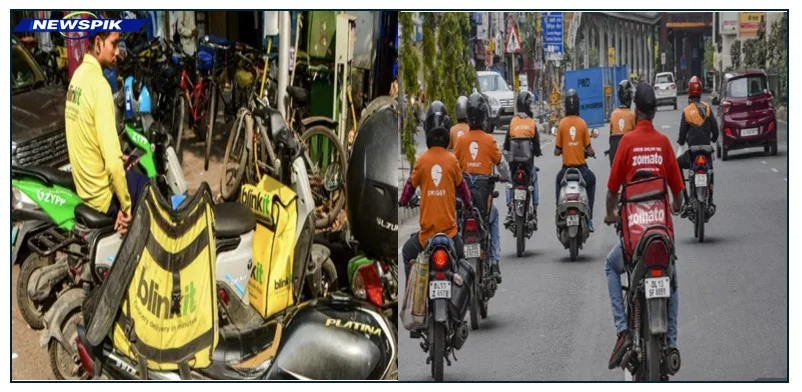

The Union Labour Ministry has advanced a radical transformation in the approach of giving social security benefits to gig and platform employees in India. The new draft regulations published on December 30, 2025, will mean that workers will have to be continuously involved with an aggregator for at least 90 days during a financial year to qualify for government-funded social security programs. This limit increases to 120 working days per year in a year when a worker is linked with several aggregators.
The announcement is timely, as it occurred during strikes organized by several gig and platform employees in large cities on the eve of the New Year. These demonstrations raised the issue of poor payouts, an increase in operational costs, insecure working hours, and the absence of welfare. It is against this backdrop that the current draft sheds light on eligibility and seeks to establish a systematic approach to social protection.
What do the draft rules propose?
According to the proposed guidelines, the gig or platform worker will be classified as engaged with an aggregator provided that they receive any income on work on a specific calendar day, irrespective of the value they receive. This is to say that one completed job on a day would be part of the required working day.
If a worker has multiple aggregators, including Swiggy, Zomato, Uber, Ola, Amazon, or Blinkit, in the same financial year, the number of engagement days will be cumulative across them. Interestingly, when a worker works on behalf of three different aggregators in the same day, it would be counted as three engagement days. This strategy recognizes the multi-platform working trend that is very prolific amongst gig workers in India.
The other important aspect of the draft explains that eligibility is not just limited to the workers who are directly hired by the aggregators but also to those who are employed by an associate company, holding, and subsidiary firms, LLPs, or third-party agencies. This will ensure that contractual and indirectly employed workers are not left out and cannot be excluded on technical grounds of hiring.
Why People Who Work for Swiggy, Zomato, and Blinkit Are Protesting in India
Online identity and registration became obligatory
The draft rules also emphasize formal registration. All the qualified unorganised, gig as well as platform workers should enroll to the portal that has been designed by the central government to receive benefits. When they are done, they will be issued a digital identity card that will contain their photograph and the necessary information. This is based on the already operational e-Shram portal that serves as a national database of unorganised sector employees.
The government is confident that a centralised digital ecosystem will enhance transparency, streamline the delivery of benefits, and improve future policy planning. Nonetheless, employees will be asked to revise information (address, occupation, mobile number, skills, and other useful information) on a regular basis. Lack of updating records can make one ineligible to benefit from schemes, as it is in the draft.
Why these rules matter?
One of the most rapidly expanding groups of workers in India is gig and platform workers. Millions of people are dependent on the new-age model of employment, relying on delivery partners and ride-hailing drivers, as well as freelancers and on-demand service providers. However, most of them do not have a definite employer-employee relationship; they lack legal protection and have low levels of social security, unlike traditional employees.
These regulations are trying to establish a balance between defining quantifiable engagement requirements and the nature of gig employment. It is done to ensure that people who rely heavily on gig platforms as a source of income are given priority in welfare programs such as insurance, pensions, and financial support.
Issues of concern and debate
Although the proposal is a step in the right direction, there are still debates. According to the arguments of the worker groups, a requirement of 90 to 120 days can be excessive when demand is irregular, the platform uses algorithms to control accounts, and accounts are suddenly suspended. There have been numerous calls to have the policy take into account the number of hours worked, as opposed to days of token engagement.
It is also questioned how the benefits are going to be financed and whether the platforms will be forced to make contributions towards a social security pool. According to the worker unions, eligibility rules should be supplemented by mandatory contributions from the aggregator; otherwise, the burden can be indirectly transferred to the workers.
Simultaneously, industry associations have complained about the complexity of operations and compliance. They caution that excessive regulatory pressure may inhibit innovation and affect the platform’s sustainability.
The road ahead
Before finalising the draft rules, the labour ministry has requested comments and the input of stakeholders on the draft rules. When executed properly, the given policy can become a significant milestone in the legalization of gig work as a regulated and accepted form of employment in India.
The next few months will be critical as the government, aggregators, and millions of workers who depend on this ecosystem continue to talk. What is now evident is how India is decisively on the path to creating a formal system of social security for its gig workers, the long-awaited move to cement labour rights in the digital economy.

I am a versatile content writer from the MP region, covering politics, business, crime, current affairs, entertainment, video games, and sports with clear insights, engaging analysis, and timely, reader-focused updates.