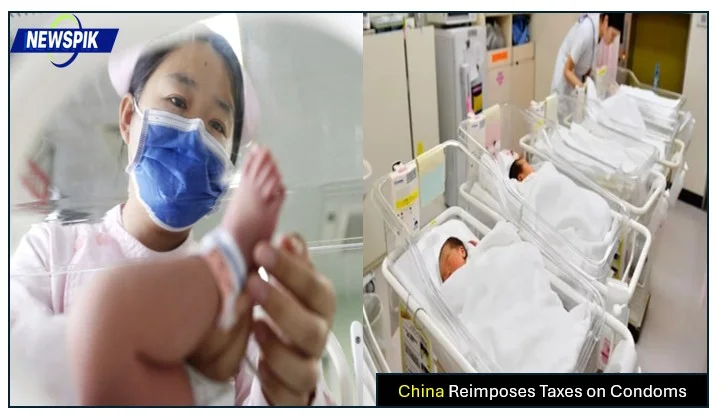

China has reintroduced tax on contraceptive products such as condoms and birth control pills, which is a major turnaround of a thirty-year policy where the products were not taxed. The measure, which takes effect on 1 January 2026, imposes a 13 percent value-added tax (VAT) on contraceptive devices and drugs. Thus, the commodity will fall under the same taxation rules as most consumer commodities.
This action is generally considered part of Beijing’s long-term process to undo the ongoing decline in the country’s demographic situation and to promote the idea of larger families, in the context of what some experts increasingly describe as the gravest population crunch of the 21st century.
Decline of Population Rings Alarms
The Chinese population has declined in three consecutive years, and the population in the year 2024 is set to give a faster decline, with births very low and the number of deaths rising steadily. Demographers assume that the trend will continue to decline in the future, and the long-term effects of this would include, among other things, shortages, economic slack, stress on social security systems, and declining domestic demand.
The country’s fertility rate is far below the replacement rate of 2.1, down to approximately 1.0 in most major cities, a rate rivaling some of the lowest-fertility countries in the world. Although the one-child policy was abolished in 2015, and a two-child policy was established, the birth rates are yet to show improvement.
The Digital Dynasty: Why a Chinese Billionaire Wants 20 American Sons to Rule
Policy Change: Population control to Population Support
Dilution of tax exemptions signifies a significant and viable change in China’s policy attitude. The government spent decades promoting population control to curb the high growth rates. Birth control (free or subsidized) was a main feature of the public health policy, especially in the one-child policy period.
The modern government is taking the wrong direction. The reinstatement of taxes is meant to be subtle in discouraging the use of contraception, but it is a way for Beijing to strongly desire to redefine social behavior in regard to marriage and childbearing.
Complementary Measures Introduced
In recent years, China has implemented a number of supportive measures in order to promote childbirth. These include:
- Childcare subsidies are tax-exempt.
- Financial support programs for families with children are available annually.
- Policies encouraging employers to offer improved maternity cover.
- Local government benefits such as cash bonuses, paid parental leave, and housing benefits.
In 2024, the government also suggested that universities include love education to spread positive stories about family, marriage, and parenthood. The leaders once again gave their word at the Central Economic Work Conference last month that they would stabilize population growth.
Reasons Why Young Chinese are reluctant to have children?
Many Chinese youths are still unwilling to start families, even with the change of policy. Surveys consistently cite:
- The expensive nature of parenting.
- Accommodation and education costs.
- Job insecurity
- Workplace gender inequality.
- Habitual inclinations and changing cultural attitudes.
Most urban couples are not financially ready, and women are usually scared of losing their careers due to being pregnant or caring for their children. The slowdown in the economy has worsened the fears.
Divergent reactions to the Tax Policy
Public reaction is divided. The advocates feel like the action strengthens the demographic strategy of China, and it could lead to less use of long-term birth control, which could lead to a rise in births. Critics, however, caution that taxing such necessary reproductive health products may pose a health hazard to the population, particularly the youth and poor people.
Health experts have warned that restricting access to cheap contraception can cause unwanted pregnancies, and unsafe abortions can keep rising. Others claim that the policy attempts to simplify what is a demographic issue by making low fertility an issue of choice; on the contrary, it should be pursuing more profound economic and social issues.
Looking Ahead
Although there is a strong political statement of the policy, professionals are not convinced that taxation will have a huge effect on birth control. Some say that enduring transformation will require implementing strong welfare reforms, long-term financial aid for families, greater gender equality in the workplace, and lower education and housing costs.
The demographic transition in China, characterized by strong population control, should be replaced by efforts to instill trust in family security and sustainable livelihoods. The impact of the reinstatement of taxes on contraceptives in this endeavor is yet to be felt.
At least in the short term, it is except that China is entering a new demographic age, and the government is throwing everything it can possibly pull a policy lever to get its people to have more children, as the entire world clumsily waits to see how China copes with its most urgent population crisis in decades.

A versatile writer mainly works on trending news, daily updates from politics, business, crime, current affairs and entertainment.